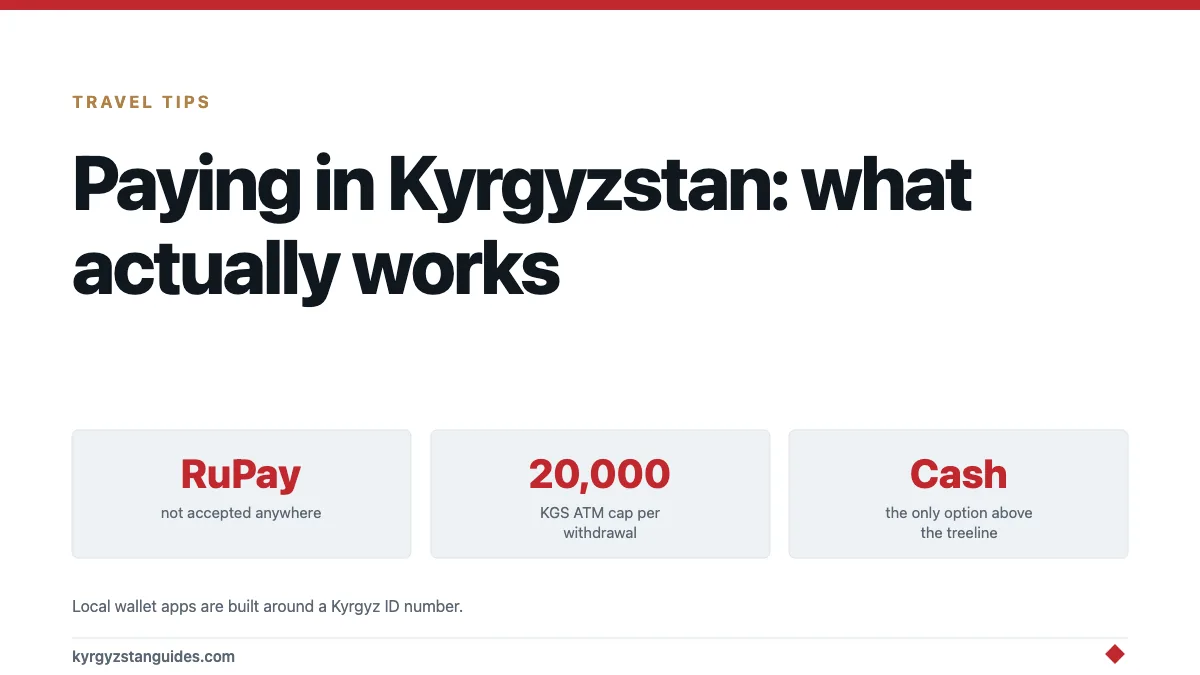
Every payment app a Kyrgyz person will recommend to you is going to refuse to open. MBank, O!Dengi, Elsom, Balance.kg — they're all built around a Kyrgyz ID number, and a visitor on a tourist stamp doesn't have one, so what you'll actually use is som in your pocket, a Visa or Mastercard in the cities, and a fairly careful plan for the days you're above the treeline.
And if you're flying in from India, there's a second thing to sort before you go, because RuPay doesn't work here at all. More on that below, since it catches people at the airport ATM on night one.
The awkward part is that the advice you get locally is sincere and completely useless. Ask a guesthouse owner in Karakol how to pay for the extra night and she'll point at the QR sticker taped to the counter — part of a national payment standard that has transformed a cash economy in about four years, because that's genuinely how everyone around her pays for everything. She isn't wrong about the country. She's wrong about your phone, and neither of you will work out why for a minute or two.
The short version
| What you're paying for | What works | What doesn't |
|---|---|---|
| City hotel, guesthouse in town | Card or som | Local wallet apps |
| Supermarket, chain pharmacy | Card or som | — |
| Marshrutka, shared taxi | Som, small notes | Everything else |
| Bazaar, canteen, roadside cafe | Som | Card |
| Yurt camp, village homestay | Som you brought with you | Card, app, ATM |
| Park gate, museum | Som | Card |
| Yandex Go | Card in the app, or som to the driver | — |
Why the apps won't open for you
Kyrgyzstan runs on phone money to a degree that surprises almost everyone arriving from outside Central Asia. The National Bank has spent years pushing the domestic card scheme, Elcart, and the wallets stacked on top of it, and the adoption numbers are genuinely striking — MBank alone reports over three million active customers in a country of roughly seven million people. That's why there's a QR sticker on every counter, and why the woman ahead of you in the queue is buying two samsy by scanning it rather than digging for coins.
But these are regulated financial products, and the door they open through is identity. Onboarding assumes a Kyrgyz passport or a residence permit that can be checked against the state registry. Banks here will open an account for a foreigner. That part is true and gets repeated a lot. But look at what they ask for and the catch shows up immediately. The Bishkek law firm Kalikova & Associates lists an original passport plus a registration card, which is the document confirming your temporary address in the country. Bakai Bank's own non-resident checklist says the same thing.
Now, a hotel can sometimes generate that registration for you, so it isn't impossible. It's just that on a twelve-day trip you'd be spending a morning in an office to solve a problem you don't really have, and that morning is worth more at Ala-Archa.
You'll also run into a second route if you search for this, and it's worth naming so you can walk past it. A handful of consultancies advertise remote Kyrgyz bank accounts for non-residents — kgaccount.com and wolja.digital are two of them: with promises of an account in one to three working days. Read the pages properly and it's clear these are paid intermediary services built for people setting up offshore company structures, not for a traveller who wants to buy lunch in Osh. Priced accordingly, too.
One honest gap, because it matters. We went looking for a single documented case of a tourist completing MBank or O!Dengi registration inside the app on nothing but a foreign passport, and came up empty. No forum thread, no blog write-up, nothing in the banks' own English pages, which address branch account-opening rather than app sign-up for visitors. That absence doesn't prove it's impossible. It's a fair signal that it isn't the easy path, and that anyone telling you it's simple hasn't done it either.
If you're coming from India, read this bit twice
RuPay is not accepted in Kyrgyzstan. Not at ATMs, not at terminals. Neither are Maestro, Cirrus, Plus, JCB, American Express, Diners or Discover, according to ATM Fee Saver's country breakdown, and that list quietly rules out the default card in a lot of Indian wallets.
So the thing to do before you fly is boring and it'll save your first evening: carry a Visa or Mastercard debit card, and check with your bank that it's enabled for international ATM use. Plenty of Indian banks ship cards with overseas withdrawals switched off by default, and you find out at 1 a.m. at Manas airport, which is exactly the wrong moment.
Our guide for Indian travellers covers the visa and flight side of the same trip.
The Kyrgyzstan ATM details nobody mentions
Two, and they're both about money you lose without noticing.
Most machines cap a single withdrawal at 20,000–25,000 KGS, with 20,000 the common ceiling on both Visa and Mastercard. At roughly 87–89 som to the dollar through 2026, that's about $225–285 a go. If your bank charges a flat fee per withdrawal, the maths matters: three trips to the machine on one holiday is three fees, and the way to reduce that is fewer, larger withdrawals rather than topping up as you go.
The other one is the screen that appears mid-transaction offering to bill you in your home currency instead of som. Decline it. That's dynamic currency conversion, the exchange rate is set by the machine's operator rather than your bank, and it is reliably worse. Take the som, let your own bank do the conversion. It's a two-second decision that shows up on your statement a week later.
Cash, and how much to actually carry
Som, and in notes small enough to be useful. Handing a 5,000 note to a village shop is a small social event; 100s, 200s and 500s are what you spend.
The rule here is the same one that governs everything else in this country, which is that the higher you go, the less of the modern world comes with you. Bishkek and Osh have ATMs on most commercial streets. Karakol, Cholpon-Ata, Naryn and Jalal-Abad have them. Kochkor has a couple. From the moment you turn off towards Song-Kul, Tash-Rabat, Sary-Mogol or any jailoo at all, work on the assumption that the last machine you passed was the last one you'll see.
Which means you draw for the mountain days while you're still in the last town, and you draw more than the arithmetic says. A yurt night with dinner and breakfast is somewhere around 1,200–1,800 KGS per person. A driver's day rate runs into the thousands. And the single thing you can't do at 3,000 metres, with no signal and no terminal, is go back for more.
How much is enough? For most people a week in the mountains lands between 15,000 and 25,000 som once beds, food, a shared car and the odd park fee are in — which, conveniently, is about one ATM withdrawal. Draw it in one go before you leave town and you've also dodged a second fee.
Our guide to money, ATMs and cards in Kyrgyzstan goes through it region by region if you want the longer version.
What the locals are actually tapping
Worth understanding, if only so the QR stickers stop being mysterious.
Elcart is the national card scheme, and until very recently it stopped dead at the border, a Kyrgyz card simply didn't work abroad. That changed in June 2026, when the country's Interbank Processing Center tied up with Alipay+ to let Elkart Mobile users pay across more than 60 countries through the shared QR network, a partnership confirmed by the National Bank of the Kyrgyz Republic. It's a real change, and a useful one, for Kyrgyz people travelling out. It does nothing whatsoever for you coming in, which is a distinction most coverage of that announcement skipped.
MBank, O!Dengi, Elsom and Balance.kg are the wallets. Transfers between people, phone top-ups, utility bills, and the QR payment at the till. That code on the counter is waiting for one of these, not for an international scheme.
So when the shopkeeper gestures at the sticker and you hold up a Visa card, you're both behaving perfectly sensibly. You're just standing in two different payment systems that happen to share a shop.
If you're staying more than a month
Then the whole calculation inverts and the paperwork becomes worth it.
Once you have a registration card, which a landlord, an employer, or a long-stay guesthouse can help produce, the bank account gets straightforward, and the wallets and their QR payments come with it. Anyone here for a season, working remotely, or coming back year after year will find daily life noticeably easier with a local account than without one. Our digital nomad guide has the longer-stay logistics.
For two weeks, it's effort aimed at the wrong problem.
What we couldn't verify
Saying this plainly, because the rest of the page is only worth anything if you can trust the parts we're less sure about.
We could not confirm from any operator page or first-hand account whether a tourist can complete MBank or O!Dengi registration in-app on a foreign passport alone. The banks' English material covers opening an account at a branch, not app onboarding for visitors. Wallet fees change and we couldn't pin them to a verifiable date.
If you've done it, tell us and we'll update this page. Our editorial policy explains how that works.
This page describes how paying works on the ground for visitors. It isn't financial advice, and it's no substitute for checking current terms with your own bank before you fly.
On crypto, the legal position is unambiguous: virtual assets are not a means of payment in Kyrgyzstan by statute. See our page on crypto and the digital som, including why the digital som is not legal tender until 2027.
FAQ
Can tourists use MBank in Kyrgyzstan?
Almost certainly not. MBank onboarding is built around Kyrgyz identity documents, and opening an account at a branch requires a passport plus a registration card confirming your address in the country. We found no documented case of a short-stay visitor self-registering in the app on a foreign passport alone.
Does RuPay work in Kyrgyzstan?
No. RuPay isn't accepted at Kyrgyz ATMs or payment terminals, and neither are Maestro, Cirrus, Plus, JCB, American Express, Diners or Discover. Carry a Visa or Mastercard debit card and confirm with your bank that international ATM use is switched on.
How much cash can I withdraw at once in Kyrgyzstan?
Most ATMs cap a single withdrawal at 20,000–25,000 KGS, with 20,000 the usual limit on Visa and Mastercard. That's roughly $225–285 at 2026 rates. If your bank charges per withdrawal, take fewer and larger amounts.
Should I let the ATM convert to my home currency?
No. That's dynamic currency conversion, and the rate comes from the machine's operator rather than your bank. It's consistently worse. Choose to be charged in som and let your own bank handle the exchange.
Do I need cash in Kyrgyzstan?
Yes, more than most first-time visitors expect. Cities take cards, but marshrutkas, bazaars, canteens, homestays, yurt camps and park gates are cash-only. Draw som before you leave the last town heading into the mountains.
What is Elcart, and can a tourist get one?
Elcart is Kyrgyzstan's national card scheme, and it's for residents. Since June 2026 Elkart Mobile users can also pay abroad via Alipay+, but that's a benefit for Kyrgyz travellers heading out, not for visitors arriving.
How much cash should I take to Song-Kul or a yurt camp?
Enough for the whole stay plus a real margin. For most people a mountain week works out between 15,000 and 25,000 som. There's no ATM, no card terminal and often no signal to fix a shortfall once you're up there.