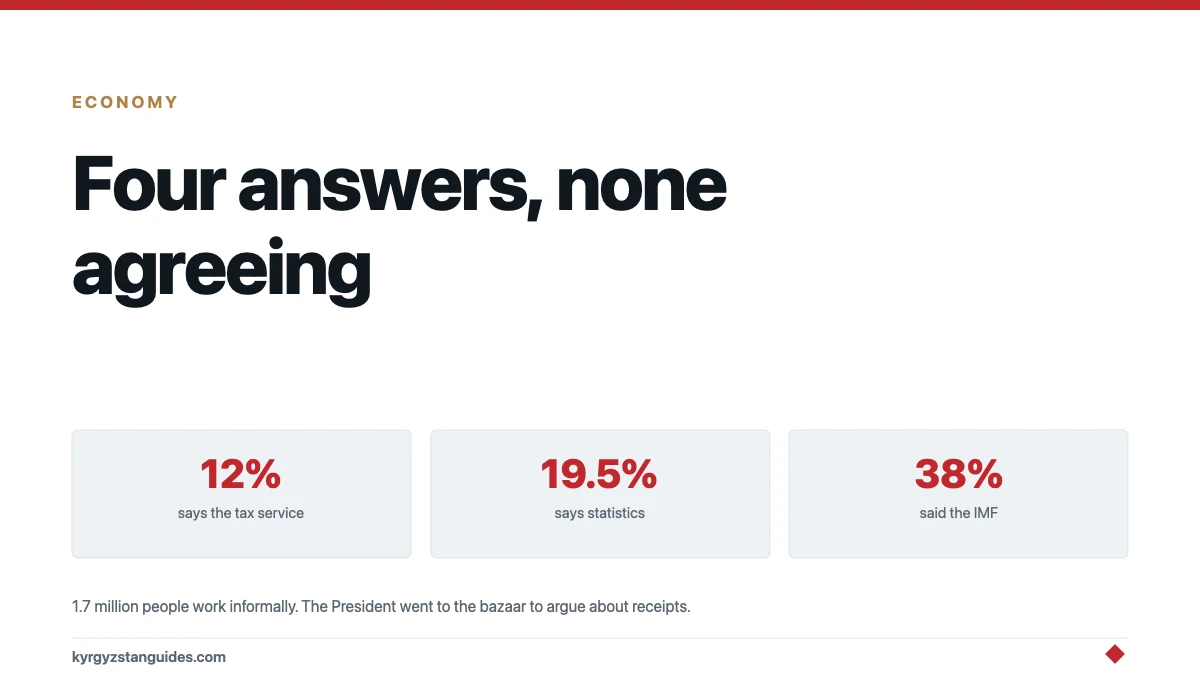
Ask how big Kyrgyzstan's informal economy is and you get anything from 12 per cent of GDP to 38 per cent, depending on who you ask. All four of the figures below come from serious institutions. None of them is wrong. They are measuring different things and saying so quietly.
| Estimate | Figure | Source and year |
|---|---|---|
| State Tax Service, shadow business only | about 12% | head of the tax service, April 2026 |
| National Statistical Committee, "non-observed economy" | 19.5% of GDP, 308 billion som | official, 2024 data |
| CIS Statistics Committee | 17–19% | cited in a 2019 report |
| IMF working paper | about 38% | 2018 |
| Bertelsmann Transformation Index | about 25% | 2018 |
Anyone who quotes you a single number for the Kyrgyz shadow economy has picked one and dropped the rest. The most recent authoritative figure is the statistics committee's 19.5 per cent for 2024, and the detail inside it is more interesting than the headline: the shadow sector grew 12.9 per cent in comparable prices while real GDP grew 11.5 per cent. Informality outpaced the formal economy. The share was up 0.3 points on 2023, though still down 0.6 points on 2020.
The tax service's much lower 12 per cent is not a contradiction. It counts businesses evading tax. The statistics committee counts hidden, informal and illegal activity, including household production. Different question, different answer.
The employment figure is the one that lands
Whatever the GDP share, the labour figure is not ambiguous in the same way.
Roughly 1.7 million people worked in Kyrgyzstan's informal sector in 2025, according to the head of the statistics committee's labour statistics department — and that was a decrease on 2024. Against total employment of around 2.8 million, that is a very large majority of the workforce. The percentage is my own arithmetic from two separately published figures rather than a ratio the committee itself published, so I would not put a decimal on it.
The ILO's framing is that Kyrgyzstan has one of the highest levels of informality in Europe and Central Asia, with informal employment at about 57.5 per cent of the labour force as of 2023. An older 2019 ILO figure put informal-sector economic activity at 71.8 per cent, accounting for 23.5 per cent of value added and 95.3 per cent of the new jobs created that year. Those last figures come from an ILO document I could only read through search summaries rather than extract directly, so treat them as reported.
That 95.3 per cent, if right, is the whole story in one statistic: the formal economy was creating almost no new jobs. Everything new was informal.
Which sectors
Construction has the highest share of informal main jobs among employed men, and the ILO's formalisation project targets garments, construction, mining and food processing as priorities.
The statistics committee's non-observed economy report points at wholesale and retail trade with vehicle repair, transport and storage, and manufacturing. Note what it excludes: agriculture is left out of that report's sector breakdown entirely, which matters in a country where agriculture employs around 16 per cent of workers.
The tax service's own list is services, retail trade, vehicle repair, hospitality and restaurants, and construction.
Put those together and it describes most of what a visitor actually transacts with. The guesthouse, the driver, the café, the man who fixed your tyre.
The patent, explained properly
A "patent" in Kyrgyzstan is not an invention right. It is a fixed monthly fee that lets an individual legally do one listed activity without registering a full business.
You buy it on paper or through the tax service's online taxpayer cabinet or with an eID card. The current list covers 86 activity types — 56 for individual entrepreneurial activity and 30 for individual labour activity. A taxi driver pays 1,000 som a month and that is the tax settled.
The system has been repeatedly narrowed. From 1 February 2023 the list for individuals was cut to 33 activity types. From 1 January 2024 patent-based trading was abolished outright, pushing traders into other tax regimes — except for the garment sector, which kept its own arrangement plus a 0.25-per-cent-of-revenue unified tax through 2027, as our post on the garment industry covers.
The alternative single-tax rates set alongside that reform are worth knowing because they explain why so little revenue gets collected from small business: zero per cent on annual revenue up to 8 million som, 0.5 per cent up to 30 million, 1 per cent up to 50 million.
Cash, QR codes, and a genuine transformation
Around seven years before the current reporting — so roughly 2019 — cash handled over 90 per cent of all transactions in Kyrgyzstan.
That has changed faster than almost anywhere. Kyrgyzstan built a single national QR payment standard called ELQR, piloted from around 2018 and launched fully in May 2022. By November 2024 monthly QR transactions reached 42.68 million worth 48.79 billion som. In the first half of 2025 QR payment value reached 274.9 billion som, roughly twenty times the same period a year earlier. More than 80,000 QR codes were in operation, with 20 of the country's 21 banks aligned to the standard.
Those figures come from a foundation that promotes the system rather than from the National Bank, so the multipliers are advocacy numbers and I would want central bank data before treating the growth rates as precise. The direction, though, is visible on the ground: you will be shown a QR code at a bazaar stall, and the phrase to know is QR barbı?
The practical point for a visitor is that this cuts both ways. Kyrgyzstan is now easy to pay in digitally, and paying by QR at a market stall is entirely normal. Our post on paying in Kyrgyzstan covers what works for a foreign card.
When the state tried to see inside the bazaar
The best illustration of how informality defends itself is the cash register fight.
From 1 January 2022 businesses had to use new online cash registers transmitting sales data to the tax service in real time. Traders at the big bazaars had begun protesting in December 2021, and the protests escalated through January.
In early February 2022 President Japarov went to Osh Bazaar and Dordoi in person, acknowledged that the Cabinet had made mistakes, and explained the benefits of the system to traders directly. The chair of the Dordoi trade complex union said the protest had some effect even though it did not reverse the policy. Penalties for non-use were set at 7,500 som for individuals and 23,000 som for legal entities.
A head of state personally negotiating with market traders over receipt printers is not a normal scene. It tells you how much political weight the bazaar carries here, and why formalisation moves at the speed it does. Our post on the bazaar economy explains why those markets matter as much as they do.
The pension cut that was really an informality policy
One more piece connects directly. On 23 July 2024 Kyrgyzstan cut the total social insurance contribution rate from 27.25 per cent to 12.25 per cent, with almost the entire reduction coming out of the employer's share — from about 17.25 per cent down to 2.25 per cent.
The stated logic was to bring wages out of the shadows. A 27 per cent payroll charge was an incentive to declare a worker at minimum wage and hand over the rest in an envelope; 12.25 per cent might not be. Russian coverage ran it under a headline about salaries emerging from hiding.
Whether it worked is unresolved, and the early signal is not good: the number of people paying social contributions fell by almost 98,000 during 2025. Our post on Kyrgyz pensions covers what that does to the pension system, which is the bill for this policy.
Remittances, the money that arrives from outside
Remittances were 17.6 per cent of GDP in 2024 per World Bank data. Some secondary sources say 24 per cent. Quarterly flows are large and well documented: $699.7 million in the first quarter of 2026, with $629.3 million of it from Russia.
This is not informal income in the technical sense — bank transfers are recorded. But it is household money arriving outside domestic production and wages, and it shapes the same behaviour: people who can fund a household from abroad have less reason to formalise anything at home.
What this means when you are actually here
Concretely: many guesthouses take cash and issue nothing. A driver who agrees a price to Song-Kul is very likely working on a patent or on nothing. Wages in envelopes are documented in the garment sector, where only 35 per cent of even large factories issued written contracts. Vehicle repair and small services are on the tax service's own problem list.
The claims that get made loosely — "all the taxis are unregistered", "no guesthouse gives receipts" — I could not attach figures to, and I am not going to assert them as facts. What is documented is the sectoral pattern, and the practical consequence for you is simple: carry cash as well as a card, do not expect a receipt, and agree prices before the service rather than after. Our guide to bargaining is the other half of that.
One last honest gap. I could not find any 2024–2026 Kyrgyz legal reform specifically on registering informal or self-employed workers. Searches kept surfacing Kazakhstan's self-employment tax reforms, which are a different country's law. If such a Kyrgyz reform exists, it is not prominent.
FAQ
How big is Kyrgyzstan's informal economy?
Estimates range from about 12 per cent of GDP (State Tax Service, 2026, counting shadow business only) to 19.5 per cent (National Statistical Committee, 2024, counting hidden, informal and illegal activity) to around 25 and 38 per cent in older IMF and Bertelsmann estimates from 2018. There is no single agreed figure, and the differences come from methodology rather than error.
How many people work informally in Kyrgyzstan?
About 1.7 million in 2025 according to the statistics committee, against total employment of roughly 2.8 million. The ILO puts informal employment at about 57.5 per cent of the labour force as of 2023 and describes Kyrgyzstan as having one of the highest informality levels in Europe and Central Asia.
What is a "patent" in Kyrgyzstan?
A fixed monthly fee that lets an individual legally carry out one listed activity without registering a full business. The list covers 86 activity types, and a taxi driver, for example, pays 1,000 som a month. Patent-based trading was abolished from 1 January 2024, though the garment sector kept a special arrangement.
Is Kyrgyzstan a cash economy?
Less than it was. Cash handled over 90 per cent of transactions around 2019, but the national ELQR QR payment standard launched fully in May 2022 and by late 2024 was handling over 42 million transactions a month. QR payment at a bazaar stall is now normal, though cash remains essential outside the cities.
Why did bazaar traders protest against cash registers?
The requirement from 1 January 2022 to use online cash registers reporting sales to the tax service in real time made previously invisible turnover visible. Protests began in December 2021, and in February 2022 President Japarov visited Osh Bazaar and Dordoi in person to argue the case, conceding that the Cabinet had made mistakes. Fines for non-use are 7,500 som for individuals and 23,000 som for legal entities.
Why did Kyrgyzstan cut social insurance contributions so sharply?
To reduce informality. The total rate fell from 27.25 to 12.25 per cent on 1 August 2024, with the employer's share cut from roughly 17.25 to 2.25 per cent, on the theory that a lower charge would encourage employers to declare real wages. The number of people paying contributions nonetheless fell by almost 98,000 during 2025.
Will I get receipts as a tourist in Kyrgyzstan?
Often not. Guesthouses, drivers and small services frequently operate on a patent or informally, and receipts are not standard practice outside larger businesses in Bishkek. Agree prices in advance, and carry cash alongside a card even though QR payment is now widespread.