Try to read a Kyrgyz novel in English that is not by Chingiz Aitmatov and you will run out of options almost immediately. That is not a judgement on the writing. It is a statement about translation, and it is the single most useful thing to know before you go looking.
A literary blogger who read a book from every country in the world wrote in 2012 that every effort to find translated alternatives to Aitmatov ran into dead ends. Names surfaced later in the comments — Begenas Sartov, Kazat Akmatov, Alykul Osmonov, Medin Alybaev — and a British publisher, Hertfordshire Press, began issuing some Kyrgyz authors in English from around 2013. That is roughly the state of it.
So this post does what it can: the writers who matter in Kyrgyz, what they wrote, and where you can engage with any of it on the ground. Our post on books about Kyrgyzstan covers what is actually readable in English.
Aitmatov, in one section
Born 12 December 1928 in Sheker, died 10 June 2008 in Nuremberg. Debut story 1952, graduated Moscow's Gorky Literary Institute in 1958, and the 1959 novella Jamila made him internationally famous after it ran in Novy Mir.
The major works: Tales of the Mountains and Steppes (1963), Farewell, Gul'sary! (1966), The White Ship (1970), The Ascent of Mount Fuji (1973), The Day Lasts More Than a Hundred Years (1981). Lenin Prize 1963, USSR State Prize 1966 and 1983.
Translated into more than 160 languages and published in 128 countries with sales over 100 million copies, by the figure most commonly cited — which comes from a secondary source rather than a literary institution, so treat the precision loosely even though the scale is not in doubt.
Then the diplomatic career: Congress of People's Deputies member and Gorbachev adviser from 1989, Soviet then Russian ambassador to Luxembourg, and from 1994 until his death the independent Kyrgyz Republic's ambassador to the Benelux countries, additionally accredited to NATO and UNESCO.
Before him: the akyns
Kyrgyz literature was oral for most of its existence, performed by akyns — improvising poet-singers with a komuz.
Toktogul Satylganov (25 October 1864 – 17 February 1933) is the most celebrated. Self-taught, he composed about poverty and feudal cruelty, was imprisoned in 1898 on false charges connected to the Andijan uprising and exiled to Siberia for seven years, and welcomed the 1917 revolution. If you wonder why a town, a reservoir, a dam, streets and a conservatory all carry his name, it is because the Soviet state canonised him as the founding figure of revolutionary Kyrgyz oral poetry. Our post on Toktogul's reservoir is named for him at two removes.
Togolok Moldo, real name Bayymbet Abdyrakhmanov (10 June 1860 – 4 January 1942), was a poet, manaschi and folk-song writer who began composing at fourteen and wrote the first Kyrgyz fables — Kemchontoi and Babyrkany, both 1900. Admitted to the Union of Soviet Writers of Kyrgyzstan in 1938, given the Order of the Badge of Honour in 1939, published since 1925. He is on the 20-som banknote, which is the most widely distributed Kyrgyz literary portrait in existence.
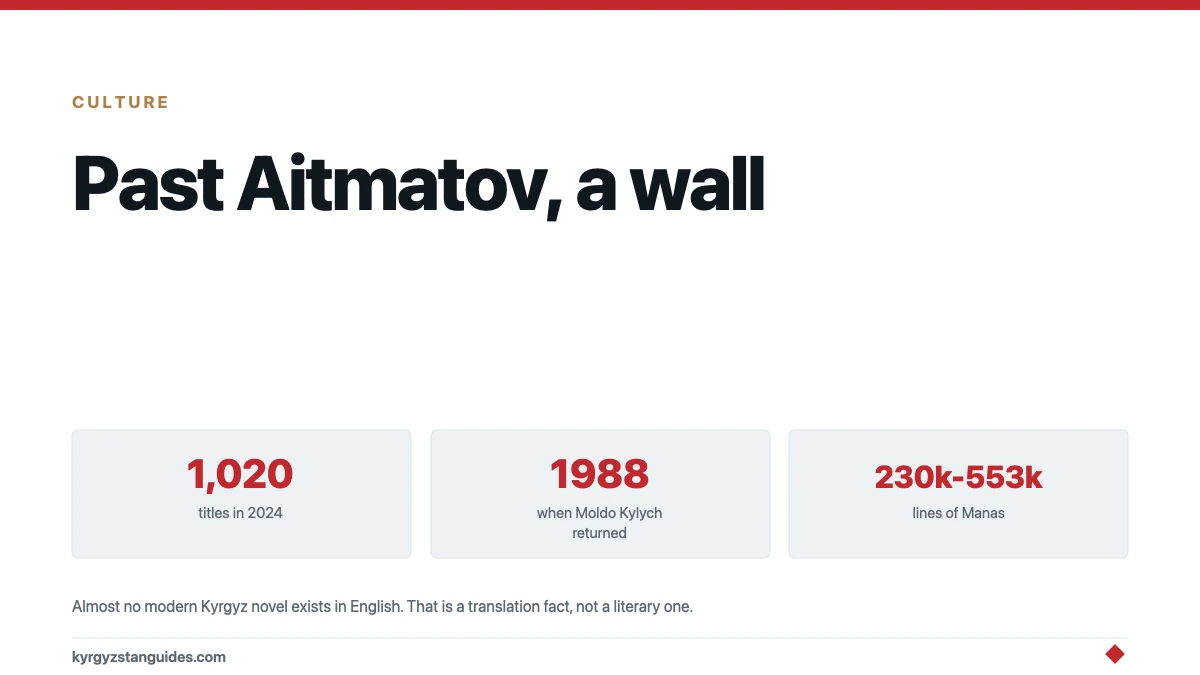
Moldo Kylych (1866–1917) is the interesting one, because of what happened to him afterwards. He came from an aristocratic background and wrote from an Islamic, anti-colonial position, most notably Qïssa-i zilzila, "Tale of the Earthquake", in 1911, expressing disillusionment with Russian rule. His work was banned in the Soviet period as bourgeois-nationalist, and he was only rehabilitated into the canon in 1988, after a review begun in 1986.
A national literature with a seventy-year hole where its Islamic anti-colonial voice should be is not an accident, and the hole was filled in living memory.
The Soviet generation
Aaly Tokombaev (7 November 1904 – 19 June 1988) helped standardise the Kyrgyz alphabet, published On Lenin in 1927 and Flowers of Labor in 1932, and wrote the novel Urkun about the 1916 anti-tsarist revolt. He was arrested in 1937 and freed in 1939 — which, given what happened to Kasym Tynystanov in 1938, was survival by a narrow margin.
Kasymaly Bayalinov (1902–1979) wrote "Ajar" in 1927, described as the first short story published in Kyrgyz.
Tugelbay Sydykbekov (14 May 1912 – 19 July 1997) wrote Keng-Suu, "Broad River", in 1937–38, regarded as the first Kyrgyz novel, and is called the patriarch of Kyrgyz literature. His later novel Kök Asaba, reconstructing sixth-to-eighth-century Yenisei Kyrgyz history, was written in 1969 and published only in 1989 — another twenty-year gap that tells you what could and could not be said.
Alykul Osmonov (21 March 1915 – December 1950) was a poet and translator who put Pushkin and Shakespeare into Kyrgyz and transcribed oral poetry. He caught tuberculosis as a child in an orphanage, which forced him out of pedagogical school, and died at 35. Sources give 12 or 27 December for the death date and confirm the TB history without explicitly stating it killed him, so I will not assert the cause. The National Library in Bishkek is named after him.
None of these four turned up a confirmed English-language book translation in my searching.
Manas
The epic deserves its own note because the numbers attached to it are wild.
Line counts range from roughly 230,000 to about 553,500, depending entirely on which recorded version you count — Sagymbay Orozbakov's, Sayakbay Karalaev's, others. It is commonly described as around twenty times the length of the Iliad and Odyssey combined. No single authoritative figure exists, and UNESCO's own page does not give one.
UNESCO inscribed the Manas, Semetey, Seytek trilogy on the Representative List of Intangible Cultural Heritage in 2009. The tradition is carried by manaschi who perform without musical accompaniment at weddings, funerals and public gatherings, and it is shared by Kyrgyz communities in Kyrgyzstan, China, Kazakhstan and Tajikistan. Our post on the Manas epic goes deeper.
Publishing now
In 2024 Kyrgyzstan published 1,020 book titles with a total print run of 1,617,000 copies, and more than 58 per cent of titles were in Kyrgyz.
A Soviet-era comparison circulates — nearly ten million books a year through 1990 — which would make the decline enormous. I could not confirm it against a primary statistical source, so I am flagging it rather than using it as a headline.
I also could not find any national Kyrgyz literary prize, state or independent, and could not find a single post-1991 Kyrgyz writer with a documented international literary prize. That is a real gap in the record rather than a gap in my searching, as far as I can tell, and it is more honest to report it than to fill it with names.
Post-independence work does exist. Kazat Akmatov wrote Kündü aylangan zhyldar (1989), described as the first Kyrgyz novel built around the Manas epic and its tellers. Sooronbai Jusuev wrote a verse novel, Kurmanjan Datka (1994), about the nineteenth-century southern Kyrgyz leader — a subject our post on Kurmanjan Datka covers.
Where to go
Raritet, the city's largest bookshop, sits on the west side of Ala-Too Square near the Erkindik statue. The English Bookshop, the Macmillan distributor here, is at Chyngyz Aitmatov Avenue 299/3.
The National Library, named after Alykul Osmonov, was founded in 1934 from a merger of the Frunze city library and the Council of People's Commissars library, starting with 16,000 items and now holding over six million documents in 89 languages. It moved into its seven-storey building in 1984, and there is an Osmonov memorial museum on the second floor.
And Ata-Beyit, about 30 km south of Bishkek near Chong-Tash. The 137 men executed on 5 and 8 November 1938 were secretly buried there, including Törökul Aitmatov, Chingiz Aitmatov's father. The grave was found only in 1991. Aitmatov named the site himself — Ata-Beyit, "grave of the fathers" — and is buried there.
A writer who chose to be buried in the mass grave containing his father is the shortest way to understand what Kyrgyz literature has been carrying.
FAQ
Can I read Kyrgyz literature in English?
Barely, beyond Aitmatov. Multiple searches turned up almost no post-1991 Kyrgyz writer with a documented English-language book publication, and none of the major Soviet-era figures — Tokombaev, Bayalinov, Sydykbekov, Osmonov — has a confirmed English translation. Hertfordshire Press began publishing some Kyrgyz authors in English from around 2013.
Who was Toktogul Satylganov?
The most celebrated Kyrgyz akyn, an improvising poet-singer, who lived from 1864 to 1933. He was imprisoned in 1898 on false charges connected to the Andijan uprising and exiled to Siberia for seven years. The Soviet state canonised him as the founder of revolutionary Kyrgyz oral poetry, which is why a town, a reservoir and a conservatory carry his name.
How long is the Manas epic?
Genuinely disputed — from roughly 230,000 to about 553,500 lines depending on which recorded version is counted, with Sagymbay Orozbakov's and Sayakbay Karalaev's tellings differing substantially. It is often described as twenty times the length of the Iliad and Odyssey combined. UNESCO's own page gives no line count.
When did UNESCO recognise Manas?
In 2009, inscribing the Manas, Semetey, Seytek trilogy on the Representative List of the Intangible Cultural Heritage of Humanity. Performers, called manaschi, recite without musical accompaniment at weddings, funerals and public gatherings.
Why was Moldo Kylych banned?
His work was suppressed in the Soviet period as bourgeois-nationalist because he wrote from an Islamic, anti-colonial perspective, most notably "Tale of the Earthquake" in 1911, which expressed disillusionment with Russian rule. He was rehabilitated into the Kyrgyz canon only in 1988.
How many books does Kyrgyzstan publish?
1,020 titles in 2024, with a total circulation of 1,617,000 copies, more than 58 per cent of them in the Kyrgyz language. No national literary prize, state or independent, turned up in searching.
Where is Chingiz Aitmatov buried?
At Ata-Beyit, about 30 km south of Bishkek near Chong-Tash, the site where 137 men executed in November 1938 were secretly buried — among them his father, Törökul Aitmatov. The mass grave was discovered in 1991, and Aitmatov himself gave the site its name, meaning "grave of the fathers".