Ask for directions in Osh and sooner or later someone will say “near KhBK”. The letters stand for khlopchatobumazhny kombinat, cotton-cloth combine, and they name a whole district of the city: five-, nine- and fourteen-storey blocks, two schools, a park under construction, a municipal office. The combine itself has not woven anything in roughly twenty years. The district kept the name the way a town keeps the name of a river that has changed course.
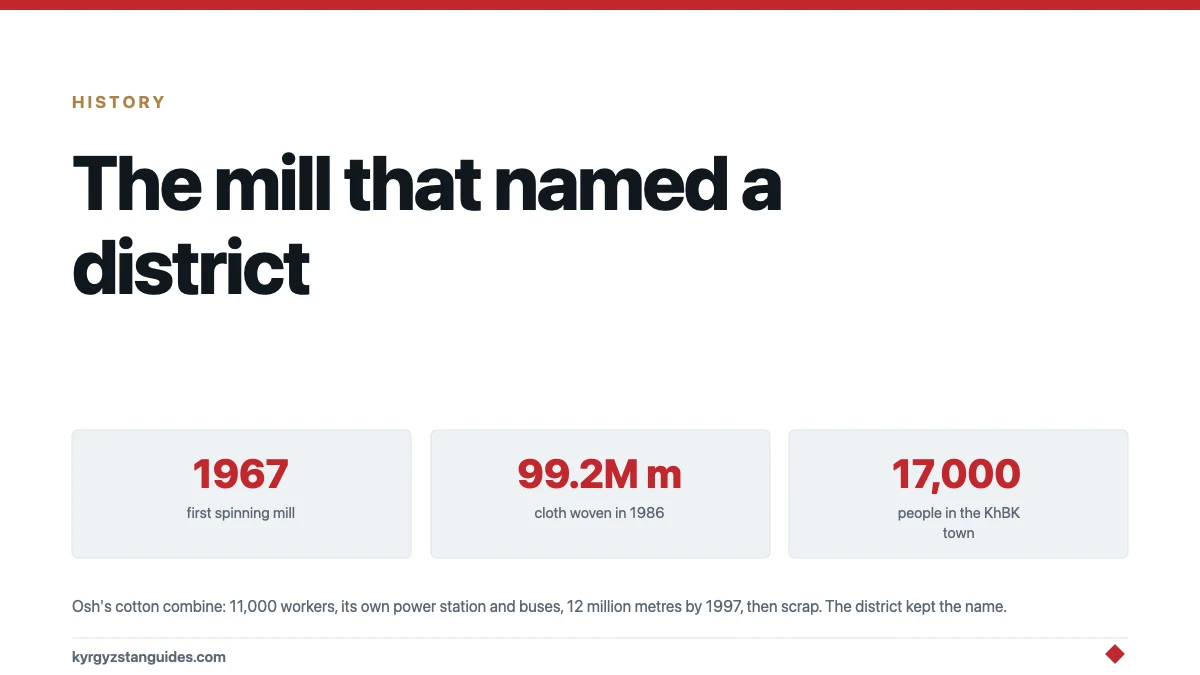
At its peak this was one of the largest cotton mills in the Soviet Union, and by one account the largest. It employed more than 11,000 people, ran its own power station and bus fleet, and in 1986 turned out 99.2 million linear metres of cloth. No English account of it exists. The story below is assembled from the Osh city encyclopedia material reproduced by open.kg, a 2023 piece by the local history project Incredible Osh built on the memories of the first director’s son, and Kyrgyz-language reporting by Azattyk and the city’s own press office from 2010 to 2026.
A Party directive and a bare hillside
The combine was written into the directives of the 21st Party Congress in 1959, as a mill designed for 81 million metres of finished cloth a year. The Osh encyclopedia calls it a major enterprise “not only in Central Asia but in the Union”. The point was obvious: the Fergana Valley grew the cotton, and the cloth was being woven two thousand kilometres away in Ivanovo. Building a combine in Osh put the loom next to the field.
Construction began in July 1961. The design called for 243,500 spindles and 4,144 looms, with an eventual output of 74.6 million metres once the plant reached full capacity. Those two figures, 81 million in the directive and 74.6 million in the design, are the first of several numbers in this story that do not quite agree; we give both.
The first stage, spinning-and-weaving mill No. 1 with 60,000 spindles, started in 1967. The full complex, a finishing-and-dyeing works plus two spinning-and-weaving mills, was commissioned in May 1975. The builders came from across the Union: the encyclopedia lists names from Frunze, Tashkent and Chimkent alongside the local construction trust, “OshKhBKstroy”, and records that the chief project engineer was F. I. Sivashev and the architect P. V. Balandin.
The first director
The combine’s official name was the Kyrgyz Textile Combine in Honour of 50 Years of October, and its first director was Stepan Yanev, appointed in 1967 while the mill was still being built. His name does not appear in the “Osh Oblast” encyclopedia of 1988, which is why Incredible Osh went looking for it; his son Kior wrote to them with the family story.
Yanev was born in 1929 in Nizhnyaya Ala-Archa, outside Frunze, into a Bulgarian-Gagauz family that had come to Central Asia from Bessarabia during the Stolypin resettlement, by ox cart via two Bulgarian-Gagauz villages near Pavlodar. His father was repressed under Stalin; Stepan barely remembered him. He studied finance in Tashkent, graduated in 1951, and worked in the republic’s light-industry administration before running the “40 Years of October” garment factory in Frunze from 1963 to 1967, where he was decorated for its results. In 1967 he was sent south to the unfinished combine. He stayed two years, kept in touch with the workforce after he was moved on in 1969, and retired in 1990 as first deputy minister of light industry of Kazakhstan. He died in Moscow in 2002.
The later directors, as the encyclopedia lists them, were Sh. Dubanaev, A. Mamatov, N. Alymbekov, M. Akunov, Z. Yusupov and K. Satyvaldiev.
What 11,000 people made
By the start of 1986 the combine had 53 main and auxiliary shops and was producing 99.2 million linear metres a year: plain-dyed and printed cotton cloth, linen-type fabrics, and the non-woven products that every Soviet mill made on the side, wadding, packing and sacking cloth, technical wipes and cotton wool. More than 11,000 people worked in production, more than a thousand of them with “shock worker” status. One weaver, D. Kadyrov, was elected a deputy of the USSR Supreme Soviet; another, L. Bogacheva, was credited with fulfilling two five-year plans in five years; 120 workers received Soviet orders and medals.
In 1977 the combine was reorganised as the Osh Cotton Production Association, OPKhBO. By then it was a small state inside the city. It had its own combined heat-and-power plant, a fleet of buses and lorries, holiday homes and children’s camps in Arslanbob, and buses that collected workers from villages across the district every morning. The workshop walls and the outer walls of the combine carried monumental panels by well-known artists in the socialist-realist style. Incredible Osh calls OPKhBO the largest enterprise in the Soviet cotton industry; the encyclopedia is more careful and says “one of the largest”. We have not found a Union-wide ranking to settle it.
Alongside the mill rose the town. Work on the first stage of the workers’ settlement began in 1964 on what the encyclopedia calls a bare outskirts. The final tally: 61 apartment blocks totalling 204,700 square metres, eight hostels with 1,790 places, ten hostels for young families with 954 rooms, nine kindergartens, two schools, two cinemas, a club, two polyclinics and eleven canteens and service points. The combine’s own territory was 130 hectares. More than 17,000 people lived in the settlement, which was called Tekstilshchik, “Textile Worker”, and which everyone called KhBK.
1995 to 1997: the last good years
The combine survived the first post-Soviet years better than most. On 1 September 1995 it was reorganised as the Osh state joint-stock company Tekstilshchik, and a report written around 1997, reproduced in the encyclopedia material, says that of 29 light-industry enterprises in the republic it was the only one “working in a normal situation and successfully fulfilling its production tasks”. Its output was 65 per cent of everything the city of Osh produced.
The numbers in that report are worth setting out, because they show the slope. In 1995 the company produced goods worth 376.3 million som. In the first ten months of 1996 it wove 24.8 million linear metres against a plan of 21.8 million. In 1997 it produced 12 million linear metres of cloth and 211 tonnes of yarn, worth 230.3 million som. From 99 million metres in 1986 to 12 million in 1997 is a fall of nearly 90 per cent, and the report presents 1997 as a success.
The director then was Kakhramon Satyvaldiev, a Tashkent Textile Institute graduate who had worked at the combine from 1969 to 1985 as shift foreman, head of the weaving shop and deputy production chief. He told the reporter that the plant was replacing 956 of its 2,521 old looms, that the textile designer Kimiya Tologeldieva was producing cloth in 118 colour shades, and that average wages had risen from 450 som in 1995 to 600 som. Over 1995 to 1997 the company paid 73.5 million som in taxes, and it was still paying small cash grants to veterans of the Second World War and the Afghan war.
After that: scrap
What happened next is the part no source narrates in full. The closest we have is a Bishkek fabric trader quoted by Azattyk in October 2019, explaining why almost no Kyrgyz-made cloth is sold at the Madina market: the Soviet-era textile combines in Bishkek and Osh, she said, “were fully privatised and liquidated, not one was saved, and under President Akayev their machines were handed in for scrap metal.” Akayev left office in 2005, which puts the end of weaving somewhere between 1997 and 2005. The worsted-cloth combine in Bishkek followed a different route to the same place, through bankruptcy courts and a security-service case; in Osh the paper trail is thinner.
What the mill left behind was the district, and the district’s problems. On the night of 12 June 2010, during the Osh violence, 24.kg reported that about 3,500 residents of the KhBK district had come out despite the curfew and organised self-defence units, with army special forces standing between what the reporter called the Uzbek and Kyrgyz quarters. The source was Ruslan Tashtanov of the foundation For International Tolerance, who lived in the district.
In March 2013 Azattyk reported on the “Chaika” hostel, where 54 families, 213 people, had lived for 23 years. Many were workers who had come from distant villages to the combine in Soviet times and had never been given flats. The hostel now belonged to Vocational Lyceum No. 16, whose director said the students needed the rooms, and the families had two months to leave. They had no residence registration, so no right to a plot of land; the mayor’s office had turned them away for that reason. “Where do I go with four children?” one resident asked.
The district today
The administrative name has changed. The former KhBK is now the municipal territorial administration “Manas-Ata”, and the city’s press office still writes “formerly KhBK” in brackets so that people know where it means. Under the previous mayor, Zhenishbek Toktorbaev, unauthorised commercial buildings along Kasymbekov Street in the district were demolished to make way for a park; the national news agency Kabar published sketches of it, with a cycle path, fountains and rest areas. In spring 2026 some of the former owners fenced their plots again, and on 7 May 2026 the new mayor, Zhanarbek Akaev, met them on site, confirmed the park would go ahead, offered them commercial land elsewhere and ordered the fences removed. At a separate residents’ meeting one entrepreneur complained that his building had been demolished despite a state deed and full permits.
For a visitor the district is a short marshrutka ride from the centre and there is nothing to tour. The mill buildings are private or derelict; we could not confirm whether any of the Soviet panels survive on the walls. If you want the cotton story, the Osh guide covers the city, and our piece on the Kyrgyz textile industry explains how the country went from weaving 99 million metres a year to sewing imported cloth for Russian marketplaces.
What we could not establish
- When the looms stopped. Somewhere between the 1997 report and 2005, on the evidence of the Azattyk quote. No source gives a year.
- Who bought it and for how much. The encyclopedia material stops in 1997. A company registry lists an LLC in Osh called “Cotton Combine KhB and Teks”; whether it is a successor, and whether it ever produced anything, we do not know.
- Whether it was the largest cotton mill in the USSR. Incredible Osh says so; the encyclopedia says one of the largest. Ivanovo’s combines would be the comparison.
- The fate of the combine’s own power station and the Arslanbob camps.
- What survives of the artists’ panels.
FAQ
What was the Osh cotton combine (KhBK)?
A Soviet cotton-cloth mill in Osh, written into the 1959 Party directives, built from July 1961 and completed in May 1975. It had 243,500 spindles and 4,144 looms by design, employed more than 11,000 people and produced 99.2 million linear metres of cloth in 1986. Its official name was the Kyrgyz Textile Combine in Honour of 50 Years of October.
Is the Osh cotton combine still working?
No. It became the joint-stock company Tekstilshchik in 1995 and was still weaving 12 million metres a year in 1997, but according to a trader quoted by Azattyk in 2019 it was privatised, liquidated and its machines sold for scrap before 2005. No source gives the exact closing year.
Where is the KhBK district in Osh?
On the city’s former outskirts, around the combine’s 130-hectare site. The workers’ settlement, built from 1964, had 61 apartment blocks, 18 hostels, nine kindergartens, two schools and two cinemas, and housed 17,000 people. It is now the municipal territorial administration “Manas-Ata”, though residents still call it KhBK.
Who was the first director of the Osh cotton combine?
Stepan Yanev (1929–2002), appointed in 1967 while the mill was under construction and moved on in 1969. He came from a Bulgarian-Gagauz family resettled from Bessarabia and later became first deputy minister of light industry of Kazakhstan. His name was left out of the 1988 “Osh Oblast” encyclopedia.
What happened in the KhBK district in June 2010?
On 12 June 2010, during the violence in Osh, around 3,500 residents of the district came out despite the curfew and formed self-defence units, with army special forces positioned between the Uzbek and Kyrgyz quarters, according to 24.kg.
What is being built on the former combine land now?
A park along Kasymbekov Street in the Manas-Ata district, with a cycle path and fountains, on land cleared of unauthorised commercial buildings. In May 2026 the mayor of Osh confirmed the park would proceed after some former owners re-fenced their plots.
Sources: open.kg: the Osh cotton combine, from the Osh city encyclopedia material (Russian), Incredible Osh: Stepan Yanev, first director of the KhBK (Russian), 24.kg, 12 June 2010: residents of the KhBK district defend their homes (Russian), Azattyk, March 2013: 54 families in the Chaika hostel (Kyrgyz), Azattyk, October 2019: the burdens of light industry (Kyrgyz), Azattyk, 7 May 2026: the Osh mayor meets owners of fenced plots in Manas-Ata, formerly KhBK (Kyrgyz), Kabar: a new park on Kasymbekov Street in Osh (Russian)