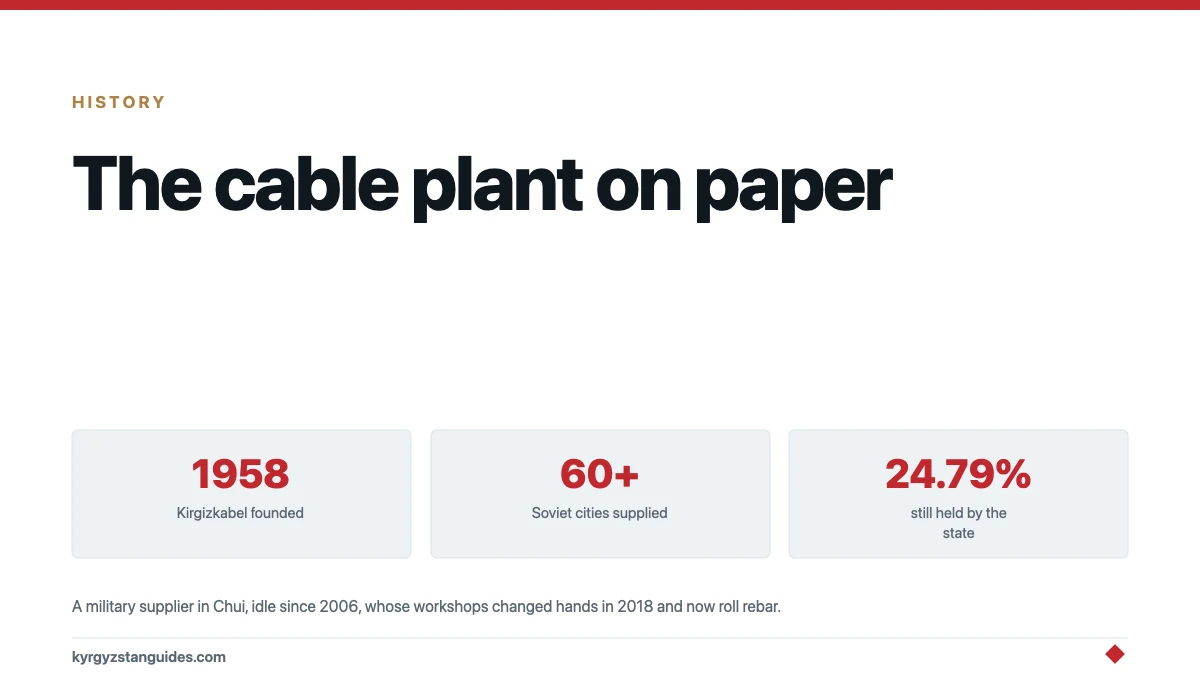
Kaindy is a town of about ten thousand people on the railway west of Bishkek, best known today for its sugar factory. For thirty years it had something rarer: a cable plant that supplied wire to more than sixty Soviet cities and to the military. Getting a job there, a former machinist recalled, took connections. The plant stopped in 2006, changed hands through a chain of deals that a Kyrgyz investigative outlet traced to a parliamentary deputy’s ex-wife, and by 2021 existed, in the words of that investigation, “only on paper”. Its workshops now belong to a company making steel rebar.
Beyond a line in an investment catalogue asking for $450,000 of modernisation money, there is no English account of any of this. The story below is assembled from the Kaindy city administration’s own history, a 2021 investigation by PolitKlinika published on Factcheck.kg, the responses it drew, and business-press chronologies. The dates conflict in a couple of places, and we flag each one.
A railway town before it was a factory town
The town predates the plant by half a century. According to the Kaindy mayor’s office, the railway station and two barracks for railway workers were finished in 1916, and the first train ran through on 8 August 1924. The name, locals say, comes from a birch wood that once stood there: Chon Kaiyndy was the gorge and river, and the settlement took the name.
In 1931 a timber yard became an artel founded by Interhelpo, the Czechoslovak workers’ cooperative that had moved to Kyrgyzstan a few years earlier. Kaindy became an urban-type settlement in September 1934. Then came the Soviet build-out: the cable plant in 1958, a sugar factory in April 1963 processing 25,000 centners of beet a day, a meat plant in December 1965, a brickworks in 1973, timber and reinforced-concrete plants in 1976. The sugar side of that story is in our piece on Kyrgyzstan’s sugar industry, which still runs through Kaindy-Kant today.
1958: Kirgizkabel
The city history is specific: in 1958 the Kirgizkabel plant was created on the base of the flax-processing works. The Factcheck investigation says the plant “started work in 1960”, and Tazabek says “the late 1950s”. Taking the city’s date as the founding and 1960 as the start of production reconciles them, but we cannot confirm that reading.
What the plant made is clearer. Cables, including for the military. By the mid-1970s, according to both Tazabek and Factcheck, it supplied more than sixty cities across the Soviet Union. A film clip from the Soviet Kirgizia newsreel, found by the research group Laboratory Ci and republished by Factcheck, shows the opening of a new workshop.
A machinist who spent 34 years at the plant described it to PolitKlinika as a prestigious place that you joined “only through connections”. Eight-hour shifts, a canteen, showers, clean clothes on the way in and out. His wage in 1971 was 170 to 180 roubles a month. “We filled two fridges every month, bought food, brought home sweets in boxes.”
After 1991: who owned it?
The Soviet collapse did to Kaindy what it did to the Mailuu-Suu lamp plant and the Kök-Jangak mine: the market vanished, the wages stopped, the workers were let go. “Then everyone started selling, we were all cut, and it all went downhill,” a former employee said. “It was hard for everyone, especially when they started tearing everything down. There was nothing to pay wages with; the plant owed us.”
The ownership trail is broken. The State Property Fund told PolitKlinika that the plant’s documents were lost during the revolutions of 2005 and 2010. What survives: 35 per cent of shares went to employees and 4.95 per cent were sold at coupon auctions, probably in the 1990s. The remaining 60.5 per cent passed between the state and unnamed Russian individuals and companies. The earliest public shareholder record, from October 2012, shows three Russian shareholders holding 67 per cent and the state, through the Fund, 24.79 per cent.
The plant borrowed against its property, could not repay, and the debt stayed. From 2003 the whole complex and its equipment were pledged to Kazkommertsbank. The investment agency told PolitKlinika that the plant had made no profit since 2005. It stood idle from 2006. In the last quarter of 2008 it restarted on a small scale, processing customer-supplied raw material on a tolling basis, and lost money doing it.
The years of promises
Between 2011 and 2017 several government delegations visited, each saying the plant must be revived. In early 2013 the government told other state enterprises to order cable from Kaindy; a few orders came, then stopped. In summer 2012 the plant’s executive director, Bektur Kalykov, put the cost of modernisation at about $15 million. Officials hoped that joining the Eurasian Economic Union in 2015 would open markets. It did not. Kalykov’s own diagnosis, given to Vecherny Bishkek, was that the plant could not compete with Chinese cable, which had filled the market so completely that even Kyrgyz state enterprises bought it. “Unfortunately, a great many people go for the cheapness of the product and nothing else bothers them.”
In 2017, months before Sooronbay Jeenbekov was elected president, the decision was taken to sell.
2018: the transfer
What happened next is the core of the PolitKlinika investigation, and the account below follows it, together with the rebuttal the new owners sent to Kaktus.media in March 2021.
The buyer was a Kyrgyz company, Metall-Ken, set up by Chinese investors (90 per cent) and Gulsara Sulaimanova (10 per cent), who was its general director. Sulaimanova is the former wife of the parliamentary deputy Aliyarbek Abzhaliev, whose family is related by marriage to the then president. The Chinese founders later sold their 90 per cent to Fujian Taihao International Trade, a Chinese metals company. Metall-Ken says the plan from the start was a metal-processing plant, not cable, with investment of up to $10 million.
Metall-Ken did not buy the plant’s shares. Instead, between May and August 2018, it acquired the plant’s physical assets. By then the pledged property had passed from Kazkommertsbank to a creditor called Crannet Corporation, about which almost nothing is public, though a company of the same name is registered in the British Virgin Islands. Metall-Ken paid off the Crannet debt in 2018, took over the claim, and lent the plant a further 20 million som interest-free to clear wage, tax and Social Fund arrears.
In the same weeks, Sulaimanova’s brother-in-law Aibek Turdubaev and her brother Kushbak Sulaimanov became shareholders of the cable plant. By mid-July they held a controlling stake and called a shareholders’ meeting, which voted to hand the plant’s property to Metall-Ken in settlement of the debt. Almost all the real estate had transferred by the end of August 2018.
The State Property Fund, still holding 24.79 per cent, says it was told of a meeting but that the meeting was held on a different date. “We were simply led around by the nose,” its department head Timur Malbashev told PolitKlinika. The Fund went to court to annul the meeting. Metall-Ken’s director, Wang Shien, says the meeting followed the joint-stock company law to the letter, with twenty days’ notice and a public announcement.
Two other threads run through that spring. The plant’s main building was in the hands of a separate firm, Target Company, which the security service raided in April and May 2018 in a VAT-refund fraud case, arresting its founders. Metall-Ken says Target Company had nothing to do with the cable plant beyond renting a shoe workshop next door. And an electricity firm then owned by Sulaimanova and Turdubaev, Askarenergo, built an office on security-service land and supplied power to a security-service housing estate in western Bishkek. Asked about it, the security service replied only that it was not an Askarenergo customer.
2019 to 2024: rebar, licences, a town’s new employer
In January 2019 Tazabek confirmed that the state’s 24 per cent stake remained with the Property Fund, now in a company without workshops. In February 2021, after the investigation ran, Metall-Ken wrote to PolitKlinika offering to buy the state’s shares “to avoid groundless speculation”, and said it had already paid more than 23 million som in taxes and contributions. Its metal plant, delayed by the pandemic, was due to open in the second quarter of 2021.
On 4 June 2021 Tazabek reported that rebar production had started on the site of the cable plant. On 16 August 2023 the energy department cancelled the licences of seven energy companies, the Kaindy cable plant among them, which suggests the paper company still held an electricity-related licence it no longer used. By 2024 the mayor’s office listed Metall Ken, alongside Kaindy-Kant and the meat plant, as one of the town’s three large producers.
So the site works again, making steel bars for the construction boom around Bishkek rather than cable for Soviet cities. Cable itself has not left the region: in July 2024 the Cabinet announced a new, unrelated cable plant elsewhere in Chui, built with a $4.7 million loan from the state-owned Ayil Bank out of $6.5 million invested, according to Trend. It is a different company on a different site. Whether the joint-stock company that once owned it will ever be wound up, and whether the state will see anything for its quarter share, were open questions when the last reports were filed.
Seeing Kaindy
Kaindy is on the Bishkek–Kara-Balta road and the railway, about 100 km from the regional centre by the city’s own reckoning. There is nothing to visit at the plant; it is a working industrial site in private hands. The town itself is a tidy example of the Chui valley’s Soviet industrial belt, with its 1963 sugar factory still running each autumn and a Victory Park with a restored stadium. If industrial history is your interest, Kara-Balta, twenty minutes west, has more to look at and a guide of its own.
What we could not establish
- The founding year. 1958 (city history), the late 1950s (Tazabek) or 1960 (Factcheck).
- Peak employment and output. None of the sources gives a figure.
- The outcome of the State Property Fund’s court case over the 2018 shareholders’ meeting.
- What Crannet Corporation is, beyond a BVI-registered name.
- Whether Metall-Ken bought the state’s 24.79 per cent, as it offered to in 2021.
FAQ
What was the Kaindy cable plant?
A Soviet cable factory in Kaindy, Chui region, created in 1958 as Kirgizkabel on the site of a flax works. By the mid-1970s it supplied cable to more than sixty Soviet cities, including the military. It stopped production in 2006 and its workshops passed to a metal company in 2018.
Is the Kaindy cable plant still operating?
Not as a cable plant. The joint-stock company exists on paper, with the state holding 24.79 per cent. Its buildings and land went to Metall-Ken in 2018, which started rebar production on the site in June 2021 and is listed by the town as one of its three main producers.
Who owns the former Kaindy cable plant?
The workshops and land belong to Metall-Ken, a company whose 90 per cent Chinese stake is held by Fujian Taihao International Trade, with 10 per cent owned by Gulsara Sulaimanova. The shell joint-stock company is held by private shareholders and the State Property Fund.
Why did the Kaindy cable plant close?
It lost its Soviet market after 1991, borrowed against its property, pledged everything to a bank in 2003, made no profit after 2005 and stood idle from 2006. Its director blamed cheap Chinese cable, which even Kyrgyz state enterprises preferred to buy.
Where is Kaindy?
In Chui region, on the railway and the main road between Bishkek and Kara-Balta, about 100 km from the regional centre. It has had a railway station since 1916 and became a city in 2012. Its other big employers are the Kaindy-Kant sugar factory and a meat plant.
What else was made in Kaindy?
Sugar, from a plant opened in April 1963 that still processes beet each autumn; meat and sausages, from a 1965 plant; bricks from 1973; and timber and reinforced-concrete products from 1976. In 1931 the Czechoslovak cooperative Interhelpo founded a timber artel there.
Sources: Kaindy mayor’s office: history of the town (Russian), Factcheck.kg / PolitKlinika: transfer of the Kaindy plant (February 2021, Russian), Kaktus.media: Metall-Ken’s statement (March 2021, Russian), Tazabek: history of the Kaindy cable plant (May 2025, Russian)