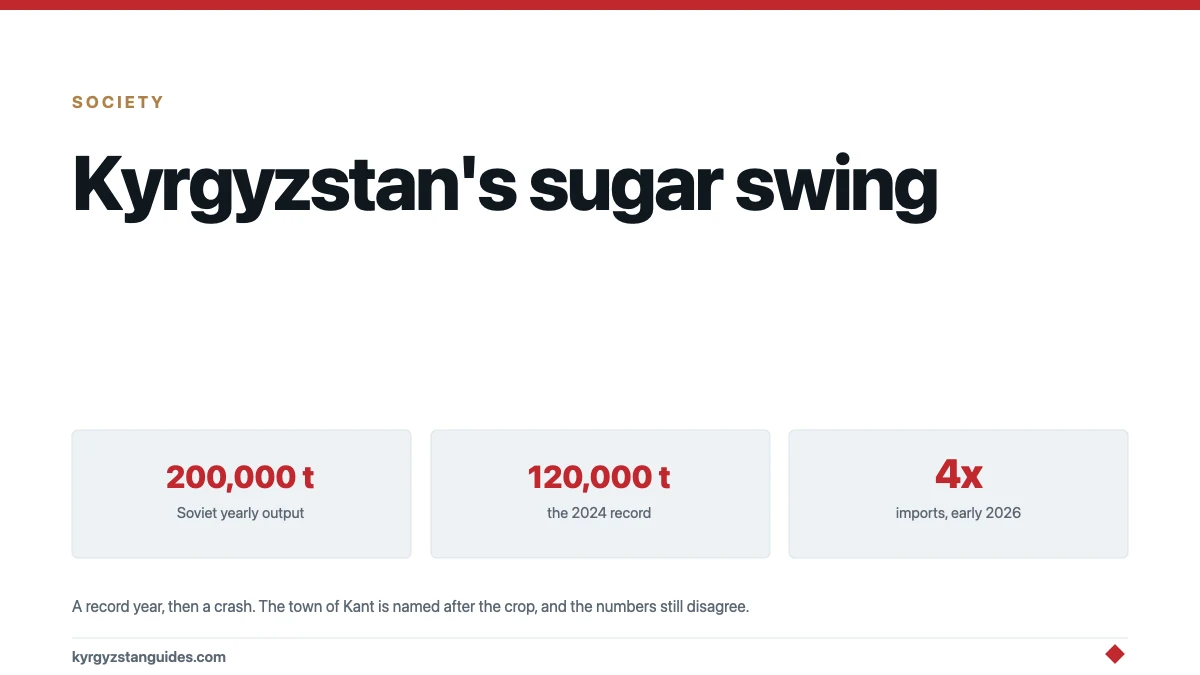
In January 2025 Kyrgyzstan did something it had not managed since the Soviet Union fell apart: it declared that its own factories could cover the country’s sugar for the year, and shut the door on imports to prove it. Twelve months later the beet harvest had dropped by roughly a third, and by the summer of 2026 sugar was arriving from Brazil, Russia and Belarus at four times the previous year’s pace. In the Chui valley between Bishkek and Tokmok, the autumn beet harvest is the visible end of that swing.
This is the story of a crop most visitors never notice, told through the numbers that exist for it. Several of those numbers disagree with each other, sometimes badly, and we say so where they do.
Where the name on the map comes from
Twenty kilometres east of Bishkek sits a town called Kant. Кант is the Kyrgyz word for sugar, and the sugar factory built there in the early 1930s is the usual explanation for the name. Our Kant guide goes into why the founding dates wobble between 1932 and 1934 and why local historians are careful not to tie the town’s name too tightly to the plant. Either way, the word itself is the clue: sugar was important enough here to name a place after.
You meet the same word at the table. Sugar for your tea is kant, and in a guesthouse it sits next to the bread and jam as one of the things a host puts out without being asked. The customs around that table are in our piece on Kyrgyz tea and bread.
The Soviet sugar belt
During the Soviet period the Kirghiz SSR grew beet on a scale that is hard to picture from today’s figures. According to The Times of Central Asia, the republic produced more than 200,000 tonnes of sugar a year, exported up to 70,000 tonnes of it, and its plants could take in about 10,000 tonnes of beet a day. The same report calls Kyrgyzstan the “sugar beet basket of Central Asia”.
The plants named in that account are Kant, Kara-Balta, Tokmok, Novo-Troitsk, Belovodsk and Kaindy. That is six names, although the sentence introducing them says five. We could not find a primary list that settles the count. What is clear is the geography: every one of those towns is in the Chui valley, the irrigated strip along the Kazakh border that also feeds the capital.
Why there? Beet wants deep soil, a long growing season and a lot of water at the right moment. The Chui valley has the first two, and the third comes down from the glaciers of the Kyrgyz Ala-Too in summer. Sugar beet is still grown in only two regions of the country, Chui and Talas, according to the state Public-Private Partnership Center.
What 1991 did to it
The collapse was not sudden, but it was thorough. Once the Soviet supply chain disappeared, so did guaranteed buyers, spare parts and cheap inputs. Beet areas shrank, and the plants aged without replacement. The 2017 Times of Central Asia report notes that in a quarter-century of independence no new sugar plant had been built, and that the existing ones sat idle for long stretches because of broken equipment and too little beet.
The Koshoy plant is the clearest example. It had been standing idle when, in 2016, it received a $10 million loan from the Russian-Kyrgyz Development Fund to modernise. It reopened in October 2017 able to process up to 3,000 tonnes of beet a day. The same fund came back in December 2025 with a further $25 million for the industry, according to Trend, after about $16 million in 2016–2017 that had let both plants resume work. Kaindy-Kant, founded in 1963 and privatised in 1999, kept going throughout and is described by the EBRD as the country’s leading producer. More than 3,500 farmers supply it with beet. Between them these two plants are, in practice, the Kyrgyz sugar industry.
By 2019 their combined throughput was still modest. The Public-Private Partnership Center reports 426,010 tonnes of beet processed that year and 58,050 tonnes of granulated sugar produced. Domestic demand was put at 110,000 to 120,000 tonnes, and the country imported 26,467 tonnes of white sugar worth $12.2 million to make up part of the gap.
The record, and the arguments about it
Then came 2024. Here the figures start pulling in different directions.
| Source | 2024 beet harvest | What it says about sugar |
|---|---|---|
| Ministry of Agriculture, via 24.kg (26 Dec 2024) | 870,200 tonnes, up 249,200 on 2023 | Enough for about 120,000 tonnes of sugar, covering domestic demand |
| The Times of Central Asia (Nov 2025) | “more than 620,000 tonnes” | Government declared full domestic coverage for late 2024 and most of 2025 |
| Trade press summaries | figures above one million tonnes | 120,500 tonnes of sugar for the season |
We trust the ministry’s 870,200-tonne figure most, because it is the official one and it came out closest to the harvest. The 620,000 figure may be an earlier estimate or a different measure. We could not trace the million-tonne figure to a primary source, so treat it as unconfirmed. On sugar output the sources agree more closely: around 120,000 tonnes, which is roughly what the country eats in a year.
That was enough for the government to act. In late December 2024 the Council for Food Security proposed a six-month ban on sugar imports, which took effect in January 2025. The stated aim was to support local growers and give them reason to plant more the next year.
Demand is another figure that moves around. The partnership centre says 110,000 to 120,000 tonnes a year; the government’s own self-sufficiency claim uses about 120,000; a 2024 Times of Central Asia report cites 145,700 tonnes for the population’s needs. A range of roughly 110,000 to 146,000 tonnes is the honest answer.
The crash that followed
The 2025 season went the other way. According to Akchabar, citing official data, the beet harvest fell to 538,900 tonnes, with average yields of 401.9 centners per hectare. That is far below what the record year produced, on 13,400 hectares of sown land. AKIpress reported the value of sugar production rose in 2025 to 4.6 billion som, but money value and tonnes are different measures, and we could not see the tonnage behind that headline.
The import figures tell the rest. Over the first seven months of 2026, 66,900 tonnes of white sugar came into the country. That is four times what arrived over January to July of 2025, and Brazil now leads the list of suppliers, ahead of Russia, Azerbaijan, Kazakhstan and Belarus. On 10 October 2026 a draft decree went out for public consultation proposing another ban of up to six months, this time on white sugar only, timed to cover the new processing season. The worry stated in the draft is that cheap imports arriving just as local sugar reaches the market would push prices down and hurt beet growers.
Why farmers keep getting squeezed
A June 2024 Times of Central Asia piece let the growers explain the problem in their own terms. Imports from Russia and Kazakhstan undercut them. Resellers sometimes export the beet itself, which helps the farmer’s price but not the shop price of sugar. Some European seed varieties are poorly suited to local conditions. The number of beet farms, about 3,000 at the time, was falling. Planting needed to reach around 20,000 hectares for real self-sufficiency, against 15,000 actually sown that year.
One grower, Mirgasym Allakhveranov, put the trade-off plainly: export is good for the farmer because the price rises, but “for the population it is not very good.”
The government has tried the obvious tools. It has offered soft loans, which the same report put at 7 billion som. It has used bans in both directions, suspending sugar exports for six months in May 2022 after prices rose 10% in a month, and blocking imports in 2025. The earlier ban is telling: the anti-monopoly agency found there was no actual shortage in 2022, yet prices kept climbing. Sugar prices in Kyrgyzstan respond to fear as much as supply.
2026: a better harvest on less land
This year’s numbers are moving in an odd direction. According to an 8 October 2026 report in Akchabar, the beet area shrank by 11.9% this year, to 11,800 hectares. Yet the expected harvest is 700,000 to 710,000 tonnes, because yields are forecast to recover to about 600 centners per hectare after a better season. By that date about a third of the area had been lifted.
If the forecast holds, 2026 will land between the bad year and the record, and the import ban now under discussion is meant to stop that recovery being undercut. Whether it works will show in the shop price of sugar this winter. We will update this page once the season’s official totals are published.
What this means if you are travelling
None of this changes your trip. Sugar is in every shop and every chaikhana. But it explains a few things you may notice:
- October and November in the Chui valley is beet harvest season. Expect slow trucks on the roads around Kant, Tokmok and the Kaindy area, and piles of beet by the fields waiting for collection.
- The town of Kant is an easy stop 20 km east of Bishkek, and the name means exactly what you think. There is no factory tour we could confirm, so do not plan around one.
- Price talk at bazaars and in taxis often turns to sugar, flour and fuel. Now you know why sugar is on that list.
For the wider picture of what Kyrgyz farms grow and why so much wheat is imported, see our overview of Kyrgyz agriculture today.
What we could not establish
- The exact number of Soviet-era sugar plants: one report names six while saying five.
- Which 2024 harvest figure is the definitive one: we have three, and only one is from the ministry.
- The tonnage behind the 2025 production value of 4.6 billion som.
- Whether either working plant offers visits to the public.
FAQ
Does Kyrgyzstan produce its own sugar?
Partly, and the share swings sharply. Two plants in the Chui valley, Kaindy-Kant and Koshoy, process locally grown beet. In 2024 they produced about 120,000 tonnes, enough for the country’s annual demand. Then the 2025 beet harvest fell to 538,900 tonnes, and by mid-2026 imported sugar had climbed back to 66,900 tonnes for just seven months.
Why is the town of Kant called Kant?
Кант is the Kyrgyz word for sugar, and a sugar factory built in the early 1930s is the usual explanation for the name. Local historians caution that the plant and the place name are not necessarily directly linked, and the factory’s founding year is recorded as either 1932 or 1934.
Where is sugar beet grown in Kyrgyzstan?
Only in two regions, Chui and Talas, according to the state Public-Private Partnership Center. The Chui valley along the Kazakh border holds the factories and most of the fields, watered by summer meltwater from the Kyrgyz Ala-Too range.
Did Kyrgyzstan ban sugar imports?
Yes. A six-month import ban was proposed in December 2024 and took effect in January 2025, after a record 2024 harvest. In October 2026 a new draft decree proposed a ban of up to six months on white sugar imports during the 2026 processing season, after imports rose fourfold.
How much sugar did Soviet Kyrgyzstan produce?
More than 200,000 tonnes a year, according to The Times of Central Asia, with up to 70,000 tonnes exported. Plants in the Chui valley could process about 10,000 tonnes of beet a day, which earned the republic the label “sugar beet basket of Central Asia”.
When is sugar beet harvested in Kyrgyzstan?
In autumn, mainly October and November. By 8 October 2026 about a third of that year’s 11,800 hectares had been harvested. The factories then process the beet over the following months, usually into the new year.
Sources: The Times of Central Asia: reviving the sugar industry (2017), 24.kg: temporary ban on sugar imports (Dec 2024), Akchabar: 2026 beet harvest forecast, EBRD: Kaindy-Kant financing (2017)