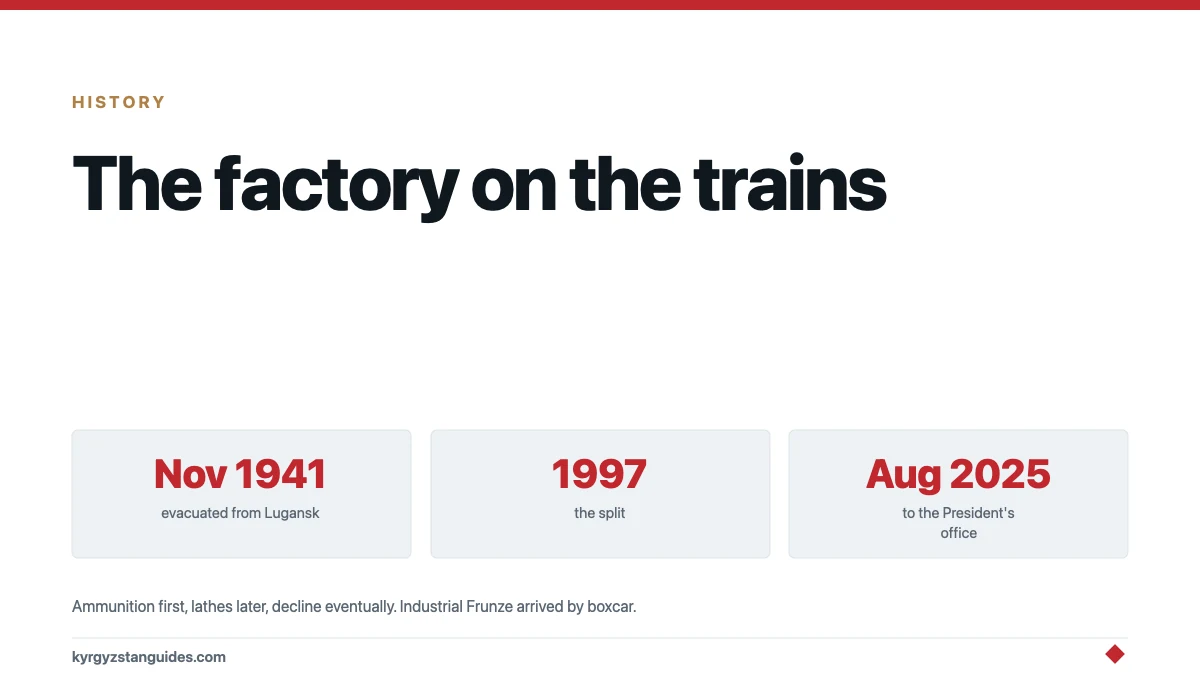
In November 1941, as German armies closed on the Donbas, the Soviet Union picked up a cartridge factory in Lugansk and put it on trains to Frunze. The machines were reassembled on the site of some repair shops and a tobacco-fermentation plant, and a Central Asian capital that had never made anything more martial than preserves began producing ammunition for the Eastern Front.
That factory became, over the following half-century, the Lenin Machine-Building Plant — one of the anchor enterprises of industrial Frunze — and it still exists, after a fashion, as Bishkek's machine-building works. Its story is the whole arc of Soviet Kyrgyz industry in one site: wartime birth, planned-economy maturity, post-1991 subdivision and decline, and a 2025 twist that suggests the state has remembered it owns the place.
A sourcing note up front, in keeping with how this site works: this post leans more than most on Russian machine-industry catalogues and registry filings, because the subject sits below the radar of scholarship and journalism alike. Where a fact rests on a catalogue, the text says so.
The Lugansk inheritance
The parent enterprise's pedigree runs deep, and in two distinct roots that get conflated: a cannon-foundry works founded in 1795 — Catherine the Great's armaments push — which closed in 1887; and the cartridge plant founded on its property in 1892, opening in 1895. It is the cartridge plant, numbered Plant No. 60 in the Soviet defence nomenclature, that concerns Frunze.
The wartime dispersal is documented in the standard register of Soviet defence plants: No. 60's evacuation in 1941 scattered it to five numbered plants and to Frunze — the Frunze destination recorded as the republic's local-industry repair works. One evacuated factory becoming six is how Soviet industry survived 1941: not moved but propagated, like a plant from cuttings.
What the register does not say — and an earlier draft of our research wrongly thought it did — is that the Frunze cutting inherited the number. That detail, the Frunze works keeping the designation No. 60 while rebuilt Lugansk took No. 270, comes from the machine-tool catalogues; it is plausible, consistent, and resting on sources of registry grade rather than archive grade. So: stated, and flagged.
From ammunition to lathes
The post-war trajectory, from the same catalogue record: the plant shed its wartime name for Frunze Machine-Building Plant, later honoured as the Lenin Machine-Building Plant, and matured into a machine-tool production association. Its product list across the decades reads like a tour of Soviet industrial priorities — ammunition first, then presses, metal-cutting lathes and eventually CNC machine tools, electric motors, starters, thermal relays, agricultural equipment.
Machine tools deserve the emphasis. A factory that makes machines that make machines sits at the top of an industrial food chain, and Frunze hosting one meant the Kyrgyz SSR was wired into the union's most strategic civilian tier — the same tier our Kyrgyzstan-in-WW2 post shows arriving as thirty-plus evacuated enterprises, and our torpedo-plant post follows to the lake. Plant No. 60's ammunition line, for its part, was spun off in the 1990s as the separate Bishkek Stamping Plant — the cartridge DNA carrying on under state ownership while the civilian works went its own way.
The tobacco shed underneath
One founding detail rewards a pause: the evacuated machinery landed partly on a tobacco-fermentation plant. That is not colour — it is a before-and-after of the republic's entire economy in one address. Pre-war Kyrgyz industry, such as it was, processed what the land grew: tobacco, wool, hides, fruit. The war unloaded metalworking on top of it, literally — machine tools on the floor where leaf had cured — and the republic's industrial identity flipped in a season from processing harvests to machining steel.
The old layer never vanished; it just moved down the road and down the rankings. The tobacco economy that once ranked among the republic's leading sectors dwindled on its own post-Soviet track, while the metal layer laid over it in 1941 became the prestige economy for fifty years — and then dwindled in its turn. Two industrial eras, one plot of Frunze ground, both now chiefly legible as history.
1997 and after: the long dwindle
The post-Soviet record, from registry and exchange filings: in 1997 the association was divided — the machine-building works corporatised as a joint-stock company, the stamping plant split off to the state. A 2004 reorganisation followed, and the catalogue-era figure for the state's residual share in the machine works stands at about 75.8 per cent — a number this post cannot confirm as current, the public exchange filing being silent on it.
Kyrgyz business press across the 2010s and 2020s tracked the familiar decline-era repertoire — tax arrears, pre-bankruptcy language, single-digit-to-partial capacity utilisation — without the plant ever quite dying. Soviet-built works of this class rarely do die cleanly: the land, the halls and the grid connection are worth more than the order book, and something always limps on.
Then the 2025 signal: in August, management of the state's stake was transferred to the Presidential Administration's property office — management, note, not a sale or a new owner. In today's Kyrgyzstan, where the state has been reclaiming commanding heights across the board, moving a dormant defence-lineage plant into the president's own portfolio reads less like housekeeping than like a bookmark.
Why bother with a factory nobody can tour
Partly because it is Bishkek's history hiding on an industrial street. The city's Soviet architecture walk covers the ministries and mosaics, but the apartment districts exist because plants like this one filled them; the factory is the reason for several tram routes' worth of city. Industrial Frunze was not a backdrop to the capital — it was the payroll.
Partly because of what the 1941 origin says about how industrial Kyrgyzstan happened at all: not by development planning but by catastrophe logistics — a war flinging the union's machinery east, some of it as far as the Tian Shan foothills, where it rooted. Half the republic's industrial pedigree traces to boxcars with front-line postmarks.
And partly as a specimen of the hardest source problem on this site. A plant that made ammunition kept its history off the record as policy; what survives publicly is catalogues, filings and headlines. The honest telling is necessarily a frame around gaps — which is still worth more than the alternative of silence, so long as the gaps are drawn in ink.
What I could not establish
More than usual, so the list is the point. Whether the Frunze works formally carried the No. 60 designation — catalogue-grade sourcing only, as flagged. The current state shareholding, employment, and what if anything the halls produce today. The plant's wartime output figures — nowhere public. The 100-hectare site figure that circulates — unverified here. And the intent behind the 2025 transfer: revival, redevelopment, or simple consolidation, the filing does not say. A reader who can improve any of this from Kyrgyz archival sources would genuinely advance the record — the English-language one now consists of this page.
FAQ
What was Factory No. 60?
A Soviet cartridge plant in Lugansk — founded 1892 on the grounds of a 1795 cannon foundry — whose 1941 evacuation dispersed it to several sites including Frunze, where its machinery seeded what became the city's machine-building works, later named the Lenin Machine-Building Plant.
Did the Frunze plant keep the number 60?
The machine-industry catalogues say yes — with rebuilt Lugansk renumbered 270 — but the standard register of defence plants records only that part of No. 60 went to Frunze. This post states the inheritance as catalogue-sourced rather than archivally proven.
What did the Lenin Machine-Building Plant produce?
Ammunition in wartime, then the Soviet civilian ladder: presses, metal-cutting and eventually CNC lathes, electric motors, starters, thermal relays and agricultural equipment — machine tools being the strategic heart of it. The ammunition line continued separately as the state Bishkek Stamping Plant after a 1997 split.
Does the factory still exist?
As a joint-stock company in Bishkek, yes — through a 1997 division, a 2004 reorganisation, and decades of decline tracked in tax-arrears and low-utilisation headlines. In August 2025 management of the state's stake was transferred to the Presidential Administration's property office.
Can you visit it?
No — it is a closed industrial site with no tourism dimension. Its traveller-facing relevance is interpretive: it explains a stretch of industrial Bishkek, several residential districts, and how a 1941 evacuation built the city's working-class geography.
Why was Soviet industry evacuated to Frunze?
Because 1941 demanded factories beyond bomber range, and the Kyrgyz SSR offered rail access, power and safety. More than thirty enterprises arrived in the republic during the war — the founding event of its industrial economy, of which Plant No. 60's machinery was one trainload.
What happened to the original Lugansk plant?
It was rebuilt after the war under the new number 270 and continued as one of the Soviet Union's major cartridge producers — while its wartime cuttings, Frunze's included, grew into independent enterprises across the union.