For a quarter of a century, the question "who runs the village canal?" in Kyrgyzstan had a specific answer: a water users' association — farmers organised by law around their irrigation network, with an elected council, paid staff, and the mirab, the water master, walking the ditches. In June 2025, that era quietly ended: the law behind the WUAs was repealed, and a new Water Code points the system back toward the state.
Nobody has written this arc up in English, which is remarkable given who built the WUAs in the first place: they were the flagship reform of Western development lending in Kyrgyz agriculture. Their abolition closes a thirty-year policy circle — collective, then communal, now state — around the one resource this farming country cannot do without.
Why associations existed at all
The Soviet collapse orphaned the ditches. Off-farm canals — the trunk system, including the hand-dug giants — stayed with the state; but the capillary network on the farms had belonged to kolkhozes that ceased to exist, leaving hundreds of thousands of new smallholders drawing from channels nobody owned, maintained or policed.
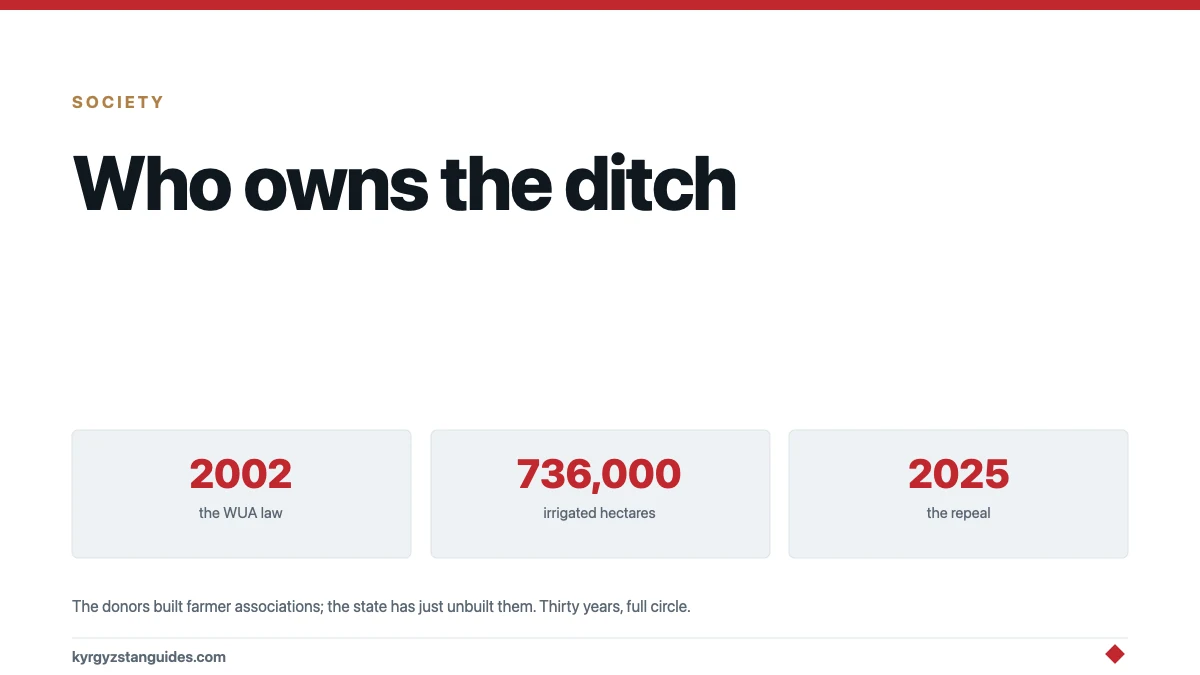
The answer, urged and financed by international lenders from the 1990s, was the water users' association: farmers on one hydraulic unit, organised as a body that collects fees, maintains the network and allocates the water. A 2002 law gave the model its statute. An Asian Development Bank project official later put the paternity bluntly — the World Bank, he said, had imposed the associations on Kyrgyzstan. Imposed or adopted, they became the sector's skeleton across the 736,000 irrigated hectares that feed this country.
How one actually worked, per a field study of four Osh-region associations: a general assembly of members electing a small council — five to seven people in the cases studied — over an executive of director, accountants, canal riders and mirabs, the sequence-keepers of irrigation turns. The mirab is the ancient office the whole modern structure rested on: the man who knows whose turn the water is.
What the system was like to live under
Two documented textures, one fiscal and one legal.
Fiscal: associations ran on members' fees, and chasing them was half the job — unpaid water charges became a staple of aksakal court dockets, the elder judges pressed into service as the irrigation system's debt collectors.
Legal: the model kept evolving to patch its gaps. A December 2021 amendment to the Water Code allowed irrigation systems to pass into municipal ownership — and fifteen village administrations in Osh and Jalal-Abad regions duly took their canals over from struggling associations. The numbers one administration head gave parliament in 2022 sketch the inheritance: 701 kilometres of canal, all of it earthen, 68.5 km needing urgent repair at a cost of 273 million som to irrigate 8,568 hectares. One rural district. Those figures are a single official's statement, not an audit — but as a core sample of what "the farmers now own the ditches" meant physically, they will do.
The 2025 reversal
Then the circle closed. On 27 June 2025 a new Water Code was adopted, and its companion law repealed the 2002 WUA statute outright. The Kyrgyz-language explainer coverage put the direction plainly: irrigation structures of rural districts move to state ownership. The 2021 municipal option — four years old — was superseded along with the associations themselves; the new code's text, searched directly, contains no "association" and no "mirab", defining its water suppliers as territorial state bodies or, residually, other legal entities.
Entry into force followed the code's own six-months-after-publication clause, which from the July 2025 signing lands the new regime at the start of 2026. What implementation looks like ditch-by-ditch — what happens to association staff, debts, pumps and those 701 earthen kilometres — is precisely the part no source yet describes.
Why reverse? No official obituary for the WUAs accompanied the repeal, but the state's whole direction of travel supplies context: the same years merged the village administrations and centralised their executives. A fragmented, fee-starved communal model sat awkwardly in a recentralising state — and thirty years of leaking earthen canals had given the communal model's critics their evidence, fair or not.
The donors adjust their aim
The development industry that built the associations has not left the sector — it has shifted targets. Swiss-funded work now runs irrigation-efficiency partnerships in the Ferghana valley's water-stressed south, financing technology and canal repair rather than governance models; the lending logic has moved from who should own the ditch to how much the ditch loses. Given that agriculture takes roughly nine-tenths of the country's water withdrawals through channels that waste a large share of every litre, that may be the more durable question — and it is one the new state ownership will now answer for, alone, in full view of the same donors who once bet on the farmers.
Why this deserves a page on a travel site
Because water order is village order here. The mirab's schedule decided when fields flooded, which decided everything from what grows to when disputes flare; the association meeting was, with the mosque and the school, one of the places a village governed itself. Whatever replaces that — a state water office with a district map — rearranges a small but real piece of rural life that no guidebook will ever mention and every green field displays.
One sentence of scale for the file: the statute repealed in 2025 had governed the watering of nearly three-quarters of a million irrigated hectares for twenty-three growing seasons.
And because it is a perfect specimen of a pattern this site keeps documenting: the donor-era institution, built in the 1990s image of community self-management, dismantled in the 2020s by a state reclaiming the commanding heights. The canals themselves, Soviet-dug and gravity-fed, outlast every theory of who should own them.
What I could not establish
The fate of existing associations' assets, staff and debts under the new code — genuinely unwritten so far. Any official statement of motive for the repeal. The total number of WUAs at abolition — counts varied across years and sources, so none is given here. And the new code's operational structure below district level: whether something mirab-shaped survives inside the state bodies, which for actual farmers is the only question that matters.
FAQ
What was a water users' association in Kyrgyzstan?
A farmers' body, organised by a 2002 law around a shared irrigation network, that collected fees, maintained on-farm canals and allocated water — with an elected council and staff including the mirab, the traditional water master. They were championed and financed by international lenders after the Soviet farm system's collapse orphaned the local canals.
Do the associations still exist?
Their legal basis is gone: the 2002 law was repealed on 27 June 2025 alongside adoption of a new Water Code, whose text contains neither associations nor mirabs and which directs rural irrigation structures toward state ownership, effective from the start of 2026 under its six-month clause. How wind-down works on the ground is not yet documented.
Who owns village canals now?
Direction of law: the state. A 2021 amendment had briefly allowed municipal ownership — fifteen village administrations in Osh and Jalal-Abad took over canals under it — but the 2025 code supersedes that experiment along with the associations.
What condition are the canals in?
The one concrete core sample, from an administration head's 2022 statement to parliament: 701 km of canal in his district, all earthen, 68.5 km needing urgent repair costed at 273 million som for 8,568 hectares. A single official's figures — and consistent with the national picture of Soviet-era channels losing a third or more of their water.
What is a mirab?
The water master — the office, far older than any modern law, of keeping the irrigation turn: who opens which gate, when, for how long. The WUA era professionalised mirabs as association staff; the 2025 code does not mention them, leaving the office's future inside state structures an open question.
Why were the associations created in the first place?
Because decollectivisation left on-farm canals ownerless among hundreds of thousands of new smallholders. International lenders pressed the association model as the fix — an ADB project figure later said the World Bank had "imposed" it — and for a quarter-century it was how Kyrgyz irrigation nominally governed itself.
Why does any of this matter to a visitor?
Every green field in a brown valley is the system working; every dispute about it runs through institutions like these. The handover from village associations back to the state is the kind of deep rearrangement of rural life that never reaches guidebooks — and shapes the landscape in every window.