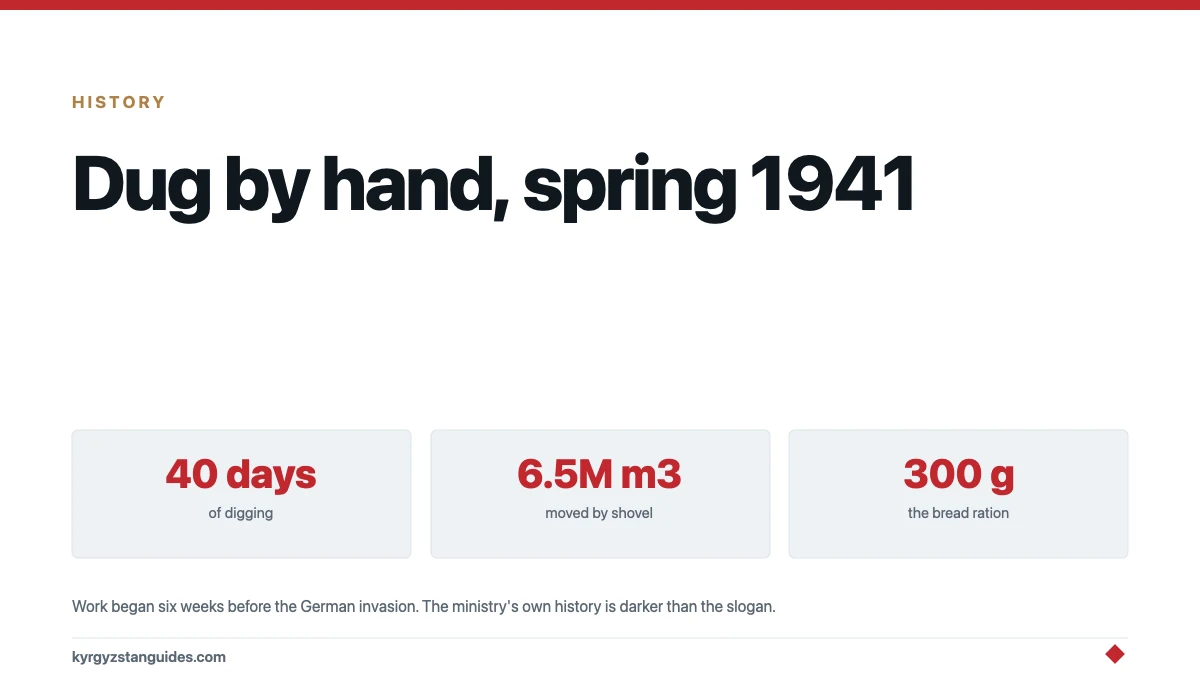
Work began on 10 May 1941 — six weeks before Germany invaded the Soviet Union. Somewhere between 32,000 and 40,000 people, depending on which account you read, went out onto the Chuy valley steppe with shovels, picks and wheelbarrows, and in about forty working days they moved roughly 6.5 million cubic metres of earth.
The Great Chuy Canal is the reason the valley around Bishkek looks the way it does: the poplar lines, the beet and grain fields, the aryk channels threading the capital — all of it hangs off water that the canal pulls from the Chu River. It is the largest thing ever built by hand in Kyrgyzstan, and in English it has essentially no written history at all. The Russian record, mostly on the water ministry's own site, is vivid and considerably darker than a Soviet achievement story.
The decision, and the timing
The USSR's Council of People's Commissars issued its decree on 16 March 1940 — one document covering both the canal and the Orto-Tokoy reservoir that would regulate it. The Kyrgyz republican decree followed on 25 April 1940. Construction itself started the next spring.
That timing deserves a moment. The dig ran from 10 May to roughly 23 June 1941, by the account of the historian Alexander Zabolotny, originally published through the Kabar agency. Germany invaded on 22 June. The canal's main excavation was finishing in the same hours the war began, which means the people who dug it walked almost directly from the trench to the mobilisation points. Our post on Kyrgyzstan in the Second World War picks up what happened to them next.
The numbers, as the sources give them
| Construction start | 10 May 1941 |
| Main excavation | about 40 working days |
| Earth moved | about 6.5 million m³, by hand |
| Workforce | 32,000–40,000 — sources disagree, and no single figure deserves to win |
| Western branch length | 147 km (some accounts say 145) |
| Engineering works | 46 reinforced-concrete conduits totalling 2,460 m |
Two clarifications, because the published numbers trip people up. First, the 100 km figure you will meet in some Kyrgyz material is a different canal — the eastern branch, built later and operating by 1958. The 147 km is the western branch, the 1941 dig. Second, one ministry page carries a much larger earth-moving figure that cannot be reconciled with the 6.5 million; I am using the number the historian's account supports and leaving the other out.
Workers were reported meeting 160 per cent of their daily norms, and Kazakhstan took on two of the twelve work sections — the canal serves fields on both sides of the border, and still irrigates roughly 10,000 hectares in Kazakhstan against about 41,500 in Kyrgyzstan.
What the ministry's own history says it cost
The water ministry's site carries a piece whose Russian title translates as "there was nobody to carry the bodies away — the untold history of the Great Chuy Canal". That is a government source, not a dissident one, and what it describes is this: a bread ration of 300 grams a day for diggers doing norm-and-a-half manual labour, deaths from hunger and from disease in the camps along the route, and children hauling the dead away on carts.
The mobilisation was framed as voluntary mass enthusiasm, and some of it genuinely was — the method came straight from the Fergana canal dig of 1939, which had made "people's construction" a Soviet showpiece. But a 300-gram ration is not a detail anyone volunteers for. Both things are true at once: it was a real engineering feat, and it was done to people as much as by them. The ministry publishing that account itself, decades later, is the most interesting part.
The canal went to war with everyone else
The dig ended and the war began in the same week, and the canal's next decade belongs to the war economy.
Power was part of the design almost immediately: small hydroelectric stations were built on the canal's drops, and construction of one of them began in May 1942 — eleven months into the war — with its winter shifts staffed, by the historian's account, by women and children, because the men who had dug the channel were by then at the front. A canal built to water beet fields spent its first years also keeping lights on in a republic that had just absorbed dozens of evacuated factories.
The system kept growing after the war at the pace you would expect of the time: the western branch was fully operational by 1953, the eastern canal by 1958, and the southern branch was finished in the 1970s. Three decades, start to finish, for a scheme announced in one decree of 1940.
Orto-Tokoy, the other half of the scheme
A canal that big is useless without storage, because the Chu carries its water in the wrong months. The same 1940 decree therefore ordered the Orto-Tokoy reservoir upstream on the Chu near Kochkor — the first reservoir ever built in Kyrgyzstan, holding about 470 million cubic metres. Planning began in 1940 and the reservoir was completed in 1960; the war sits in the middle of that gap and explains most of it.
You drive past Orto-Tokoy if you take the Kochkor road toward Song-Kul — it is the long blue water in the dry hills just after Balykchy's turn-off, and almost nobody in the car knows it is the oldest reservoir in the country, or that it exists because of a canal two hundred kilometres away.
What it does now
The canal still works, which after eighty-five years is its own verdict. It also leaks and silts, like the rest of the Soviet-built network — our post on Kyrgyz farmland and irrigation has the honest national figures, which run from bad to worse depending on the channel. Around 93 per cent of Kyrgyzstan's water withdrawals go to agriculture, and in the Chuy valley a large share of that moves through this one system and its branches.
The canal is not a sight, exactly. It is a working piece of 1941 that you cross a dozen times without noticing on any drive east of Bishkek — a straight line of water with poplars, traffic bridges, and the occasional boy swimming where he shouldn't. But once you know what it is, the valley reads differently: every green field between Bishkek and Tokmok is the canal's argument.
What I could not establish
A definitive workforce figure — the sources give 32,000, 35,000 and 40,000, and I am not going to pick. A properly sourced death toll: the ministry's account describes deaths from hunger and disease but attaches no number, and none appears anywhere else I could reach. One account mentions silver artefacts dug up on the first day; it is a single uncorroborated detail and I am leaving it as exactly that. And one ministry page claims the canal's chief engineer once met Lenin — Lenin died in 1924, so whatever that anecdote refers to, it is not this canal.
FAQ
When was the Great Chuy Canal built?
The main excavation of the western branch ran from 10 May 1941 for about forty working days, finishing as Germany invaded the USSR in late June. It followed decrees of 16 March 1940 (USSR) and 25 April 1940 (Kyrgyz SSR), and later branches followed — the eastern canal was operating by 1958.
How was the canal dug?
By hand. Between 32,000 and 40,000 people, depending on the source, moved about 6.5 million cubic metres of earth with shovels, picks and wheelbarrows, with 46 reinforced-concrete conduits totalling 2,460 metres built into the route. The method copied the Fergana canal's "people's construction" of 1939.
How long is the Great Chuy Canal?
The western branch of 1941 is 147 kilometres (145 in some accounts). The 100-kilometre figure that circulates refers to the separate eastern branch, completed later. The system irrigates roughly 41,500 hectares in Kyrgyzstan and about 10,000 in Kazakhstan.
What were conditions like for the workers?
Harsh enough that the water ministry's own published history is titled "there was nobody to carry the bodies away". It describes a 300-gram daily bread ration, deaths from hunger and disease along the route, and children hauling bodies on carts. No death toll has ever been published.
What is the Orto-Tokoy reservoir?
The storage half of the same 1940 decree — the first reservoir built in Kyrgyzstan, on the Chu near Kochkor, holding about 470 million cubic metres. Planned from 1940 and completed in 1960, it regulates the river so the canal has water in the growing season. You pass it on the road from Balykchy toward Kochkor and Song-Kul.
Can you see the Great Chuy Canal today?
Constantly, without noticing. It crosses every drive east of Bishkek toward Tokmok as a straight, poplar-lined waterway with traffic bridges. It is working infrastructure rather than a monument, and there is no museum or marker telling you what it is.
Does the canal still work?
Yes — it remains the spine of Chuy valley irrigation, feeding the fields and the aryk networks around Bishkek. Like the rest of the Soviet-built system it leaks and silts, and about 93 per cent of Kyrgyzstan's water withdrawals go to agriculture, much of it through channels of this vintage.