Bishkek sits on a semi-desert plain. Summer temperatures pass 35°C. It receives less rain than you would guess from looking at it, and it is one of the leafiest capitals you'll ever walk around.
The reason is in the gutter. Every street has a narrow open channel running along it, an aryk, carrying snowmelt off the Ala-Too, whose peaks behind the city reach close to 4,900 metres. Those channels water the trees. The trees make the shade. The shade makes the city liveable.
It is the single most important piece of infrastructure in Bishkek and the one visitors step over without noticing.
How it was designed
Deliberately, and early.
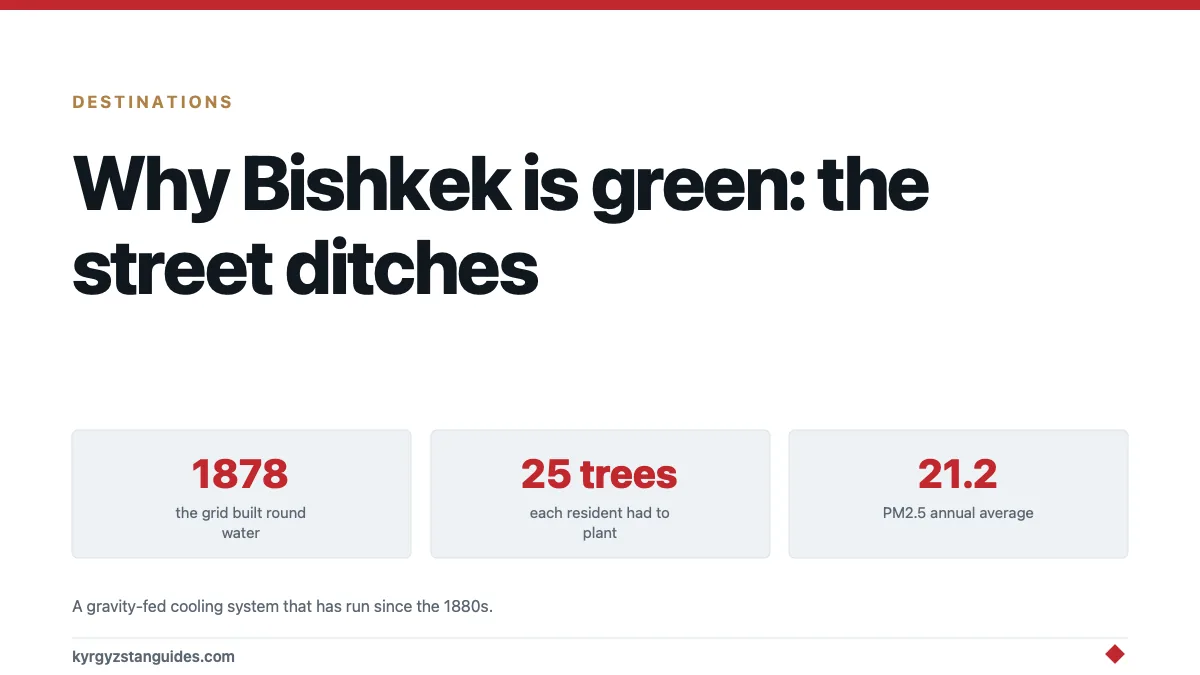
The city plan approved on 31 August 1878 laid out a checkerboard grid, chosen specifically because it suited the arrangement of irrigation ditches and allowed the streets to ventilate. That was the stated reasoning at the time, in a settlement that had begun ten years earlier with fifty families on a post road.
Then came the part that makes the whole thing work. According to the city's own official history, residents were obliged to plant at least 25 trees along the street outside their house.
Not encouraged. Obliged.
The gardener A.N. Fetisov founded the Karagachevaya Grove in 1881, and the transformation from semi-desert to garden city was under way within a generation of the town being founded.
This is unusually well documented for a piece of nineteenth-century urban greening, and it is a complete answer to the question of why a city in a dry plain has elms and poplars over most of its pavements.
What an aryk actually does
Four things at once, which is why removing them causes more trouble than it looks like it should.
Irrigation. The obvious one. Trees on a dry plain need water at the root all summer, and a channel beside every pavement delivers it without pipes, pumps or electricity.
Cooling. Open water evaporating along every street lowers the ambient temperature. Combined with the canopy, the difference between a treed Bishkek street and an open one in August is substantial and immediately noticeable.
Drainage. The same channels take stormwater and meltwater. Soviet planners in Frunze had to deal with excess water as much as scarcity, and the network handles both directions.
Ventilation. The grid was oriented so air moves along the streets. Shade plus moving air plus evaporating water is a passive cooling system designed before anyone had air conditioning to compare it against.
It's a gravity-fed, zero-energy climate system that has been running since the 1880s.
Where it's failing
This is the part worth knowing, because it's happening now.
Development covers channels. New buildings, widened roads and paved forecourts interrupt aryks — a side effect of the construction boom and of the settlements built beyond the city’s edge. A blocked channel kills the trees downstream of it, and the trees are not replaced at anything like the rate they're lost.
Maintenance is unglamorous. Clearing silt and leaves from thousands of kilometres of open ditch is exactly the kind of municipal work that gets deferred.
Water is upstream of everything. The aryks depend on rivers fed by snow and ice. What is happening to Kyrgyzstan's glaciers eventually shows up as less reliable summer flow in a city ditch.
Air quality makes it urgent. Bishkek's winter air is genuinely bad. IQAir has repeatedly listed it among the ten most polluted cities in the world on winter days, and on 23 December 2025 it ranked as the most polluted major city on the planet. The 2024 annual average PM2.5 was 21.2 µg/m³, over four times the WHO guideline; in winter, readings run many times higher again.
The causes are residential coal heating, an old vehicle fleet, and temperature inversions that trap everything in the basin. Mature trees are one of the few local mitigations available, and cutting them for parking is a straightforwardly bad trade.
Tree felling in Bishkek is a live civic argument, and it is one of the few issues that reliably gets people out to protest.
The same idea, older
Bishkek's aryks look like a nineteenth-century Russian colonial invention, and the grid and the planting obligation genuinely were. The technique wasn't.
Gravity-fed open channels distributing mountain meltwater across a dry plain is how the settled parts of Central Asia have worked for a very long time. The oasis cities of the Fergana valley, the irrigated land around Osh, the terraces in the southern valleys. A study of early Soviet Bishkek's growth describes the friction of the period directly: a town trying to establish water infrastructure in a landscape where herders were still moving animals through it, and livestock trampling the new channels.
That tension, a settled irrigation system laid over a pastoral landscape — is roughly the story of northern Kyrgyzstan in miniature, and it's running down both sides of every street in the capital.
What this means when you are there
Mind the ditch. Genuinely. They are open, sometimes deep, often partly covered by a loose slab, and an ankle goes into one very easily at night. This is the most likely minor injury in Bishkek and nobody warns anyone about it.
Do not drink from them. They are irrigation channels carrying surface runoff, not drinking water, whatever they look like. Our note on tap water covers the rest.
Walk the residential streets. The interesting thing about Bishkek isn't its monuments. It is the ordinary streets in the centre, under a continuous canopy, with the water running. Our things to do in Bishkek and three-day itinerary both benefit from an afternoon of nothing but walking.
Summer versus winter is a different city. In July the canopy is the whole experience. In January the trees are bare, the smog sits in the basin, and Bishkek is a much harder place to like. If you have a respiratory condition, this is worth factoring into when you come. Our best time to visit guide covers the seasons generally, but the air is the specific winter problem in the capital.
Look up at the mountains from any north–south street. The grid was laid out on a plain with a 4,000 m wall on one side. That view down the length of a street is free and is the best thing about the city's layout.
Why it's worth a thought
Because it's a rare case of a city solving a climate problem by design and then living off that decision for 150 years.
Somebody in 1878 decided the street grid should follow the water. Somebody made residents plant trees. A gardener established a grove. None of it was expensive, none of it required technology, and the result is a capital that's genuinely pleasant to walk in a climate that gives no help at all.
It also sits oddly against the rest of the country's infrastructure story. Kyrgyzstan's power supply strains every winter and its rail network barely exists. Its capital's cooling system, meanwhile, is a set of ditches that has worked without interruption since before the invention of the aeroplane.
Whether it survives the next thirty years of development is the open question, and it will be decided by whether anyone keeps clearing the channels.
FAQ
What is an aryk?
An open irrigation channel running alongside a street. In Bishkek they carry snowmelt from the Ala-Too mountains and water the street trees.
Why is Bishkek so green?
By design. The 1878 city plan used a grid chosen to suit irrigation ditches and street ventilation, and residents were required to plant at least 25 trees each along their street.
Can you drink the water in Bishkek's aryks?
No. They are irrigation channels carrying surface runoff, not treated drinking water.
Are the aryks dangerous?
They are open channels at pavement edges, sometimes deep and sometimes partly covered. Twisted ankles are common, especially at night, so watch your footing.
Who created Bishkek's tree cover?
The 1878 plan and a tree-planting obligation on residents, with the gardener A.N. Fetisov founding the Karagachevaya Grove in 1881 as an early anchor of the city's greening.
Is Bishkek losing its trees?
Tree loss to development and blocked aryks is a recurring civic controversy, and it matters more than usual because Bishkek has significant winter air pollution and few other local mitigations.