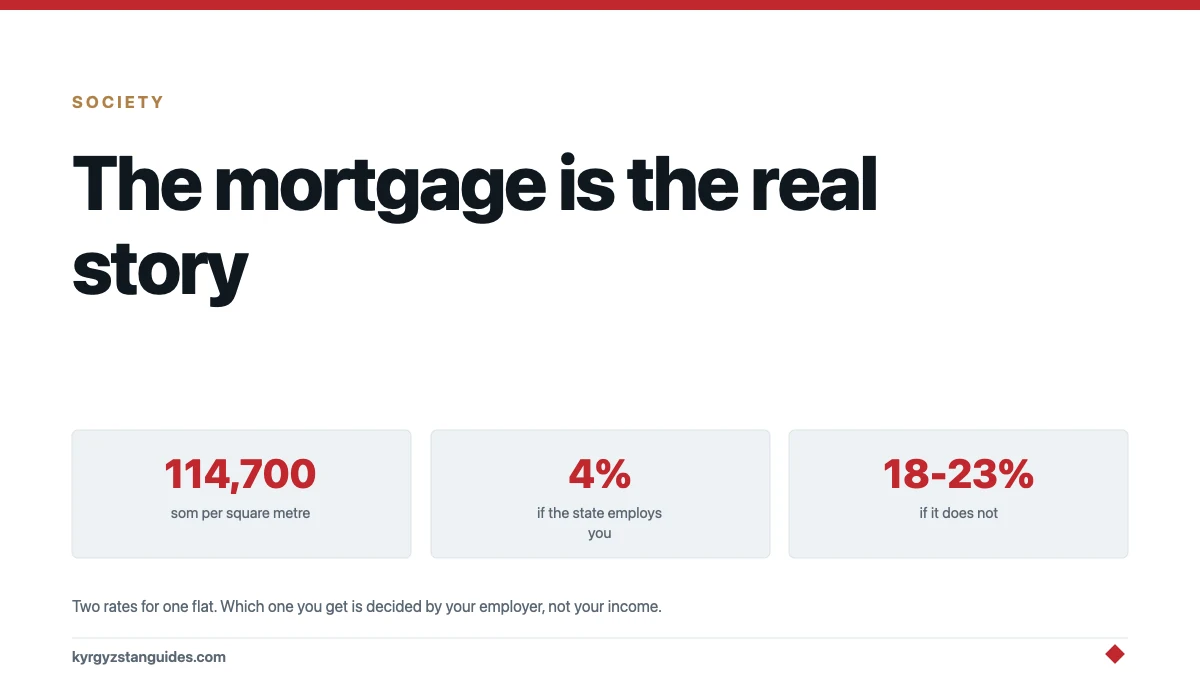
A square metre of Bishkek apartment cost 114,700 som in June 2026 — about $1,300. For a modest two-room flat of 55 square metres that is roughly 6.3 million som, call it $72,000, in a country where the average pension is under $150 a month and a garment worker's piece rate is measured in tens of som per finished shirt.
But the price is not the interesting number. This is:
| Mortgage source | Interest rate |
|---|---|
| State Mortgage Company, social and preferential programmes | 4% |
| State Mortgage Company, "accessible" programme and shared construction | 8% |
| Commercial banks, som loans | 18–23% |
A four per cent state loan and a twenty-one per cent commercial loan are not two prices for the same product. They are two different economies. Which side of that line you fall on is decided by your employer, and that is what actually determines who owns property in Bishkek.
The prices, with the disagreements left in
Kyrgyz property data comes from the state cadastre agency and gets reported by local outlets, and the series disagree depending on which window you take. Here is what each says rather than an average of them.
| Figure | Amount | Source and date |
|---|---|---|
| Bishkek apartments, per m² | 114,700 som (~$1,300) | Economist.kg property index, June 2026 |
| Bishkek apartments, per m² | 113,300 som | 24.kg, May 2026 |
| Bishkek apartments, peak | 126,277 som | December 2025 |
| Bishkek houses, per m² | 195,100 som | June 2026 |
| Alamedin district apartments | 92,900 som | June 2026 |
| Karakol-Aksuu district apartments | 85,300 som | June 2026 |
Two things jump out. Bishkek is the most expensive apartment market in the country, but for houses it was overtaken in June 2026 by Aravan district in the south at 223,400 som per square metre — which tells you something about how thin and lumpy district-level house data is rather than about Aravan being grand.
And the direction of travel differs by property type. Over the year to May 2026, Bishkek apartments rose 6.23 per cent while houses fell 4.15 per cent. Houses were down 19.94 per cent from their January 2026 peak. Earlier in 2026 the comparison looked completely different: February 2026 against February 2025 showed houses up 16.24 per cent and apartments up 30.39 per cent.
Nationally, the state cadastre agency's five-month 2026 report has apartments up 17.2 per cent republic-wide with Osh up 25.2 per cent, and individual houses up 32.12 per cent nationally.
The market is volatile enough that any single percentage is a statement about a window, not a trend. Anyone quoting you one number for "Bishkek property growth" has picked a window.
One thing I could not source: a continuous indexed price series from 2020 to 2026. The cadastre publishes rolling comparisons, not a base-year index. So the much-repeated claim that Bishkek prices spiked specifically because of Russian relocation after 2022 appears in market commentary but I could not attach a verified 2022-specific percentage to it from an official source. I am flagging that rather than repeating it as established.
Rent
Rent data is worse. There is no official series I could find from the statistics committee, the cadastre or the National Bank for Bishkek or Osh rents. What exists is listing sites and cost-of-living journalism.
The usable picture from that: a one-room Bishkek apartment runs roughly 30,000 to 60,000 som a month, with central averages around 47,000 som and out-of-centre averages around 34,000 som. Two-room flats overlap heavily with the top of that range. A deposit of one month's rent is standard, and utilities, internet and building maintenance are usually the tenant's on top of the quoted figure.
Treat those as market indications, not statistics. They come from advertisements, and advertisements are asking prices.
The mortgage split, in detail
The State Mortgage Company runs three tracks, all with terms up to 25 years and no down payment required:
Social mortgage at 4 per cent — families with five or more children, people with disabilities, single parents, young rural specialists under 35.
Preferential mortgage at 4 per cent — public sector employees: government bodies, state enterprises, schools, hospitals.
Accessible mortgage at 8 per cent — private sector workers with at least two years of employment history. Shared construction is also offered at 8 per cent to all citizen categories.
Now the commercial side, as compiled in May 2025: KICB at 18 per cent in som, 12 per cent in dollars, up to ten years. DemirBank 19–23 per cent with a 30 per cent minimum down payment. Mbank 19 per cent for three years then 20 per cent, 30 per cent down. Optima Bank 21 per cent in som. Later listings show broadly the same band, with some promotional rates from 16 to 18 per cent.
Look at what that means in practice. A teacher and a nurse both get 4 per cent with nothing down. A self-employed trader at Dordoi — the person whose sector this economy actually runs on — is looking at 21 per cent with 30 per cent of the purchase price in cash first. On a 6-million-som flat that is 1.8 million som up front before the interest starts.
This is why the state programme, rather than the price per square metre, is the thing to understand. It is also why the private-sector 8 per cent tier requiring two years of documented employment history excludes most of the informal economy by design: you cannot document what was never declared.
Who actually buys
Remittances. Migrant transfers into Kyrgyzstan reached $699.7 million in the first quarter of 2026 alone, of which $629.3 million came from Russia. Estimates of remittances as a share of GDP range from 14 per cent in IFAD's figure to 17.6 per cent in World Bank data for 2024, with some secondary sources quoting higher — the spread is real and I would not pick one.
The state has read the same numbers. Both the State Mortgage Company and commercial banks now build mortgage products specifically for migrants, with remote and electronic applications so that a worker in Russia does not have to fly home to sign. That is a fairly direct admission of where apartment money comes from.
What nobody publishes is the cash-versus-mortgage split of purchases. I looked; no official source gives it.
The Soviet stock, and the earthquake question
Bishkek's older housing is Stalinka blocks from the 1950s and Khrushchyovka blocks from the 1950s to 1970s. Officially these are described as having exhausted their service life and as not seismically resistant, which is the stated justification for a renovation and demolition programme.
There is a real argument here, and both sides deserve stating. Critics of the programme point out that the technical condition of many of these buildings is in fact satisfactory, and that what they mostly are is valuable central land suitable for high-rise redevelopment. Some genuinely are in poor condition — damp-damaged walls, bricks falling out of two- and three-storey blocks and former dormitories.
The uncomfortable finding from a seismic investigation by RFE/RL's Kyrgyz service is broader than the Soviet stock: it proved difficult to identify even one multi-storey residential building in Bishkek that would reliably withstand a strong earthquake, and buildings generally assumed to be the sturdiest may not be. Bishkek sits near the Issyk-Ata fault. Our post on earthquakes in Kyrgyzstan covers the geology.
I could not find an official figure for what share of Bishkek's housing stock is Soviet-built, which would be a useful number and does not appear to be published.
The illegal-building problem
Between January and July 2025, more than 6,300 structures were demolished nationally in a crackdown on illegal construction, freeing 80,859 square metres of municipal land. That figure came to me through news aggregation rather than a single document I could re-open, so I would treat the precise number as reported rather than confirmed.
What is well documented is the buyer warning. The State Construction Agency publicly told citizens not to buy apartments in 38 identified illegal residential complexes in Bishkek, out of 224 buildings nationwide recognised as illegal, pending court rulings. From 2025 the construction ministry began working through these "problem" buildings, with a promise that residents would be rehoused in replacement buildings on adjacent land.
If you are ever tempted to buy property here, that blacklist is the first document to read, and it is public.
Utilities, which are rising faster than rent
Heating tariffs for households rose 25 per cent from 1 June 2024, and hot water by 39.3 per cent. Further rises of 25 per cent were proposed for 2025, with some draft proposals reaching 25, 50 and 75 per cent for different consumption bands. New heating and hot water tariffs took effect on 1 March 2026 under an energy ministry order, structured in two tiers with a social norm set at 80 square metres per household.
The justification offered is infrastructure: Bishkek's municipal heat utility reports pipeline wear of 76 per cent.
A total monthly utility bill in som for a typical Bishkek apartment is another figure I could not source reliably, which is frustrating because it is exactly what someone moving here would want.
FAQ
How much does an apartment cost in Bishkek?
About 114,700 som per square metre as of June 2026, roughly $1,300, making a 55-square-metre two-room flat around 6.3 million som or $72,000. Outlying districts are cheaper — Alamedin averaged 92,900 som per square metre in the same month.
What are mortgage rates in Kyrgyzstan?
Two entirely different markets. The State Mortgage Company lends at 4 per cent to public sector employees and priority social categories and 8 per cent to private sector workers with two years of employment history, both with no down payment and terms to 25 years. Commercial banks charge 18–23 per cent in som and typically require 30 per cent down.
How much is rent in Bishkek?
Roughly 30,000 to 60,000 som a month for a one-room apartment, averaging around 47,000 som in the centre and 34,000 som further out, plus utilities and a one-month deposit. There is no official rent statistic for Kyrgyzstan, so these come from listings rather than from government data.
Can foreigners buy property in Kyrgyzstan?
Foreigners can buy apartments and buildings, but not agricultural land, which by law can only be owned outright by Kyrgyz citizens and domestic entities. Our post on Kyrgyz farmland covers the land rules in detail.
Are Bishkek apartment buildings earthquake-safe?
Soviet-era Stalinka and Khrushchyovka blocks are officially classed as not seismically resistant, though critics of the demolition programme argue many are structurally sound and that the real driver is the land value. A seismic investigation by RFE/RL's Kyrgyz service found it hard to identify any multi-storey residential building in Bishkek that would reliably survive a strong earthquake.
How do I check whether a Bishkek apartment is legally built?
The State Construction Agency publishes a list of buildings recognised as illegally constructed and has publicly warned against buying in 38 named Bishkek complexes, out of 224 nationwide. That list is the first thing to check, before price or location.
Why are Bishkek utility bills rising so fast?
Heating tariffs rose 25 per cent in June 2024 and hot water 39.3 per cent, with further increases from 1 March 2026 under a two-tier structure with a social norm of 80 square metres. The stated reason is infrastructure decay — the municipal heat utility puts its pipeline wear at 76 per cent.