There is a building on the shore at Cholpon-Ata shaped like an ocean liner. It has a prow, decks and portholes, and it's nowhere near an ocean. This is the Aurora, and during the Soviet period it was run by the administration of the Central Committee of the Communist Party, an elite resort for people who mattered, built in the shape of a white steamship on a lake at 1,600 metres.
You can book a room there now. This is the strange gift the Soviet Union left to Kyrgyz tourism: a stock of health resorts, some crumbling and some still functioning, running treatment protocols written decades ago, for prices that have nothing to do with what they look like.
What a sanatorium actually is
Not a hotel. Not a spa. The distinction matters or you will book the wrong thing and be annoyed.
The Soviet system held that every worker had a right to rest and medical recovery at a state resort. Trade unions and ministries allocated places by putyovka, a voucher assigning a named person to a named sanatorium for a fixed course, usually fourteen or twenty-one days.
You arrived, a doctor examined you, and you were prescribed a schedule: mineral baths at this hour, mud application at that one, inhalations, massage, electrotherapy, mealtimes fixed, lights out enforced. It was medicine organised as a holiday, or a holiday organised as medicine, depending on your view.
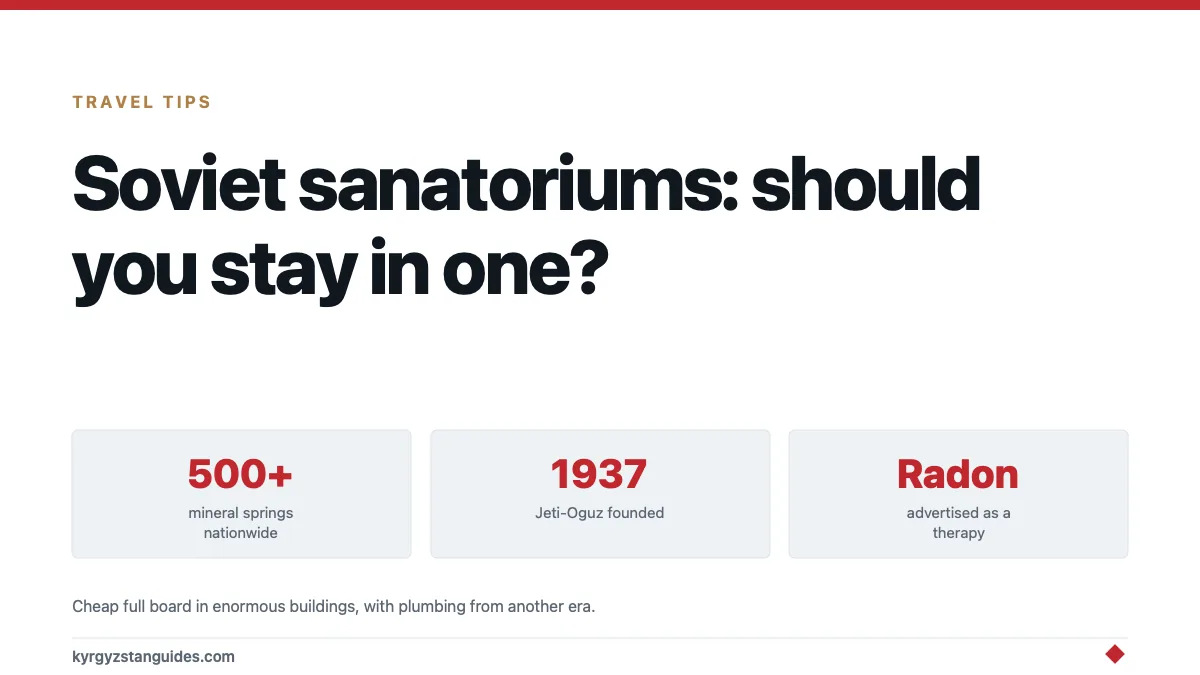
Kyrgyzstan got a lot of them. The republic has over 500 mineral springs plus significant mud deposits around Issyk-Kul, which in the logic of that system made it premium territory.
The ones still running
Jeti-Oguz — founded in 1937 according to the resort's own history, and one of the last genuinely Soviet-era sanatoriums still operating. Its springs combine hot mineral water with hydrogen sulphide and radon. Open year-round since 1965, which in a mountain valley is a commitment. The setting, below the red sandstone formations of the Jeti-Oguz valley, is better than anything the architecture achieves.
Aurora, Cholpon-Ata — the steamship. The most comfortable of the surviving big sanatoriums and the one most successfully converted toward ordinary tourism. It sits in the middle of Cholpon-Ata, the lake's main resort town.
Tamga. On the quieter south shore, a former military sanatorium in a village that is now one of the more pleasant places to slow down on the lake.
Issyk-Ata — not on Issyk-Kul at all, despite the name, but in a gorge north of the Chuy valley within reach of Bishkek. The Issyk-Ata gorge springs have been used for a very long time; there is a rock-carved Buddha nearby that predates all of this by roughly a thousand years.
The radon question
Several Kyrgyz sanatoriums, Jeti-Oguz included, advertise radon water as a therapeutic feature. This needs saying plainly, because Western visitors are often startled by it.
Radon is a radioactive gas and a known cause of lung cancer with prolonged exposure. Radon balneotherapy, bathing in or inhaling low-concentration radon water, is nonetheless a long-established treatment across the former Soviet bloc and parts of Central Europe, prescribed mainly for joint and inflammatory conditions.
The evidence base is contested. Some trials report symptomatic benefit for rheumatic conditions; regulatory bodies in most Western countries don't recognise it as a therapy, and the WHO's position on radon is concerned with reducing exposure rather than prescribing it.
Our view, for what it's worth: a short course of radon bathing isn't the risk that living in a radon-affected house is. But if you are pregnant, or you simply do not want the exposure, say so and take the ordinary mineral baths instead. Nobody will find the request strange.
Should you stay in one?
Depends entirely on what you want.
Stay in one if you find Soviet architecture and institutional design genuinely interesting, you want to be near hot springs, you like the idea of very cheap full board in a large odd building, or you want to see a functioning piece of a system that has vanished nearly everywhere else.
Don't stay in one if you want a boutique hotel, reliable hot water in every room, English-speaking reception, or flexibility about mealtimes. Many of these buildings have had minimal capital investment since 1991 and it shows in the plumbing before anywhere else.
Practical notes:
Book the room, not the course. Most now accept guests for accommodation only. If you want treatments, you buy them separately, and some still require a doctor's consultation on arrival.
Bring your own towel and flip-flops. Assume communal wet areas are exactly as communal as they look.
Russian helps enormously. English is uncommon at the older facilities. A few phrases and a translation app will do.
The food is the food. Full board at a sanatorium means a fixed canteen menu at fixed hours, designed decades ago around dietary theory rather than pleasure. It is fine. It isn't why you came.
Check the season. Several close or reduce service outside summer. Jeti-Oguz is a notable exception.
What makes them worth seeing anyway
Across the former USSR this building stock is mostly ruins. Tskaltubo in Georgia is the famous case, magnificent, abandoned, and by now thoroughly photographed by every visiting photographer with a wide lens.
Kyrgyzstan's are, in a good number of cases, still open. Still admitting patients, still running the schedule, still serving the canteen lunch at the appointed hour. That is a much rarer thing to see than a ruin, and considerably harder to photograph well, because a working institution does not perform its own decline for you.
If you're around the lake anyway, and our Issyk-Kul accommodation guide has you weighing up options, one night in a sanatorium is a better story than one more guesthouse.
FAQ
What is a Soviet sanatorium?
A state health resort where workers were sent by voucher for a prescribed course of treatment, typically 14 or 21 days, combining mineral baths, mud therapy and other treatments with fixed meals and a fixed daily schedule.
Can tourists stay in Kyrgyz sanatoriums?
Yes. Most now take ordinary guests for accommodation, with treatments bought separately. Some still require a doctor's consultation before prescribing specific therapies.
Which sanatoriums in Kyrgyzstan are still open?
Jeti-Oguz (founded 1937, open year-round since 1965), Aurora at Cholpon-Ata, Tamga on the southern shore of Issyk-Kul, and Issyk-Ata in the Chuy valley, among others.
Is radon therapy at Kyrgyz sanatoriums safe?
Radon is a radioactive gas linked to lung cancer with long-term exposure, and radon balneotherapy is not recognised as a treatment in most Western countries. A short course is low-risk, but you can ask for ordinary mineral baths instead.
How much does a Kyrgyz sanatorium cost?
Far less than a comparable hotel, often with full board included. Prices vary widely by facility and season, so confirm directly rather than relying on listings.
Why does Kyrgyzstan have so many sanatoriums?
More than 500 mineral springs and substantial mud deposits around Issyk-Kul made the republic a premium destination within the Soviet health-resort network, and a large amount was built here as a result.
The same pattern of unmarked, unprotected Soviet-era work runs through the city itself: see Bishkek’s Soviet mosaics, eleven catalogued panels and one that was destroyed in 2025 while still on the register.
For the buildings themselves, with their architects and dates, see our Soviet architecture walk through Bishkek.
Twenty kilometres east of Bishkek, Kant has a cement works that opened a new line in 2025 and a Russian air base that has been there since 2003.