There is no single best place to stay on Issyk-Kul, because there are really three different lakes wearing one name. The north shore around Cholpon-Ata is a Soviet-flavored beach resort strip. The south shore is a string of quiet villages with family guesthouses and yurt camps. And Karakol, off the lake’s eastern tip, is a mountain town that treats the water as an afterthought. Pick the wrong one for your travel style and you'll spend your holiday in marshrutkas correcting the mistake.
Our quick answer: beach holiday with kids or nightlife, stay in Cholpon-Ata. Scenery, culture, and calm, base yourself on the south shore around Bokonbaevo or Tamga. Trekking, stay in Karakol. Bucket-list yurt night, book a south-shore camp for one or two nights rather than your whole stay. Budget travelers fit in everywhere except the resort strip in August.
Cholpon-Ata and the north shore: the resort strip
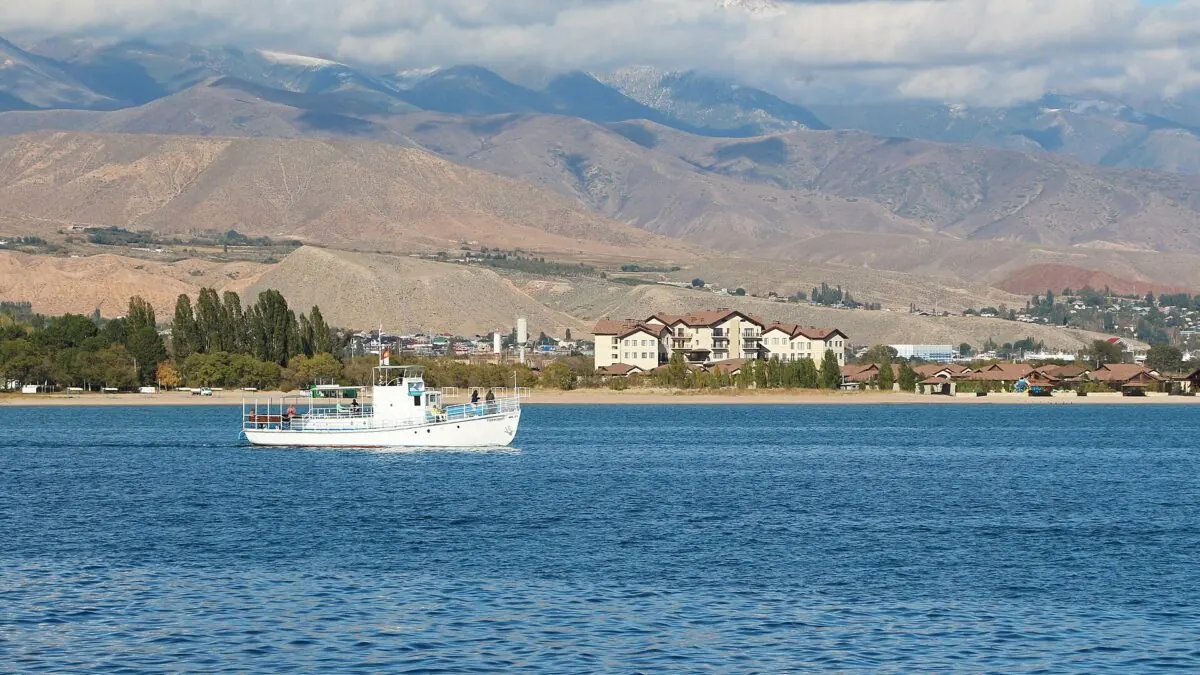
Cholpon-Ata is where Kyrgyzstan and Kazakhstan go on holiday. The town and the villages either side of it (Bosteri, Chok-Tal, Sary-Oi) hold most of the lake’s sanatoriums, resort complexes, water parks, and organized beaches. In July and August it's busy, loud, and fun in a very specific post-Soviet seaside way: pedal boats, shashlyk smoke, karaoke drifting down the beach after dark.
Accommodation runs from crumbling sanatoriums with faded grandeur to modern resorts with pools and private beaches. Expect roughly $50-120 per night for resort rooms in season, $25-45 for the many small hotels and private “otdykh” guesthouses a few streets back from the water. Outside July-August, prices drop hard and much of the strip simply closes.
Stay here if warm-water swimming and infrastructure matter more than scenery. Skip it if you came to Kyrgyzstan for mountains and silence; the north shore’s backdrop is pleasant but the whole strip faces away from the country’s best landscapes.
The south shore: guesthouses and empty beaches
The south shore is the one we would book for most independent travelers. The road from Balykchy to Karakol passes through a string of low-key villages, and the best bases are Bokonbaevo, Tamga, Tosor, and Kaji-Say. Beaches are emptier, the red rock scenery is better, and you're close to Skazka canyon, the Fairy Tale-esque badlands that justify a stay on this side by themselves.
Lodging here means family guesthouses, typically $25-40 for a double with breakfast, often with dinner available for a few hundred som more. Standards vary from basic rooms with shared bathrooms to genuinely comfortable purpose-built guest wings. The trade-off is infrastructure: restaurants are few, ATMs are unreliable, and evening entertainment is the sunset. We consider that a feature, but it is an honest limitation if you're traveling with teenagers or expect to eat out nightly.
Bokonbaevo
The south shore’s main town and its most useful base. It has the widest guesthouse choice, a bazaar, a couple of proper cafes, and a community-based tourism office that arranges eagle hunter demonstrations, felt workshops, and yurt stays. The catch: the town itself sits a few kilometers back from the water, so you are driving or taxiing to the beach.
Tamga and Tosor
Two quiet villages with the best access to good sand and clear water. Tamga has a historic Soviet military sanatorium, a handful of well-run guesthouses, and tree-lined lanes that feel almost Mediterranean in late summer. Tosor is smaller still, with a beach that stays uncrowded even in August and a couple of yurt camps nearby. Bring cash from Karakol or Bokonbaevo; banking here's theoretical.
Kaji-Say
A former uranium-mining settlement turned low-budget beach town, popular with Kyrgyz families. It has more small guesthouses and holiday cottages than Tamga, slightly more services, and marginally less charm. A fair compromise if everything else is full.
Karakol: the trekking base that happens to be near a lake
Karakol sits about 12 kilometers from the water, so it isn't a beach base at all. It's, however, the obvious headquarters for everything in the eastern mountains: Ala-Kul, Altyn-Arashan, and the Jeti-Oguz valley are all staged from here. The town has the lake region’s best hostels ($8-12 dorm beds), its best cafes, functioning ATMs, and gear rental, plus a interesting food scene built on Dungan and Uyghur cooking.
If your Issyk-Kul plan is really a trekking plan with rest days, stay here and treat the lake as a day trip. Our full Karakol guide covers the town in detail. If your plan is beaches with one hike thrown in, base on the south shore instead and accept a long day for anything alpine.
Yurt camps: one or two nights, not a week
Several proper yurt camps operate along the south shore, mostly between Bokonbaevo and Tosor, with beds in shared or private yurts for around $15-22 per person including meals. Lakeside yurt camps are more comfortable than the high-pasture versions, with real mattresses and sometimes hot showers, which makes them a gentle introduction to the format. We think one or two nights is the sweet spot; after that the novelty fades and a guesthouse bed wins. For what to expect inside, from felt walls to toilet arrangements, see our yurt stay guide.
What it costs by tier
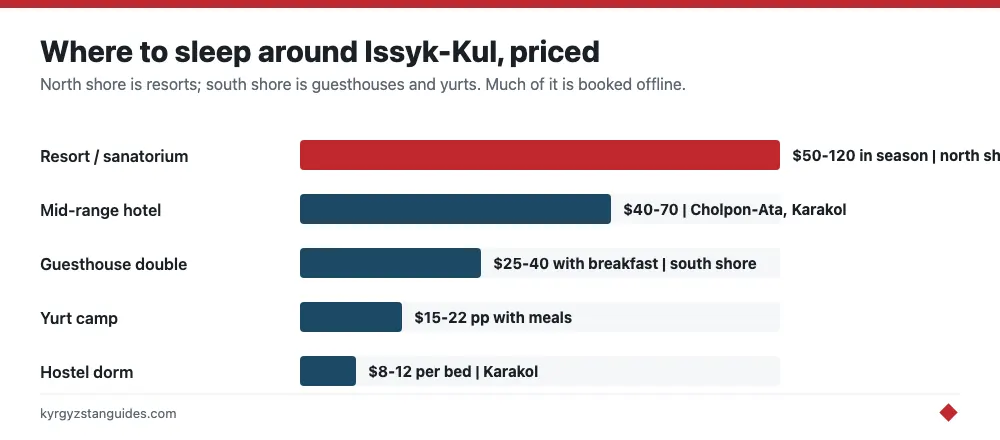
| Tier | Typical price | Where you find it |
|---|---|---|
| Hostel dorm | $8-12 per bed | Karakol, a little in Cholpon-Ata |
| Family guesthouse double | $25-40 with breakfast | South shore, Karakol |
| Yurt camp | $15-22 per person with meals | South shore |
| Mid-range hotel | $40-70 | Cholpon-Ata, Karakol |
| Resort / sanatorium | $50-120 in season | North shore strip |
Figures are high-season ranges and drop 30-50 percent outside July-August, when they are negotiable on arrival. For how lodging fits into overall daily spending, our Kyrgyzstan budget breakdown runs the full numbers.
Booking reality: much of the lake is offline
This is the part most planning guides gloss over. Booking.com and Airbnb cover Cholpon-Ata and Karakol reasonably well, but south-shore coverage is thin and often out of date. Many of the best guesthouses take bookings only by phone or WhatsApp, some list no availability online yet always seem to have rooms, and yurt camps frequently exist only as an Instagram page.
Practical consequences: book your first night or two online for peace of mind, then arrange the rest on the ground. Community-based tourism offices in Bokonbaevo and Karakol will call ahead for you, drivers know which houses take guests, and simply showing up in a south-shore village and asking works far more often than travelers raised on booking apps expect. The exception is late July through mid-August, when the north shore sells out and even south-shore camps fill on weekends; book that window ahead. Cash is essential everywhere; almost nobody outside the resorts takes cards.
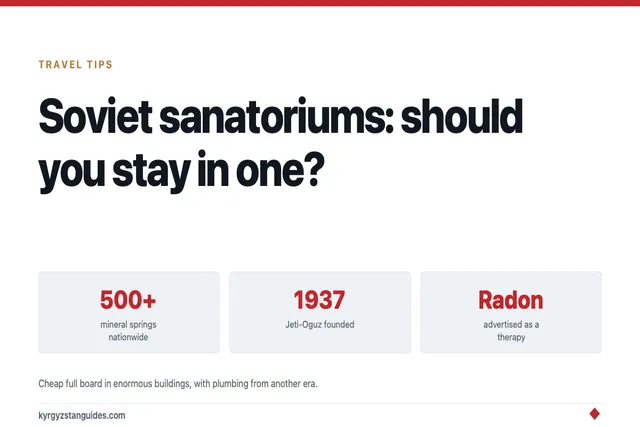
Sanatoriums are their own bureaucratic universe. Many still sell multi-day “putevka” packages with meals and treatments included, list prices only in Russian, and answer only by phone. If you want the full retro experience, ask a Russian-speaking hotel receptionist or a local fixer to call for you; the online presence of even famous complexes can be a single dead webpage.
Mistakes we keep seeing
First: booking seven nights in one Cholpon-Ata resort, then discovering that everything you actually came for, from red canyons to trailheads, is two to four hours away. Second: assuming the lake is warm; even in August the water is bracing outside sheltered northern bays, and in June it's a dare. Third: treating the south shore as a day trip from the north, which wastes four-plus hours of driving and completely misses the reason to be there, namely the evenings and unhurried mornings. Fourth: arriving in September and expecting the resort strip to be functioning; the season ends abruptly, and by mid-month many north-shore kitchens have closed, while guesthouses in the villages and Karakol are still happily open with the crowds gone.
Which shore suits which traveler
- Families with young kids: Cholpon-Ata or Bosteri for warm shallow beaches and food options.
- Couples after scenery and quiet: Tamga or Tosor guesthouse, with a Skazka sunset trip.
- Trekkers: Karakol.
- Culture-first travelers: Bokonbaevo for eagle hunters, felt workshops, and yurt camps.
- Budget backpackers: Karakol dorms, hitching and guesthouses along the south shore.
- Nostalgia hunters: a north-shore sanatorium, booked with sober expectations.
However you split your nights, remember distances: the lake is 180 kilometers long, and moving between the shores eats half a day. Two bases beat four.
FAQ
Do you need to book Issyk-Kul accommodation in advance?
Only for late July to mid-August, and only really on the north shore. The rest of the season, booking a night or two ahead by phone or WhatsApp is plenty, and walk-ins succeed in most villages.
Which side of Issyk-Kul has better beaches?
The north shore has the developed, warmer, busier beaches. The south shore has emptier and wilder ones, with coarser sand and fewer facilities. For pure swimming comfort, north; for the view from your towel, south.
Is Cholpon-Ata worth it outside summer?
Mostly no. From October to May much of the strip closes, the lake is too cold to swim, and the town feels half-asleep. The petroglyph field and the Ruh-Ordo complex still open, but they are a stop, not a stay.
Can you stay in a yurt right on the lakeshore?
Yes. Several south-shore camps sit within walking distance of the water, mainly between Bokonbaevo and Tosor. Expect around $15-22 per person with meals, shared bathrooms, and cold nights even in July; bring a warm layer.
How many nights do you need at Issyk-Kul?
Three to five covers it for most trips: one or two on the south shore, a yurt night, and either beach time in Cholpon-Ata or trail time from Karakol. A full week only makes sense if you are treating the lake as a rest stop between treks.