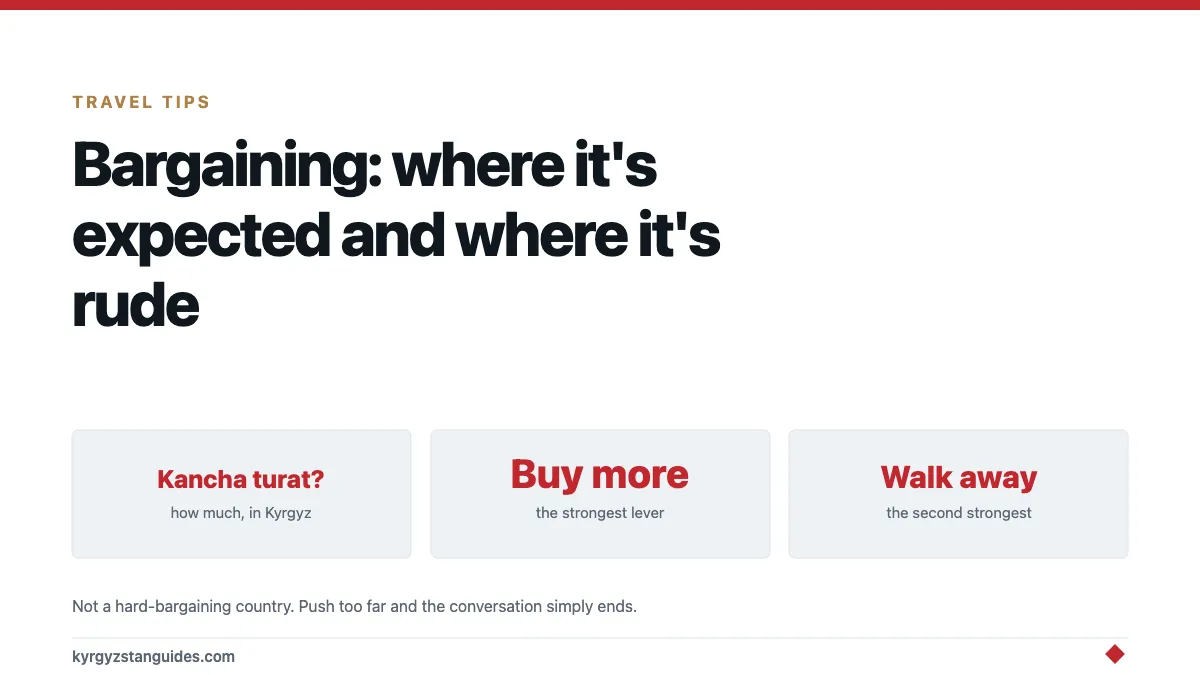
Kyrgyzstan isn't a hard-bargaining country. Prices at a bazaar have some give in them, there is no theatrical haggling culture of the kind you meet in a Turkish carpet shop, and a great many stalls now simply display a price and mean it — though a receipt is another matter, for reasons that reach the President’s office. Push too hard and you will not get a better deal — you will get a seller who has decided the conversation is over.
The single most useful phrase is kancha turat? — how much? Sellers notice the effort, and it changes the tone of everything that follows.
Where to bargain, and where not to
This is the part visitors get wrong in both directions.
Bazaars: yes, gently. Osh Bazaar in Bishkek, the markets in Osh and Karakol, the dried-fruit and souvenir rows. There is room, and some back-and-forth is normal.
Fixed-price craft shops and galleries: no. Places like CACSA and TUMAR in Bishkek operate on set prices, and haggling there is about as appropriate as haggling in a bookshop. These shops generally pay makers better and guarantee quality, which is what you're paying the difference for.
Food, transport and services: essentially no. A bag of samsy, a plate in a cafe, a marshrutka fare — these have prices and you pay them. Our marshrutka guide covers the fares.
Taxis: a different thing. Agreeing a price before you get in is not haggling, it's the transaction. Use Yandex Go in the cities and the question disappears entirely.
Guesthouses and homestays: no. CBT rates are standardised and the family isn't making much on them. Our CBT guide explains how the network prices things.
How it actually goes
Softer and shorter than you may be expecting.
Ask the price. Look at the thing properly. Make a counter-offer somewhere below, and expect to land between the two. The realistic movement on a souvenir is modest — this isn't a market where the opening figure is triple the real one.
Buying more gets you more. Two shyrdak cushions, a kilo of dried apricots and a jar of honey from the same seller will get a bundled price that individual haggling won't. This is the most effective lever available and the one most travellers ignore.
Walking away works, and it's the strongest move you have. If the price is genuinely achievable the seller will call you back. If they don't, it wasn't.
Cash only. Card terminals are rare at bazaars, as our paying in Kyrgyzstan guide explains. Have small notes.
Why it's softer here than next door
Worth knowing if you're travelling the region, because the expectations aren't the same across Central Asia.
Uzbekistan's bazaars (Samarkand, Bukhara, the tourist-facing parts of Tashkent) have a longer and more developed haggling culture, built on centuries of being a trading destination with visitors to sell to. Turkey's is more developed still. Both reward persistence in a way Kyrgyzstan does not.
Kyrgyzstan came to tourism late and came to settled trade later than its neighbours. The bazaar here is primarily where local people buy vegetables, not a stage for negotiating with foreigners. A seller at Osh Bazaar spends most of the day selling potatoes at the price potatoes cost.
So the culture you are stepping into is closer to a market at home than to a souk. That is why the opening figure is usually within sight of the real one, and why treating it as theatre lands badly.
Our comparison of Kyrgyzstan and Uzbekistan covers the broader differences between travelling in the two.
Tone is the whole thing
Aggressive haggling reads badly here. It isn't seen as sport.
Keep it friendly and keep it brief. Smile, make the offer, accept or walk. A seller who feels they are being ground down will simply stop engaging, and you'll have lost both the item and the exchange.
The register to aim for is closer to a polite negotiation between two people who both want the transaction than to a contest. Kyrgyz commercial culture isn't adversarial, and treating it as if it were marks you out immediately.
What things should roughly cost
Having a number in your head is worth more than any technique, because you cannot judge an offer without one.
| Item | Rough bazaar price |
|---|---|
| Kurut, per ball | 10–20 KGS |
| Samsy, each | 40–70 KGS |
| Lepyoshka bread | Very cheap, by the piece |
| White honey, per kilo | 600–900 KGS |
| Ak-kalpak hat | 400–1,500+ KGS |
| Small shyrdak mat or cushion | 3,500–7,000 KGS |
| Mid-size shyrdak carpet | 12,000–25,000 KGS |
| Felt slippers, toys | 150–900 KGS |
Our souvenirs guide has the fuller picture, and the white honey guide covers how to tell good honey from a sugar paste, which matters more than the price you pay for it.
The thing worth remembering
You're usually arguing about very little money.
A hundred som is roughly a dollar. Grinding a seller down by two hundred som on a felt carpet that took someone a week to make is a poor trade — for you, in dignity, and for them, in income. The traveller who pays the asking price cheerfully and buys a second item is remembered better than the one who saved four dollars.
That isn't an argument for being careless. It's an argument for knowing the rough price, making one reasonable counter-offer, and then deciding whether you want the thing.
Where prices are genuinely inflated
Being fair: there are places where the first figure is aimed squarely at tourists.
Souvenir stalls immediately outside major sites. Vendors who approach you rather than waiting to be approached. Anything sold near a tour-bus stop. In those settings the opening price may be well above the bazaar rate, and a firmer counter is reasonable.
That is a different situation from a woman selling her own felt work at Osh Bazaar, and the difference is worth reading before you decide how hard to push. Our scams guide covers the small number of genuine tourist traps here, which is a short list by regional standards.
FAQ
Is bargaining expected in Kyrgyzstan?
At bazaars, yes, but gently and briefly. Fixed-price craft shops, cafes, marshrutkas, guesthouses and CBT homestays all have set prices and haggling there is inappropriate.
How much can you bargain down in a Kyrgyz bazaar?
Not dramatically. This isn't a market where opening prices are triple the real value. Expect modest movement, and get better results by buying several items from the same seller than by pushing hard on one.
How do you ask the price in Kyrgyz?
Kancha turat?, how much? Sellers appreciate the effort and it noticeably changes the tone of the exchange, even if the rest happens in Russian or gestures.
Is it rude to haggle in Kyrgyzstan?
Aggressive haggling is. Kyrgyz commercial culture isn't adversarial, and a seller who feels ground down will disengage rather than counter. Keep it friendly, make one reasonable offer, and accept or walk.
Can I pay by card at a bazaar?
No. Card terminals are rare outside fixed-price shops. Bring som in small denominations — a 5,000 note at a stall is a problem rather than a payment.
Where should I not bargain at all?
Fixed-price galleries like CACSA and TUMAR, food and cafes, marshrutka fares, guesthouse and CBT homestay rates, and anything where a price is displayed. Agreeing a taxi fare in advance isn't haggling, it's the normal transaction.