Ride a marshrutka once and Kyrgyzstan opens up; stand baffled at a bus station and it stays closed. The marshrutka — a battered shared minibus, usually a Mercedes Sprinter or an old Soviet van — is the country’s real transport network, the thing that connects cities, towns, and villages for a handful of som. The system is simple once decoded: minibuses run fixed routes, leave when full rather than on a schedule, cost very little, and you pay the driver in cash. Learn that rhythm and you can go almost anywhere.
The confusion for newcomers is that almost nothing is written down in English, and often nothing is written at all. There’s no app that ties it together, no printed timetable, and route numbers that mean nothing until you know the city. This guide strips it back to how the system actually behaves, so you can walk up to a rank and read it. For how marshrutkas fit alongside taxis, flights, and rentals, our broader getting around Kyrgyzstan guide zooms out.
What a Marshrutka Actually Is
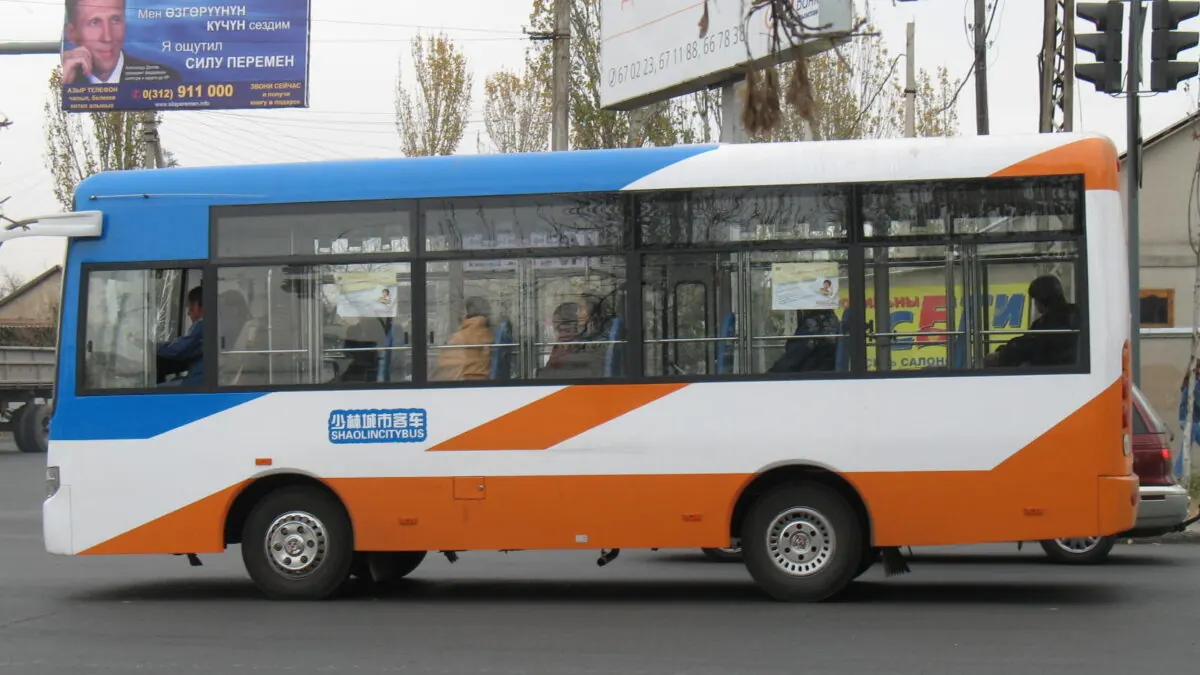
A marshrutka (from the Russian for “routed taxi”) is a shared minibus running a set route for a fixed, cheap fare. Within a city it works like a bus that stops on demand: you flag it down, ride, and call out when you want off. Between towns it works more like a shared long-distance van: it parks at a station, fills with passengers, and departs only once the seats are taken. Same word, two slightly different animals — city marshrutkas keep rough loops all day, while intercity ones leave when full and won’t budge before.
Finding the Right One
For intercity travel, head to the relevant bus station — Bishkek has a couple, and services east to Issyk-Kul and Karakol now leave from the municipal Bishkek Bus Station at Alma-Atinskaya 1/1, since the old Western Bus Station (Zapadnyi Avtovokzal) closed in October 2024; the note at the end of this guide has the details. The destination is usually painted or propped in the windscreen in Cyrillic, so learn to read a few place names in Russian script; “Каракол” is Karakol, “Ош” is Osh. If you can’t read it, just say the town name aloud to drivers and station hawkers. They will physically point you to the right van, because filling seats is their job.
Within a city, marshrutkas show a route number and a list of streets in the front window. Locals or your guesthouse can tell you which number runs your way; once you know it, you flag that number from the roadside like a bus. When in doubt, ask — Kyrgyz travelers are used to helping foreigners onto the right minibus, and a place name plus a raised eyebrow gets you a long way.
Paying
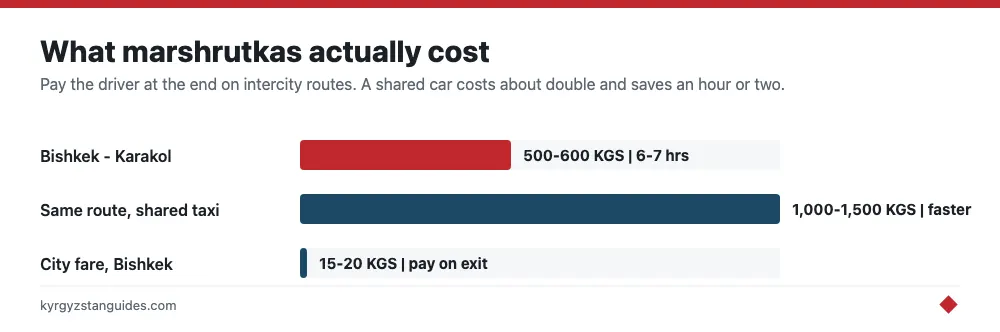
Cash only, small notes. In a city marshrutka you typically pay as you get on or as you leave, passing the fare forward hand to hand if you’re seated at the back — that chain of strangers relaying your coins to the driver is completely normal, so don’t be shy about it. City fares are tiny, on the order of 15-20 KGS. On intercity routes you usually pay the driver at the end, and fares still run cheap: Bishkek to Karakol is around 500-600 KGS, Bishkek to Kochkor around 250-300. Carry change, because a driver juggling a full van rarely wants to break a 1,000-som note.
Etiquette and Survival
A few unwritten rules smooth the ride. Give up your seat, or at least shuffle, for elderly passengers and mothers with children — it’s expected. Keep bags on your lap or under your feet in a packed van; there’s no luggage hold, and a big pack may cost you an extra seat’s fare on a long haul, which is fair and worth paying if you’re tall. To get off a city marshrutka, call out “ostanovite” (stop) or the nearer-universal “na ostanovke” near a stop, and the driver pulls over.
Comfort isn't the marshrutka’s strong suit. They fill beyond what looks possible, legroom is minimal, and windows may or may not open. On long routes, use the bathroom before you board and go easy on water. Stops are at the driver’s discretion. None of this is dangerous, just cozy; treat it as part of the experience rather than a problem to solve.
The Main Routes
Most travelers’ marshrutka miles fall on a handful of corridors. Bishkek to Karakol along the north shore of Issyk-Kul is the classic, around 6-7 hours and 500-600 KGS. Bishkek to Kochkor, the gateway to Song-Kul and Naryn, is a shorter 2.5-hour hop. Bishkek to Cholpon-Ata serves the lake’s resort strip. The long Bishkek-Osh run over the mountains exists by marshrutka too, but at 11-13 grinding hours most people fly that one instead. Shorter local links — Karakol out to Jeti-Oguz or Altyn-Arashan’s trailhead, Osh to the Uzbek border — fill in the map.
Marshrutka vs Shared Taxi
At every intercity station the marshrutkas share a lot with shared taxis — cars, usually sedans, that also leave when their four seats fill. The trade-off is consistent: the taxi costs roughly two to three times the marshrutka fare but is faster, less cramped, and skips the endless roadside pickups. On the Karakol run, that’s maybe 500-600 KGS in a minibus versus 1,000-1,500 in a shared car.
Our rule of thumb: take the marshrutka when you’re watching money or the route is short, and pay up for the shared taxi when the leg is long, you’re tall, or you simply want to arrive with your patience intact. Two or more travelers can also buy out a shared taxi’s seats and leave at once instead of waiting for it to fill — a small luxury for not much money.
The One Thing to Remember
If you take a single habit from this guide, make it this: go in the morning. Marshrutkas leave when full, and vans fill fastest early, so a morning traveler waits minutes while an afternoon one can wait an hour for the last seats, or find the day’s services have dried up entirely. Turn up at the station by mid-morning with small notes, the destination ready to say aloud, and a bit of patience, and Kyrgyzstan’s whole network is yours for the price of a coffee back home.
Bishkek's published fares, and the ones that are not published
The city sets tariffs and publishes them, which is more than most travellers realise. Bishkek city hall's own table gives 17 som for a bus, 20 som for a small-class bus, and 20 som on buses and trolleybuses with validators when paying cash. A monthly card is 1,020 som and a student one 360 som. Old-age pensioners, disability groups I to III, children under seven and postal workers on duty travel free.
What the official table does not list is a marshrutka fare. News reporting of an earlier tariff decision gives marshrutkas at 21 som on the 06:00-20:30 daytime rate and 32 som at night, with some express routes at 22 or 32. Those figures and the city's own table do not reconcile. Carry small notes and expect to pay what the driver asks, in the 20-35 som range.
City buses are a different matter. Cash was abolished on Bishkek buses and electric buses on 1 July 2026, approved by the city council the day before. The validator takes a Tulpar transport card, a student or municipal card, a Visa, Mastercard or Elkard tapped directly, or a QR code scanned in a banking app. A contactless bank card is the simplest answer for a visitor; a Tulpar card costs 60 som from the driver and includes a ride. Our guide to Bishkek bus routes covers the detail, including why only Tulpar earns the free transfers.
The trolleybuses are gone, and the reason given did not hold
If you have an older guidebook describing Bishkek's trolleybus network, delete that chapter. The system was abolished entirely at the end of 2024. At closure it ran 11 routes with 616 employees and a fleet variously reported at 152 or 179 vehicles depending on the source.
The city's initial justification was that the Asian Development Bank had required it as a condition of its transport financing. The ADB publicly denied making any such demand. No alternative official explanation has replaced it. That exchange is worth knowing if you want to understand why Bishkek's transport politics are contested.
What went in instead: 120 electric buses procured in 2024, an ADB project that launched 21 electric buses and rebuilt two depots, and 95 new Yutong buses entering service in August.
Marshrutkas are being squeezed out, not abolished
There is no dated phase-out policy for marshrutkas, and anyone who tells you there is has not found the document either. What there is, is displacement.
On 15 June, 53 minibus routes with a planned daily output of 1,202 vehicles were pushed out of the city centre; roughly 1,200 marshrutkas were removed from central streets, with around 1,000 buses bought from the republican budget to replace them. The direction of travel is clear even without a policy document: trunk bus routes in the centre, marshrutkas pushed to the edges.
Intercity is now regulated separately and recently. Cabinet Resolution No. 5 of 3 September 2026 requires a licence for passenger routes over 60 km, mandates quarterly documented road-safety briefings, requires dispatch systems showing real-time driver status and photo-verified insurance, bans right-hand-drive vehicles from licensed passenger transport, and requires non-CIS foreign nationals to hold A1-A2 state or official language proficiency to be licensed. Operating an unlicensed taxi carries fines up to 23,000 som.
One gap I will state rather than paper over: no official marshrutka safety or accident statistics exist that I could find. Neither the interior ministry nor the transport ministry publishes a crash rate or casualty count for them. The ride feels alarming and the vehicles are old; that is an impression, and I cannot give you a number to go with it.
FAQ
How much does a marshrutka cost in Bishkek?
Bishkek's official tariff table lists 17 som for a bus and 20 for a small-class bus but no marshrutka fare. News reporting of an earlier decision gives 21 som daytime and 32 som at night. Carry small notes and expect roughly 20-35 som.
Do Bishkek buses still take cash?
No. Cash was abolished on Bishkek buses and electric buses on 1 July 2026. The validators take a Tulpar transport card, a student or municipal card, a Visa, Mastercard or Elkard tapped directly, or a QR code scanned in a banking app.
Are there still trolleybuses in Bishkek?
No. The network was abolished at the end of 2024, closing 11 routes with 616 employees and a fleet reported at 152-179 vehicles. The city said the Asian Development Bank required it; the ADB denied making any such demand.
Are marshrutkas being phased out in Kyrgyzstan?
Not formally. No phase-out document exists. What has happened is displacement: 53 minibus routes were pushed out of central Bishkek, around 1,200 marshrutkas removed from central streets, and roughly 1,000 buses bought to replace them.
Are marshrutkas safe?
No official accident statistics are published by either the interior or transport ministry, so nobody can give you a rate. The vehicles are old and the driving is assertive. New intercity rules from September 2026 do require quarterly safety briefings and ban right-hand-drive vehicles from licensed service.
What is the difference between a marshrutka and a shared taxi?
A marshrutka is a minibus on a fixed route that leaves when full and stops on demand. A shared taxi is a car, usually a sedan, that also leaves when full but is faster, more comfortable and costs more. Intercity routes over 60 km now require a licence.
Long-distance services run through the night on official timetables, which is a different proposition from an overnight shared taxi. See travelling at night in Kyrgyzstan.
A 2024 reshuffle still trips up travelers. Bishkek retired both the Western Bus Station (Zapadnyi Avtovokzal) and the Akzhol mini-station on 23 October 2024, folding everything into the municipal Bishkek Bus Station that had opened that January. Eastbound services toward Issyk-Kul, Karakol, Kochkor and Naryn go from Alma-Atinskaya 1/1; westbound ones, Osh and Talas included, from Frunze 209.