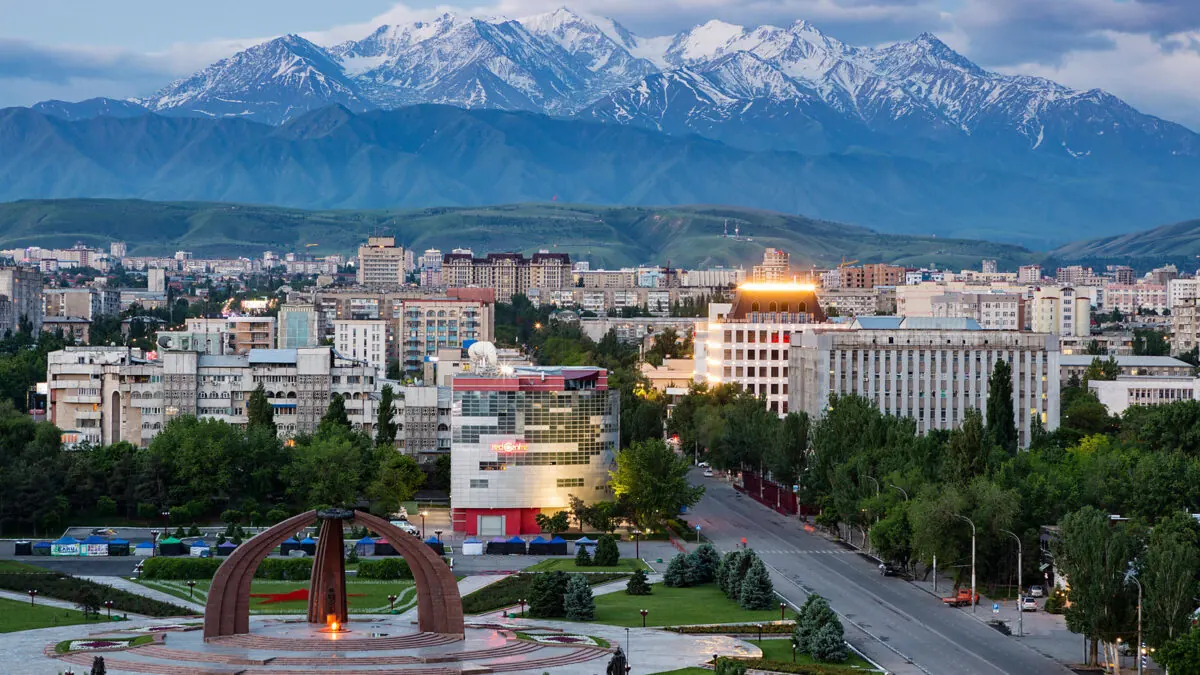
Kyrgyzstan is one of the least scam-heavy countries you’ll travel in, and it isn’t close. If you’ve come from Southeast Asia or parts of the Middle East braced for constant hustle, you can exhale — the default here is genuine hospitality, not a setup.
There is no organized tourist-scam industry in Kyrgyzstan; the few things to watch are simple taxi overcharging, bazaar markups, and the occasional fake-police shakedown, all of them easy to handle once you know the pattern. Most visitors leave having encountered nothing worse than a driver who quoted double. Still, “low-scam” isn’t “no-scam,” so here’s the honest, short list of what actually happens and how to shut it down.
Taxi overcharging — the one you’ll actually meet
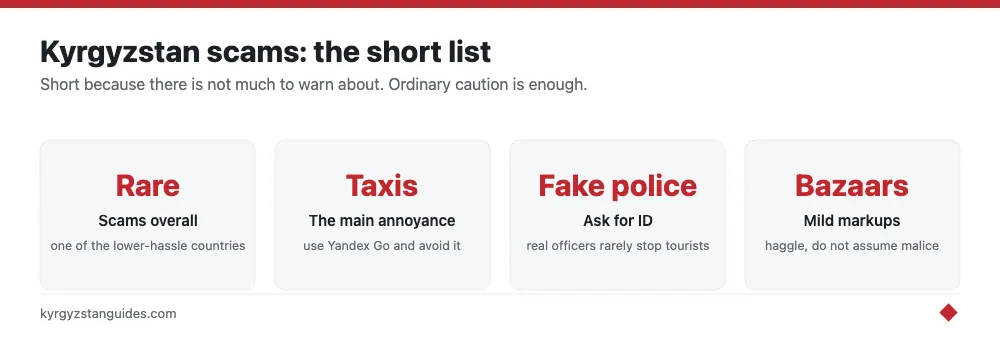
This is the most common annoyance, and calling it a “scam” is almost too strong, it’s opportunistic overcharging. Street taxis and drivers hovering outside the airport, bus stations, and bazaars will sometimes quote a foreigner two or three times the real fare, especially if you look freshly arrived and don’t speak Russian.
The fix is almost too easy: use the apps. Yandex Go works across Bishkek and other cities, shows a fair price up front, and removes the negotiation entirely. When an app isn’t an option, agree the fare before you get in, and don’t be shy about naming a lower number: a little back-and-forth is normal and expected, not rude. Knowing the rough going rate for common trips takes away all their leverage; our guide to getting around Kyrgyzstan lists typical fares and marshrutka prices so you can spot a silly quote instantly.
Two small habits help. Carry small notes so “I don’t have change” can’t inflate the price, and if a driver’s number feels absurd, simply walk to the next one, there’s always another taxi, and the market corrects itself fast. At the airport in particular, ignore the drivers who approach you in the arrivals hall and either book through an app or walk to the official rank; the men working the crowd are the ones most likely to try their luck on a tired new arrival.
Fake police and the document shakedown
This is rarer and has genuinely faded in recent years, but it’s the one worth understanding because it can feel intimidating. The classic version: someone in or out of uniform approaches, claims to be police, asks to “check” your passport or wallet, and angles for an on-the-spot “fine” for some invented problem. It has historically been more of a thing near borders and occasionally around Osh than in central Bishkek.
Handle it calmly and it deflates. Real Kyrgyz police generally don't stop tourists to inspect documents at random, and they do not collect cash fines by the roadside. So:
- Never hand over your actual passport or wallet to inspect, offer a photocopy of your passport instead, which is why you carry one.
- Stay polite but unhurried; ask to see identification, and suggest sorting any issue at the nearest police station rather than on the street.
- Don’t pay a roadside “fine.” The willingness to go to a station almost always ends the interaction, because a genuine shakedown collapses under scrutiny.
- Keep your real passport secured separately and travel with a copy for exactly these moments.
Treat this as a low-probability event you’re simply prepared for, not a reason for anxiety. It’s uncommon enough that many travelers never see it at all.
Bazaar markups and gentle haggling
At Osh Bazaar in Bishkek, Karakol’s markets, and souvenir stalls, foreigners may get quoted a higher opening price. This isn’t dishonesty so much as normal market behavior. A first number that expects a counter. It’s a feature of shopping here, not a trap.
Bargain lightly and good-naturedly. A polite counter-offer, a smile, and willingness to walk away will land a fair price, and the gap is rarely enormous to begin with. Do keep perspective: haggling hard over the equivalent of a dollar with a small vendor isn’t a win, it’s just mean. For food, produce, and everyday goods in regular shops, prices are fixed and fair: no negotiation needed. If you’re stocking up on gifts, our Kyrgyzstan souvenirs guide gives a sense of what things should cost.
The minor stuff, and why the baseline is so good
Beyond those three, the risks thin out to ordinary travel common sense. Watch for pickpocketing in crowded marshrutkas and packed bazaars, as you would anywhere. Only change money at official exchange booths or banks: never with a stranger offering a “great rate” on the street. And use ATMs attached to banks rather than isolated machines. That’s most of it.
What you largely won’t find here is worth stating plainly, because it’s rare: there’s no entrenched web of gem scams, fake tour operators, spiked-drink setups, or aggressive touts that plague some destinations. The far more typical Kyrgyz interaction is a stranger inviting you in for tea, a driver going out of his way to help, or a guesthouse family feeding you like their own. That warmth is real and it’s the norm. The scams are the exception. For the wider safety picture, from road conditions to solo travel, our is Kyrgyzstan safe guide has the full rundown.
So travel here relaxed but not naive. Use taxi apps or agree fares first, carry a passport copy for the rare fake-police moment, counter the opening price at the bazaar with a smile, and change money only at proper booths. Do those four things and you’ve neutralized essentially every scam Kyrgyzstan can throw at you: which, honestly, isn’t much.
What the foreign ministries actually say
It is worth reading the official advice rather than the forum consensus, because the two differ. The UK FCDO states that street crime is a risk including bag-snatching and mugging, names Osh Bazaar specifically as somewhere "pickpockets target tourists", and warns about strangers offering help or being over-friendly.
Australia's Smartraveller rates the country "exercise a high degree of caution", higher near the Uzbek and Tajik borders and in the Ferghana valley. It also describes the fake-police routine precisely: thieves may pose as off-duty police, uniformed police, or meet-and-greet drivers at airports. Its recommended response is the useful part, and it is better than arguing: offer to go with them to the nearest police station, where you can verify their identity and their demands. A genuine officer will agree. Nobody running a shakedown will.
Both advise against hailing taxis on the street in favour of pre-ordered or licensed services, and the FCDO adds a warning about currency-exchange offices in bazaars.
The passport question, where the advice genuinely conflicts
This one is worth knowing before you are standing on a pavement being asked for documents, because the two sides of it do not agree.
The FCDO says you must always carry your passport or a notarised copy, and that police can arrest you if you do not carry ID. The Kyrgyz legal position, as explained in a published account of the 1994 Law on the Internal Affairs Bodies, is that the country has no passport regime: officers may check documents only where there are sufficient grounds to suspect a crime or an administrative offence, and on request an officer must state their post, rank and surname and show a service ID.
Both of those are real. The practical reading is to carry a notarised copy, leave the passport in the safe, and know that you are entitled to ask who is stopping you and to see identification. Asking politely for a name and rank is not provocative here; it is what the law contemplates, and it ends most invented fines on the spot.
There is a tourist police unit, though a small one. It was created in May 2021 within the Patrol Service on Issyk-Kul with 22 officers, and by that July had assisted 150 foreign citizens. During the 2025 season the interior ministry put more than 12,000 officers nationwide and over 5,000 in resort zones, with a multilingual unit and a 24-hour four-language call centre on Issyk-Kul. The numbers that matter in an emergency are 102 for police, 103 for medical, 101 for fire and rescue, with 112 as the unified dispatch line.
Taxis and money changing are now regulated
Two things that used to be genuinely wild-west have legal frameworks as of very recently, which changes the advice.
Taxi driving is now licensed. President Japarov signed the amendment on 20 February 2025, and by 20 June 2026 more than 17,000 drivers held licences from the road-safety directorate. That does not fix the fare you are quoted, and no ministry sets taxi tariffs, but it does mean a licensed app driver is now a legally distinct thing from a man with a car. Separately, the Antimonopoly Service entered Yandex.Taxi into the state register of monopolists in April 2024, which tells you how dominant the app is.
Currency exchange is licensed by the National Bank, which publishes names, licence numbers and suspensions. Unlicensed street exchange is illegal and enforced: in June 2026 six people in Bishkek were fined 17,500 som each for exchanging cash without a licence, and in the second quarter of 2026 the National Bank issued 382 prescriptions, revoked 20 licences, suspended 26 and fined 36 bureaus. Use a licensed bureau with a posted rate and count the notes before you leave the window. If someone approaches you on the street with a better rate, the transaction itself is an offence.
The baseline, in the country's own numbers
The reassurance in this article is not a vibe. The Prosecutor General reported 34,467 registered crimes in 2025, down 5.2% on the previous year, of which 68.4% were property offences: 11,239 thefts and 9,149 frauds, against 619 robberies and 90 armed robberies in a country of around seven million.
Nobody publishes a breakdown of crimes against foreigners specifically, so treat any confident claim about tourist crime rates with suspicion, including a reassuring one. What can be said is that the overall trend is down, the violent categories are small, and the things you are realistically exposed to are the three in this article: an inflated taxi fare, a bazaar markup, and once in a long while somebody in a uniform trying it on.
FAQ
Is Kyrgyzstan safe for tourists?
Broadly yes. The Prosecutor General reported 34,467 registered crimes in 2025, down 5.2%, with 68.4% property offences and small violent-crime categories. Australia rates it "exercise a high degree of caution", with more care near the Uzbek and Tajik borders and in the Ferghana valley.
What should I do if fake police stop me in Kyrgyzstan?
Offer to go with them to the nearest police station, which is Smartraveller's own recommended response. A real officer will agree; a shakedown will not. You are also entitled to ask for their post, rank and surname and to see a service ID.
Do I have to carry my passport in Kyrgyzstan?
The advice conflicts. The UK FCDO says always carry your passport or a notarised copy and that police can arrest you without ID. The Kyrgyz legal position is that there is no passport regime and documents may be checked only on grounds of suspicion. Carrying a notarised copy satisfies both.
What are the emergency numbers in Kyrgyzstan?
102 for police, 103 for medical, 101 for fire and rescue, and 112 as the unified dispatch line. The Issyk-Kul tourist police unit, created in May 2021, can be reached on +996 312 66-01-88.
Is it safe to change money on the street in Kyrgyzstan?
No, and it is illegal. In June 2026 six people in Bishkek were fined 17,500 som each for unlicensed exchange. Use a National Bank-licensed bureau with a posted rate and count the notes at the window.
Are taxi apps regulated in Kyrgyzstan?
Since February 2025, yes — taxi driving requires a licence, and over 17,000 drivers held one by June 2026. No authority sets fares, though, so the app price is still the app's price. Both the UK and Australian advisories recommend pre-ordered or licensed taxis over hailing on the street.