Install one app before you land and you’ve solved city taxis in Kyrgyzstan: Yandex Go. It works like Uber, it’s the dominant ride-hailing service in Bishkek and Osh, and it fixes the single most annoying part of taking a taxi here — the haggle. The app shows the fare up front, so you skip the negotiation, dodge the tourist markup, and don’t need a word of Russian to get across town. That alone makes it worth the download.
There’s not much else to install. Kyrgyzstan doesn’t have a crowded field of ride apps; Yandex Go is the one that matters. It works best in the two big cities, and once you leave the larger towns you’re back to arranging cars the old way. This guide covers where the app is worth the money, how paying actually works, and the moments when flagging a street taxi still beats opening your phone. For the full transport picture, our getting around Kyrgyzstan guide sets the scene.
Yandex Go in Bishkek and Osh
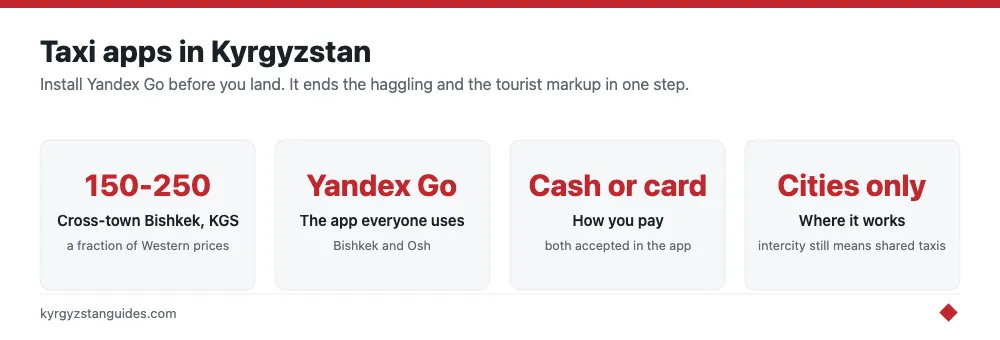
In Bishkek, Yandex Go is genuinely excellent — cars everywhere, waits of a few minutes, and fares that make a Western visitor blink. A ride across the city center often lands somewhere around 150-250 KGS, a fraction of what the same trip costs almost anywhere else, and it makes hopping between the city’s parks, bazaars, and museums effortless. In Osh, the country’s southern hub, it works too, with slightly thinner coverage but the same up-front pricing and easy hailing.
Outside those two cities, don’t count on it to the same degree. Yandex lists a handful of smaller towns too (see below), but coverage thins fast there and evaporates in the mountains and villages where most travelers actually spend their time. In Karakol you may get a car; at a trailhead or a lakeside guesthouse you won’t. Treat Yandex Go as an urban tool, at its most dependable in Bishkek and Osh, and plan other transport for everywhere else.
Ordering is straightforward if you’ve used any ride app. Set your pickup and destination on the map, pick a car class (the standard economy tier is what you want), and confirm — the driver’s car, plate, and arrival time appear, along with the fixed fare. The one wrinkle for visitors is pin placement: drop your pickup pin precisely, because a driver who can’t spot you on a busy street may cancel and cost you a few minutes. Screenshots of your destination address in Cyrillic help if you ever need to show a driver where you’re headed.
Cash vs Card
You can register a card in the app, but no official Yandex page says whether foreign-issued cards are accepted (more on that below), and a rejected card mid-trip is a bad time to find out. The safe move is to keep cash as your default and treat card as a bonus. Set the payment method to cash and you simply hand the driver the fare the app already quoted; no negotiation, no surprise, no reliance on a card that may or may not clear. Carry small notes, since a driver won’t always have change for a large one on a 200-som fare.
Are the Fares Fair?
Yes, and that’s the quiet superpower of the app. Street taxis in Kyrgyzstan will often quote a foreigner two or three times the going rate, and without the language or local knowledge you have little way to push back. Yandex Go prices the ride the same for everyone by distance and demand, so you pay a local’s fare by default. Prices rise with surge at rush hour or in bad weather, exactly as you’d expect, but even a surged fare here is cheap by any outside standard. If the app quote and a street quote diverge wildly, the app is telling you what the ride is actually worth.
When Street Taxis Still Win
The app isn’t always the answer. In smaller towns with little Yandex coverage, a street car or a guesthouse-arranged driver is simply what’s available, and the fare is fine if you know the rough going rate or have a local set it. Off the app grid entirely, you’re negotiating, so ask your guesthouse what a trip should cost before you agree to anything. And for anything intercity, apps aren’t the tool at all: no ride-hailing service covers long-distance runs like Bishkek to Karakol, which stay the domain of the shared taxis and marshrutkas at the bus stations. Yandex Go is for hopping across a city, not crossing the country.
Our take: run Yandex Go on cash as your default in Bishkek and Osh, and don’t overthink it. Everywhere else, ask a local what a ride should cost and pay that. It’s a cheap country to get around, and the app just makes the cities frictionless.
Where Yandex Go actually operates
The usual line is that Yandex Go covers Bishkek and Osh. It runs official city pages for six: Bishkek, Osh, Karakol, Jalal-Abad, Tokmok and Kara-Balta. So in Karakol or Jalal-Abad it is worth trying the app before you fall back on street haggling, even if coverage there is thinner than in Bishkek and Osh.
The published Bishkek Econom tariff is specific enough to argue with a driver about: a minimum fare of 48 som covering the first 0.6 km and 0.9 minutes, then a maximum of 10 som per kilometre and 3.7 som per minute inside the city, 23 som per kilometre outside it, two minutes of free waiting and then up to 5 som a minute, and a cap of 30 som for carrying a pet. Those are ceilings, not fixed prices.
One payment trap worth knowing: if you order by phone rather than in the app, the Bishkek line takes cash only. Card payment exists only inside the app. And whether a foreign-issued card works at all is something no official Yandex page states, so carry enough som for your first ride rather than assuming.
For context on the market: the Antimonopoly Service entered Yandex.Taxi into Kyrgyzstan's state register of monopolists in April 2024, formally recognising a dominant position. There is no meaningful competitor, which is convenient and also why fares are what they are.
Taxi driving became a licensed profession in 2025
This is new enough that most advice predates it. Compulsory licensing came into force on 22 August 2025, with a transition to 10 October 2025 for companies and 1 December 2025 for individual drivers, later pushed out again to 1 July 2026.
What it involves: licences issued by the interior ministry's road-safety directorate, around fifteen documents including a medical certificate, a criminal-record certificate, technical inspection and insurance, a thirty-day review, and a state fee of 500 som a year for an individual. Drivers report the real all-in cost at 5,000 to 10,000 som. A minimum of three years' driving experience is required, plus a roof checkerboard and an in-cabin information plate. Working without a licence is fined 7,500 som for an individual and 23,000 for a company.
Right-hand-drive cars are barred from taxi licensing altogether, on the basis of 1,506 crashes involving them in 2024, with 143 deaths. In a country with a lot of imported Japanese cars, that is a visible change.
Take-up has been slow and the numbers are disputed. The road-safety directorate said in June 2026 that just over 17,000 licences had been issued against an estimated 35,000 active drivers. An industry outlet said in January 2026 that only 7,000 to 10,000 of 60,000 to 70,000 drivers were licensed, with 40,000 queuing. Different dates, different denominators, and neither reconciles with the other.
Separately, since 1 September 2025 the aggregators act as tax agents: the platform withholds and remits drivers' income tax and insurance contributions, at 1% of income to 2028, rising later. Drivers no longer file returns. None of this changes your fare, but it explains why your driver may be newly interested in whether you booked through the app.
What nobody can tell you reliably
Two gaps worth being honest about, because confident answers exist online and are not sourced.
inDrive and Namba Taxi. Both are widely said to operate here. inDrive's own site renders its city list in JavaScript and serves no Kyrgyz city names in the page source; Namba's site blocks automated access entirely. Their presence in Bishkek is plausible and probably true, but it cannot be confirmed from a primary source, so do not plan around either as your only option.
Foreign cards. No official page states whether a US or EU card works in Yandex Go here. Assume it might not.
The one piece of official advice that is unambiguous comes from the UK Foreign Office: avoid flagging down taxis, use licensed pre-ordered services, which are more reputable and have English-speaking dispatchers, and use private cars or pre-arranged taxis at night.
Frequently Asked Questions
Does Uber work in Kyrgyzstan?
No. Uber doesn’t operate in Kyrgyzstan. Yandex Go is the equivalent app and the dominant ride-hailing service in Bishkek and Osh, working the same way with up-front pricing.
Do I need a local SIM to use Yandex Go?
You need mobile data, so a local SIM or working eSIM makes it far easier to order rides on the street. A cheap Kyrgyz SIM is the simplest fix; see our SIM card guide for the details.
Can I pay by card in Yandex Go?
Possibly. Card payment exists inside the app, but no official Yandex page says whether foreign-issued cards work, so keep cash as your default payment method and treat card as a convenience rather than something to rely on.
Is Yandex Go cheaper than a street taxi?
Usually, for foreigners. Street drivers often quote visitors an inflated price, while the app charges the same distance-based fare as for locals, so it typically works out cheaper and always more predictable.
Can I use taxi apps for intercity trips?
No. Yandex Go is for rides within a city, not long-distance routes. For intercity travel like Bishkek to Karakol, use the shared taxis and marshrutkas at the bus stations instead.
Does Yandex Go work outside Bishkek and Osh?
In a few towns, though not reliably. Yandex also runs official city pages for Karakol, Jalal-Abad, Tokmok and Kara-Balta, but coverage thins fast in smaller towns and evaporates in the mountains and villages where travelers spend most of their time — in Karakol you may get a car; at a trailhead or lakeside guesthouse you will not. Treat the app as an urban tool, most dependable in the two big cities, and arrange cars the old way everywhere else.