How do you actually get from India to Kyrgyzstan, and what should a return ticket cost? That is the question that stalls most trips before they start, so let's answer it plainly.
There is no direct flight from India to Kyrgyzstan. Every route connects at least once — most sensibly through Almaty, Tashkent, or a Gulf hub like Sharjah — and a return economy ticket from Delhi, Mumbai, or Bengaluru typically lands somewhere around ₹25,000–45,000, depending on season and how far ahead you book. Below we break down the workable routings, the airlines worth watching, the layover traps, and the cheapest months to fly. We research this for Indian travelers rather than flying it ourselves, so treat every number as a realistic range to check against live fares, not a fixed quote.
The three routings that make sense
Bishkek’s Manas Airport is the arrival point for almost every Indian traveler, and there is no non-stop service to it from any Indian city. That leaves three broad ways in, each with its own trade-off between price, time, and hassle.
- Via Almaty, Kazakhstan. The most popular hub. Air Astana and others fly Delhi–Almaty, and Almaty–Bishkek is a short onward hop — or a four-hour road transfer if the flight leg is pricey. This is usually the fastest overall option.
- Via Tashkent, Uzbekistan. Uzbekistan Airways connects Delhi and sometimes other cities to Tashkent, with an easy onward flight to Bishkek. Often a touch cheaper than Almaty and pleasant if you want to stop over.
- Via a Gulf hub (Sharjah, Dubai, or similar). Air Arabia flies Sharjah–Bishkek, so a budget carrier from your Indian city to Sharjah plus that leg can undercut everything — at the cost of a longer, more tiring journey.
A fourth option some travelers use is flying into Almaty and skipping the final flight entirely, crossing the land border to Bishkek by shared taxi or bus. It is straightforward on a Kyrgyz e-Visa and sometimes the cheapest way of all. If you are weighing whether the border route suits you, our guide to Kyrgyzstan border crossings covers what to expect at the frontier.
Fares by origin city, honestly
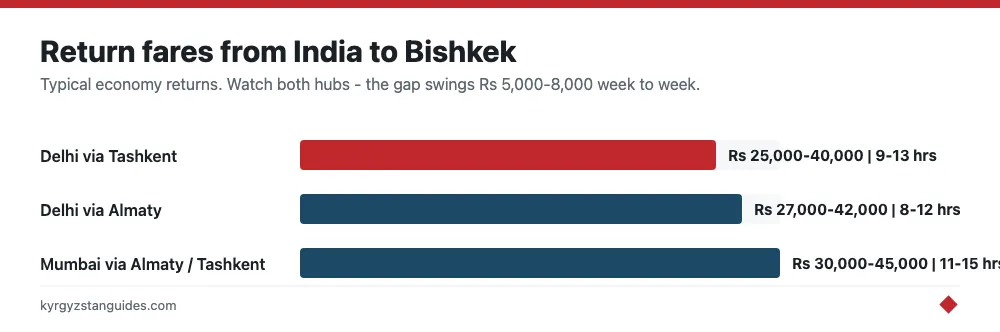
Delhi has the widest choice and usually the best prices, simply because more carriers serve the Central Asian hubs from there. Mumbai and Bengaluru travelers can reach the same hubs but often pay a little more and fly longer, especially Bengaluru, which tends to route through the Gulf. The table below is indicative — fares move constantly, and a sale can beat the low end while a last-minute summer booking can blow past the high end.
| From | Best hub | Typical return fare | Rough total time |
|---|---|---|---|
| Delhi | Almaty | ₹27,000–42,000 | ~8–12 hrs |
| Delhi | Tashkent | ₹25,000–40,000 | ~9–13 hrs |
| Mumbai | Almaty / Tashkent | ₹30,000–45,000 | ~11–15 hrs |
| Bengaluru | Sharjah / Almaty | ₹32,000–48,000 | ~13–18 hrs |
Notice that Delhi via Tashkent is often the single cheapest legitimate routing, and that Bengaluru pays a premium mostly for the extra distance to a viable hub. If you live in the south and can position yourself to Delhi cheaply on a domestic sale, doing the international leg out of Delhi sometimes saves more than it costs.
Which airlines to watch
You aren't choosing from a long list, which actually makes fare-hunting simpler. A handful of carriers do the heavy lifting on this corridor.
- Air Astana — the Kazakh flag carrier, strong on Delhi–Almaty and the onward Bishkek hop, generally reliable connections.
- Uzbekistan Airways — the natural pick for the Tashkent routing, often the value leader out of Delhi.
- Air Arabia — the low-cost route through Sharjah; cheapest headline fares if you tolerate a longer trip and hand-baggage-only pricing.
- Pegasus or Turkish — occasionally competitive via Istanbul, though usually the slowest and most roundabout way there.
Set fare alerts across at least two hubs before you commit. The gap between the Almaty and Tashkent routings on the same dates can easily be ₹5,000–8,000, and it flips depending on the week.
Watch the baggage rules as closely as the headline fare, because they change the real cost more than any other single detail. Air Arabia’s cheapest Sharjah fares are hand-baggage-only, and a checked bag added at the airport can wipe out the saving that made the routing attractive in the first place. Air Astana and Uzbekistan Airways generally include a checked allowance on their standard fares, but the very lowest fare buckets sometimes strip it out. For a mountain trip you'll almost certainly want a checked bag, so compare the all-in price with luggage, not the bare seat price, and add the bag online in advance where it is cheaper than at the counter.
Layovers: read the whole itinerary
The single most common mistake we see Indian travelers make is booking the cheapest number without reading the connection. A ₹3,000 saving that buys you an eleven-hour overnight layover in a transit hall is a bad trade, and some of the lowest fares hide exactly that.
Short, clean connections of two to four hours exist through both Almaty and Tashkent — look for them. Where the routing forces a long stop, both cities are worth breaking the journey in for a day rather than sitting in the airport, and a deliberate one-night stopover can turn dead time into a bonus city. Just make sure your onward ticket and the layover length are compatible with any transit-visa rules for your nationality; Indian passport holders should check whether a stop in Kazakhstan or Uzbekistan needs its own paperwork before booking a self-connected trip.
One more caution on self-connected tickets, where you book the two legs separately to save money: if the first flight is late, the airline on the second leg owes you nothing. Leave a generous buffer — three hours minimum — and keep your Kyrgyz e-Visa printout and onward ticket easy to reach, because staff in the region sometimes ask for proof of onward travel before they board you.
| Layover type | What to expect | Our take |
|---|---|---|
| Short (2–4 hrs) | Stay airside, quick onward flight | Ideal — pay a little more for this |
| Long (6–12 hrs) | Dead time in transit | Only if the saving is large |
| Overnight stopover | Exit and see the hub city | Great if planned, awful if forced |
| Self-connected | Separate tickets, no protection | Buffer 3+ hrs or avoid |
The cheapest months to fly
Timing moves the price more than anything except how early you book. The catch for Indian families is that the best mountain weather — roughly June to early September — is also peak fare season, and it overlaps with summer school holidays, so demand is high on both ends.
If you have flexibility, the shoulder weeks pay off. Late May and mid-to-late September tend to have softer fares while the country is still very much open, and the passes are usually still accessible into September. Deep off-season — November through March — has the cheapest tickets of the year, but you are then flying into a winter country. For a sense of whether that suits your trip at all, see our take on Kyrgyzstan in winter, and cross-check the weather window against our best time to visit Kyrgyzstan guide before you lock dates.
The practical rule: for a summer trip, book two to three months out to catch the lower end of the range. Leave it to the last few weeks in peak season and you will pay the top of every band above, or more.
There is also a mid-week effect worth exploiting. Fares out of Delhi and the Gulf hubs tend to soften for Tuesday, Wednesday, and Thursday departures compared with the Friday-to-Sunday peak, and shifting your outbound by a day or two around the same dates can save a meaningful slice. If your leave dates are fixed, at least price the days on either side; the calendar view on any fare search will show the swing at a glance. Festival periods and long weekends in India push prices up on this corridor too, so building your trip around a normal working week rather than a holiday cluster helps.
Booking tactics that actually save money
Beyond timing, a few habits reliably shave the fare. Price the Almaty and Tashkent routings on the same dates rather than assuming one is always cheaper. Check the fly-into-Almaty-then-drive option as a separate quote — it wins more often than you would think. And consider whether a Gulf-hub budget combination beats a single through-ticket for your city, particularly out of Bengaluru or Mumbai.
Once you land, the getting-around picture changes completely and cheaply; our guide to getting around Kyrgyzstan covers the marshrutkas and shared taxis that carry you onward for a few hundred rupees. And if you want to see how the flight fits a full trip, the arrival day in our 10-day Kyrgyzstan itinerary is built around a Bishkek landing.
Our verdict: the flight is the biggest single line item of a Kyrgyzstan trip from India, but it is far from prohibitive. Watch two hubs, book a couple of months ahead for summer, read the layover before you trust the price, and a return in the mid-₹20,000s to low-₹40,000s is a realistic target from any major Indian city — a modest gateway fee for one of the best-value mountain holidays within reach.
Frequently Asked Questions
Is there a direct flight from India to Kyrgyzstan?
No. There is no non-stop service between any Indian city and Bishkek. Every route connects at least once, most commonly through Almaty in Kazakhstan, Tashkent in Uzbekistan, or a Gulf hub such as Sharjah on Air Arabia.
How much does a return flight to Kyrgyzstan cost from India?
A return economy ticket typically runs around ₹25,000–45,000 from Delhi, Mumbai, or Bengaluru, depending on season and booking lead time. Delhi via Tashkent is often the cheapest legitimate routing; Bengaluru usually pays a little more for the extra distance to a hub.
Which airlines fly from India toward Bishkek?
Air Astana serves the Almaty routing, Uzbekistan Airways the Tashkent one, and Air Arabia the Sharjah low-cost option. Turkish and Pegasus occasionally compete via Istanbul but are usually slower. Setting fare alerts across at least two hubs is the smart move.
When are flights to Kyrgyzstan cheapest?
The absolute cheapest tickets fall in the November–March off-season, but you would be flying into winter. For a summer trip in the June–September mountain window, book two to three months ahead and consider the late-May or mid-September shoulder weeks for softer fares while the country is still open.
Can I fly to Almaty and travel to Bishkek by road?
Yes, and it is sometimes the cheapest option overall. Flying into Almaty and crossing the land border to Bishkek by shared taxi or bus takes about four hours and is straightforward on a Kyrgyz e-Visa. Keep your visa printout handy at the frontier.
Which Indian city has the cheapest flights to Bishkek?
Delhi, usually — it has the widest choice and the best prices because more carriers serve the Central Asian hubs from there, and Delhi via Tashkent is often the single cheapest routing. Mumbai and Bengaluru travelers reach the same hubs but often pay a little more and fly longer, with Bengaluru tending to route through the Gulf.