Before you plan anything else, know this: no marshrutka, bus, or shared taxi goes all the way to Song-Kul. Public transport gets you as far as Kochkor, and from there the lake is a private arrangement — a hired car up a rough mountain track, or a horse or a walk over a pass. Anyone selling you a “direct bus to Song-Kul” is selling a chartered vehicle, not a scheduled service, because scheduled service to the lake does not exist.
That’s the key fact, and it shapes the whole trip. The realistic route is Bishkek to Kochkor by marshrutka (about 2.5 hours, ~250-300 KGS), then Kochkor to the lake by arranged transport, usually via the Kyzart or 33-Parrots pass. The road to Song-Kul is only open roughly June to September; outside that window snow shuts the passes and the summer yurt camps pack up entirely. Get the season and the Kochkor leg right and the rest falls into place.
Step One: Bishkek to Kochkor
Every route to Song-Kul runs through Kochkor, a small town about 2.5 hours south of Bishkek at the junction of the Naryn, Issyk-Kul, and Song-Kul roads. Marshrutkas leave Bishkek’s Bishkek’s main bus station on Alma-Atinskaya 1/1 through the day for roughly 250-300 KGS, filling and departing when full rather than on a timetable, so a morning start is wise.
Kochkor is not a detour to endure; it’s the logistics hub for the whole area. This is where Kyrgyzstan’s community-based tourism began, and the local CBT office and guesthouses are the easiest place in the country to arrange the onward leg: a shared jeep to the lake, a horse trek, or a driver to drop you at a yurt camp. Our Kochkor guide covers the town and its operators in full; treat a stop here as part of the plan, not a delay.
Step Two: Kochkor to the Lake
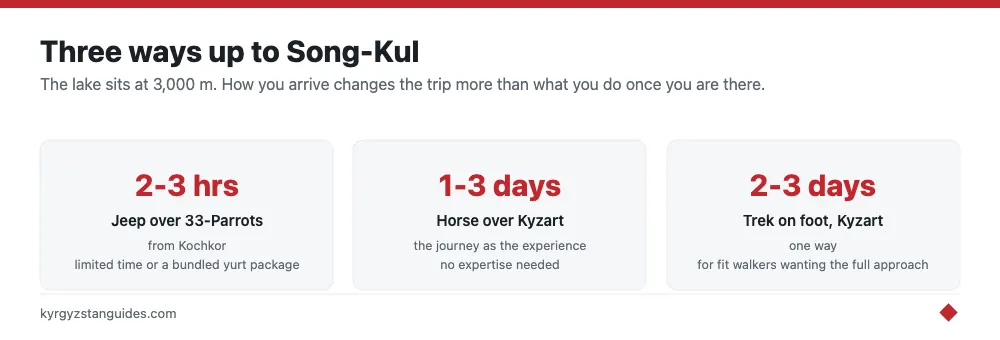
From Kochkor you have three broad ways up to Song-Kul, and they suit very different travelers.
By shared or hired jeep
The straightforward option is a car or jeep arranged in Kochkor, usually a sturdy 4×4 or an old Audi that somehow still climbs. Drivers from Kochkor take the road over the Kalmak-Ashuu pass, a series of tight switchbacks that earn their reputation, and deliver you to a yurt camp on the shore in roughly 2-3 hours. Reckon on something like 3,000-5,000 KGS for the car one-way, split among passengers, though rates swing with fuel and season. Many travelers book this as part of a one- or two-night yurt-stay package that bundles the transport, bed, and meals together.
By horse
The most rewarding way in is on horseback over the Kyzart pass, the classic multi-day approach. Guides in Kochkor or the village of Kyzart run one-, two-, and three-day rides that climb through summer pastures where herders graze their animals, cresting the pass before dropping to the lake. You don’t need riding experience for the gentler versions, and it turns the journey itself into the highlight. Our horse trekking guide explains how these trips are organized and what to expect in the saddle.
On foot
Fit walkers trek in over the same Kyzart route, typically two or three days one-way, often with a packhorse to carry gear. It’s a committing walk at altitude, but the reward is arriving at 3,000 m to a plain ringed by mountains and dotted with yurts. Most people combine a walk in with a jeep out, or vice versa, to see two sides of the approach.
The Approaches Compared
| Way in | Rough time | Suits |
|---|---|---|
| Jeep (33-Parrots pass) | 2-3 hours from Kochkor | Limited time, comfort, or bundled yurt package |
| Horse (Kyzart pass) | 1-3 days | The journey as the experience; no expertise needed |
| Trek on foot (Kyzart) | 2-3 days one-way | Fit walkers wanting the full approach |
The Season Is Non-Negotiable
Song-Kul is a high summer-pasture lake, and its access window is short. The road and passes are realistically open June through September, with July and August the safest bets; the herders and their yurts move up for exactly this stretch and come down when the weather turns. Try earlier or later and you risk snow on the passes, closed camps, and a wasted trip. Even in midsummer, nights at 3,000 m drop near or below freezing, so pack for winter after dark whatever the calendar says. For the wider picture of when the country’s high country opens up, see our guide to the best time to visit Kyrgyzstan.
What Waits at the Lake
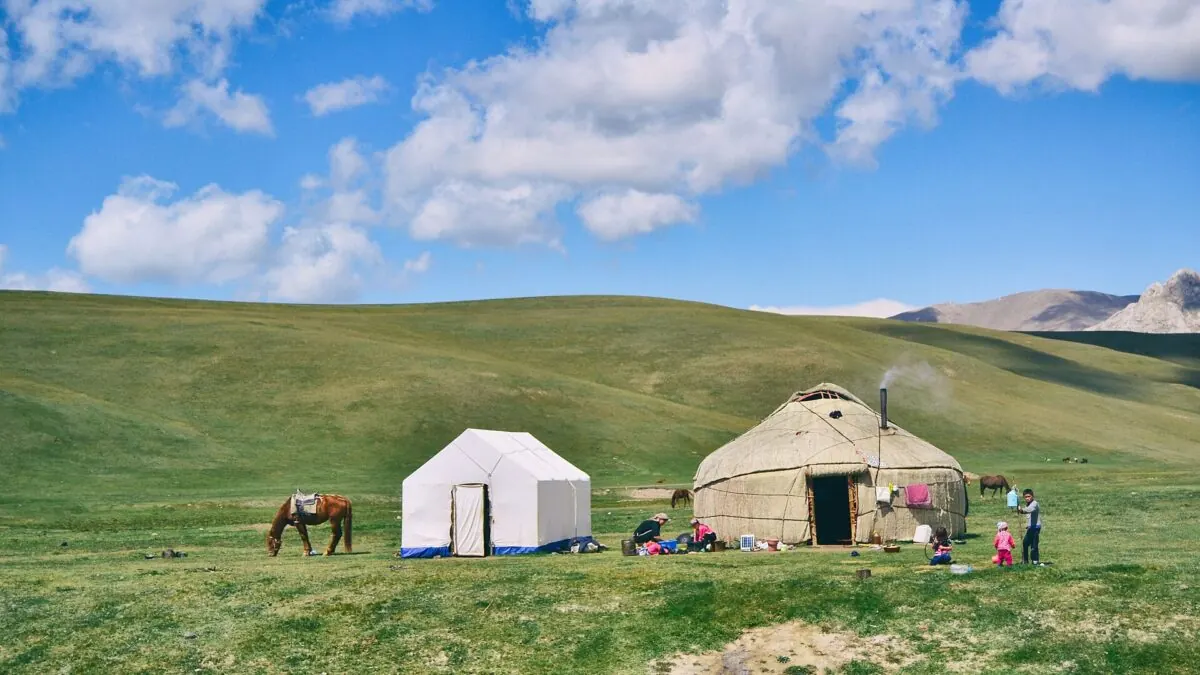
The effort is the entry fee for one of Kyrgyzstan’s defining scenes: a vast alpine lake with no permanent settlement, no road hugging its shore, just grassland, grazing horses, and clusters of white yurts under enormous skies. You sleep in a yurt, eat what the family cooks, and wake to a silence broken only by animals. There’s little to “do” beyond ride, walk, and watch the light move, which is the entire point. Our full Song-Kul lake guide covers the yurt camps, what a night up there is like, and how to choose where to stay.
Before You Go: A Checklist
Reduced to essentials, this is the trip: go between June and September, and never assume otherwise. Get yourself to Kochkor first by marshrutka from Bishkek’s main bus station on Alma-Atinskaya 1/1. Arrange the onward leg (jeep, horse, or foot) in Kochkor, ideally as a package that includes your yurt stay and meals. Carry cash in small notes, because there are no card machines past Kochkor. And pack genuinely warm layers for the near-freezing nights, no matter how hot the Bishkek afternoon felt when you left. Do those five things and Song-Kul, for all its remoteness, is one of the more reliable highlights you can build a Kyrgyz trip around.
Three passes, and they are not the same one
A correction worth making because it is repeated everywhere, including until now on this page: Kalmak-Ashuu and 33 Parrots are different passes. They approach the lake from different directions and they are several hundred metres apart in altitude.
The regional wetlands report that covers the Son-Kul protected area lists the access roads: from Kochkor over Kalmak-Ashuu, from Ak-Talaa over the Moldo pass, from Naryn over Zhon-Blak and Teskey-Torpo — Teskey-Torpok being the one usually sold as 33 Parrots for its switchbacks — and from Jumgal over Kara-Keche.
Elevations disagree between the official report and the travel sector, so here they are as ranges: Kalmak-Ashuu 3,400-3,446 m, Moldo-Ashuu 3,050-3,346 m, 33 Parrots 3,030-3,132 m, Kara-Keche 3,432 m.
The same report states flatly that motor transport does not function from November to May because of snow.
When the road actually opens
There is no published opening date, because it is not a date — it is a snow-clearing operation, announced each year. The only pass with official statements I could find is Kalmak-Ashuu, and the 2025 sequence is instructive.
On 18 April 2025 the Ministry of Transport announced that work had begun to open the pass on the Sary-Bulak to Son-Kol road, kilometres 35 to 42, with one loader, one bus, one manipulator and five workers, while snow was still falling. On 28 April the state news agency reported it open, after clearing around 18,040 cubic metres of snow since 17 April.
So: cleared and reopened in late April in a normal year. That is a road milestone, not a season opening — the yurt camps and the grazing follow later. No ministry statement could be found for the 33 Parrots or Moldo-Ashuu passes at all.
The lake itself, and when the ice goes
Song-Kul sits at 3,016 m, is 29 km long and up to 18 km wide with 96 km of shoreline, and is shallower than people expect: maximum depth 22 m, mean depth 9.2 m, volume 2.64 cubic kilometres.
On ice, the hydrology is specific. Cover forms in mid-October, reaching up to about a metre thick. Shore areas begin thawing in mid-to-late April over roughly a month, and the ice clears completely in the second half of May. The basin gets 180 to 200 days of snow cover a year and only 50 to 60 frost-free days.
The south-eastern part of the lake lies inside the Karatal-Japyryk State Nature Reserve, and the Son-Kul site totals 36,869 hectares, of which about 27,962 is water. It has been Ramsar site No. 1943 since 23 January 2011, Kyrgyzstan’s third, cited for migratory birds, breeding gulls, terns, geese and grebes, and as a refuge for great bustard and saker falcon.
Practically: herders occupy the jailoo from the beginning of May to October, yurt camps run June to September at $15-45 a night including meals, there is no electricity in most, no mobile signal, no ATM, and nights approach freezing even in July. Book one to two weeks ahead in the July-August peak, and bring cash.
Frequently Asked Questions
Is there public transport to Song-Kul?
No. No marshrutka or bus runs to the lake itself. Public transport only reaches Kochkor, from where you arrange a private jeep, horse, or trek for the final leg over the pass.
When is the road to Song-Kul open?
Roughly June to September, with July and August most reliable. Snow closes the passes outside that window, and the summer yurt camps pack up entirely, so travel in the warm months only.
How do you get from Kochkor to Song-Kul?
By arranged transport: a hired jeep over the 33-Parrots pass in about 2-3 hours, or a one-to-three-day horse trek or walk over the Kyzart pass. All are organized through guesthouses and the CBT office in Kochkor.
There is a slower way in: seven days on foot from Kyzyl-Oi through the Suusamyr valley, instead of the two-day jeep from Kochkor.
Which pass do you cross to reach Song-Kul?
It depends on the approach, and they are genuinely different passes rather than one with two names. From Kochkor the road crosses Kalmak-Ashuu at 3,400–3,446 m; from Ak-Talaa it is Moldo-Ashuu at 3,050–3,346 m; from Naryn it is Zhon-Blak and Teskey-Torpo, the latter usually sold as "33 Parrots" at 3,030–3,132 m; and from Jumgal it is Kara-Keche at 3,432 m.
When does the road to Song-Kul get cleared?
There is no published opening date because it is a snow-clearing operation announced each year. For Kalmak-Ashuu in 2025, the transport ministry announced work beginning on 18 April and the state news agency reported it open on 28 April, after clearing around 18,040 cubic metres of snow. That is a road milestone, not the season — yurt camps and grazing follow later.
How deep is Song-Kul and when does the ice melt?
Shallower than people expect: maximum depth 22 m and mean depth 9.2 m, across a lake 29 km long at 3,016 m. Ice forms in mid-October and reaches about a metre thick. Shore areas start thawing in mid-to-late April over roughly a month, and the ice clears completely in the second half of May.
Is Song-Kul a protected area?
Yes. The south-eastern part lies inside the Karatal-Japyryk State Nature Reserve, and the Son-Kul site of 36,869 hectares has been Ramsar site No. 1943 since 23 January 2011 — Kyrgyzstan's third. It is cited for migratory birds, breeding gulls, terns, geese and grebes, and as a refuge for great bustard and saker falcon.