Most travelers treat Kochkor as a bathroom stop — a place the marshrutka pauses on the way to Song-Kul before pressing on. That is a mistake. Kochkor is where Kyrgyzstan’s community-based tourism was effectively born, and it remains the single best base for organizing the trips people actually come to this region for.
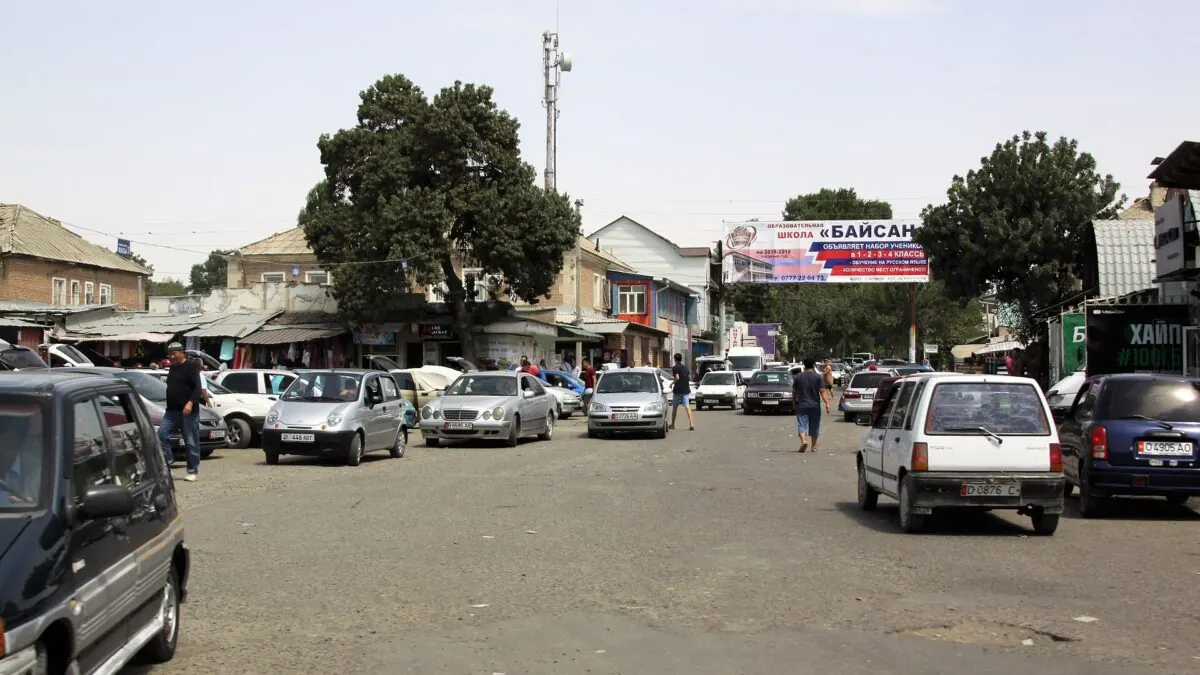
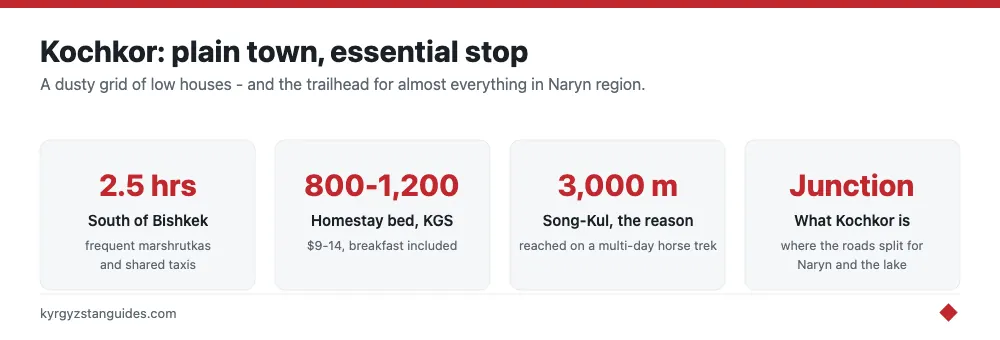
The town itself is unremarkable to look at: a small, dusty grid of low houses about 2.5 hours south of Bishkek, at the junction where roads split toward Song-Kul, Naryn, and Issyk-Kul. But behind those plain streets sits a network of homestays, felt artisans, and horse guides more organized than almost anywhere else in the country. Stop here, and the mountains around it open up.
The birthplace of Kyrgyz CBT
Kochkor is where Community-Based Tourism in Kyrgyzstan first took hold in the late 1990s, when local families organized to offer homestays, guides, and craft demonstrations that put money directly into the community rather than into outside operators. The model spread from here to Naryn, Karakol, and beyond, but Kochkor’s CBT office is still one of the most reliable in the country.
What that means in practice: you can walk into the CBT or Shepherd’s Life office, and within an hour have a homestay booked, a horse trek to Song-Kul arranged with a vetted guide, transport sorted, and a fair, posted price for all of it. For independent travelers who don't want to prepay a big tour, this is as easy as trip logistics get in Central Asia. If yurt life and horse treks are why you came, our yurt stay guide pairs well with a Kochkor start.
The posted-price part is what makes Kochkor genuinely useful rather than just charming. Elsewhere you negotiate every horse, driver, and bed from scratch; here the rates are set, the guides are known quantities, and a slice of the money stays with the families doing the work. That transparency is exactly why we send first-time visitors to Kochkor before Song-Kul rather than the other way around — get the logistics right here, and the mountains take care of themselves.
Felt, shyrdaks, and watching them made
Kochkor is also the best place in the country to understand Kyrgyz felt craft. Women’s cooperatives here run shyrdak demonstrations — the making of the vivid stitched and appliqued felt carpets that are one of Kyrgyzstan’s signature crafts. You watch raw sheep’s wool get cleaned, dyed, rolled, and cut into the bold curling-horn patterns, then stitched into a rug that takes weeks to finish.
It isn't a staged show; these are working cooperatives, and the carpets, slippers, and wall hangings are for sale straight from the makers, which is the fairest way to buy them. A shyrdak here costs a fraction of what you would pay in a Bishkek boutique, and you know exactly whose hands made it. Our souvenirs guide explains what to look for and what a good piece should cost.
The jumping-off point for Song-Kul and Kol-Ukok
Here is the real reason to stop. Kochkor is the classic launchpad for two of central Kyrgyzstan’s best horse experiences.
Song-Kul — the vast alpine lake at 3,000 m, ringed by summer yurt camps and grazing herds — is most rewardingly reached on a multi-day horse trek starting from the Kochkor side, climbing over a pass to arrive at the water the way herders do. You can also drive in, but the ride is the point. See our Song-Kul lake guide for routes and yurt-camp options, and our horse trekking guide for what a multi-day ride actually involves if you have never been on a horse for days.
Kol-Ukok is the quieter alternative — a glacial lake in the mountains south of Kochkor, reachable as a 1–2 day hike or horse trek with an overnight in a shepherd’s yurt. It sees a fraction of Song-Kul’s visitors, and CBT Kochkor can set the whole thing up. For travelers short on time, it delivers the yurt-and-alpine-lake experience in a tighter loop, and the trail climbs steadily through summer pastures where herders still bring their flocks up for the season. If Song-Kul feels too far or too popular, this is the trip we would pick.
Homestays, getting there, and day trips
Sleeping in Kochkor means a homestay — simple family rooms, shared bathrooms, home-cooked dinners of laghman or plov, and hosts who help arrange everything. Beds run roughly 800–1,200 KGS ($9–14) with breakfast, and it's the kind of stay where you learn more about daily Kyrgyz life over dinner than in any museum.
Getting there's easy: frequent marshrutkas and shared taxis run from Bishkek’s main bus station on Alma-Atinskaya 1/1 (about 2.5 hours), and onward transport links to Naryn, Song-Kul, and the Issyk-Kul lakeshore. Because it sits at that junction, Kochkor slots naturally into almost any central or southern loop rather than being a detour. Coming back from Song-Kul or Issyk-Kul, you pass through Kochkor anyway — so there is no logistical excuse to skip it in either direction.
Timing is the one thing to get right. The horse treks and yurt camps run roughly June through September, when the high pastures are open and the weather cooperates; outside that window the CBT office stays useful for craft visits and homestays, but the marquee treks close down. Aim for July or August if the mountains are the goal, and book your homestay a day ahead in peak season, when Kochkor fills with travelers staging their own Song-Kul rides.
Beyond the big treks, easy day trips from town include the felt cooperatives, short walks in the surrounding valleys, and the drive up toward the Song-Kul pass for the views alone. None of it needs a permit or a long haul.
So here is the pointer to act on: do not let the marshrutka carry you straight through. Get out at Kochkor, spend an hour at the CBT office booking a homestay and a horse guide, watch a shyrdak take shape, and use the town as the launchpad it was built to be. The plain streets are the least interesting thing about it.
The felt listing is an emergency listing, and that is the point
Kochkor's valley also holds something no write-up mentions: the Kök-Tash mausoleum, possibly the first Qara Khitai elite tomb ever identified. Kochkor sells shyrdaks, and most write-ups mention UNESCO in passing. The detail that gets dropped changes the meaning entirely.
"Ala-kiyiz and Shyrdak, art of Kyrgyz traditional felt carpets", reference 00693, was inscribed in 2012 — not on the Representative List, but on the List of Intangible Cultural Heritage in Need of Urgent Safeguarding. That is UNESCO's at-risk register. It is a different list with a different meaning, and the distinction is routinely lost.
UNESCO's stated reasons for that classification are specific: the number of practitioners is diminishing and most are over forty; transmission runs from older rural women to younger women within the family and is breaking down; synthetic carpets are outcompeting handmade ones; raw-material quality is poor; and government support is lacking.
So when you buy a shyrdak in Kochkor you are not picking up a souvenir of a thriving craft. You are buying from a tradition that UNESCO formally classified as endangered fourteen years ago, for reasons that have not gone away. That is a better reason to buy the real thing from a cooperative than any amount of authenticity marketing.
The cooperative to know is Altyn Kol, Golden Hands. It started as a group of Naryn-oblast women in the winter of 1996 and was formally constituted as an NGO in spring 1998 with more than two hundred women, with producers across At-Bashy, Ak-Talaa and other districts. Prices in Kochkor run from around $15 for small pieces to $150 and up for large ones.
The town, and the market day nobody can pin down
Kochkor village holds 11,224 people at the start of 2026, in a district of 71,147, at roughly 1,800 m. It is three to three and a half hours from Bishkek and an hour to ninety minutes from Naryn.
On the famous livestock market, I have to give you a range rather than an answer. The national tourism portal says Sunday, early, with prime hours between six and eight in the morning. An established destination guide says Saturday morning, sellers in by nine and peaking around ten, drawing traders from Kochkor, Jumgal and Ton districts and busiest in autumn. No municipal source settles it. Plan for a weekend morning and confirm at your guesthouse the night before.
The other thing Kochkor is, is the staging post for Song-Kul: two to three day horse treks run about $40-50 a day including guide, horse and food, with CBT homestays at $10-18 a night with breakfast.
One piece of context that makes the valley more interesting than a transit stop: Kochkor valley, medieval name Yarysh, is itself part of Kyrgyzstan's UNESCO tentative-list submission, carrying Turkic petroglyphs of horsemen with falcons, twenty-four Old Turkic inscriptions, tribal tamgas, and the Kyrk-Choro necropolis.
FAQ
Is shyrdak UNESCO heritage?
Yes, but on the urgent list. "Ala-kiyiz and Shyrdak, art of Kyrgyz traditional felt carpets" was inscribed in 2012 on the List of Intangible Cultural Heritage in Need of Urgent Safeguarding — UNESCO's at-risk register, not the Representative List.
Why is Kyrgyz felt craft endangered?
UNESCO cites a shrinking number of practitioners, most of them over forty, breaking transmission from older to younger women in families, competition from synthetic carpets, poor raw-material quality and a lack of government support.
When is the Kochkor livestock market?
Sources disagree: the national tourism portal says Sunday with prime hours 6-8am, an established destination guide says Saturday morning peaking around ten. No official source settles it. Plan for a weekend morning and confirm locally the night before.
What does a shyrdak cost in Kochkor?
Roughly $15 for small pieces up to $150 and beyond for large ones, buying direct. The Altyn Kol cooperative, formally constituted in spring 1998 with over two hundred women, is the established one.
How far is Kochkor from Bishkek?
Three to three and a half hours by shared taxi or marshrutka, and an hour to ninety minutes from Naryn. The village sits at about 1,800 m and holds 11,224 people.
Is Kochkor the base for Song-Kul?
Yes, it is the usual staging post. Two to three day horse treks run about $40-50 a day including guide, horse and food, with CBT homestays at $10-18 a night with breakfast.