Naryn sits at about 2,000 m, roughly 300 km and a 5–7 hour drive south of Bishkek — and for most travelers it is the last town with ATMs, hot showers, and a real choice of food before the roads turn to gravel and the border zone begins.
That is the whole point of Naryn. It is not a destination you cross the country for; it is the gateway you route through. Strung along the Naryn River in a narrow valley, this administrative capital of Kyrgyzstan’s largest region is the staging post for Tash-Rabat, Kel-Suu, Chatyr-Kul, and the Torugart pass to China. Come here to resupply, sort permits, hire a driver, sleep, and push on. Used that way, it earns its stop.
A high town on the road south
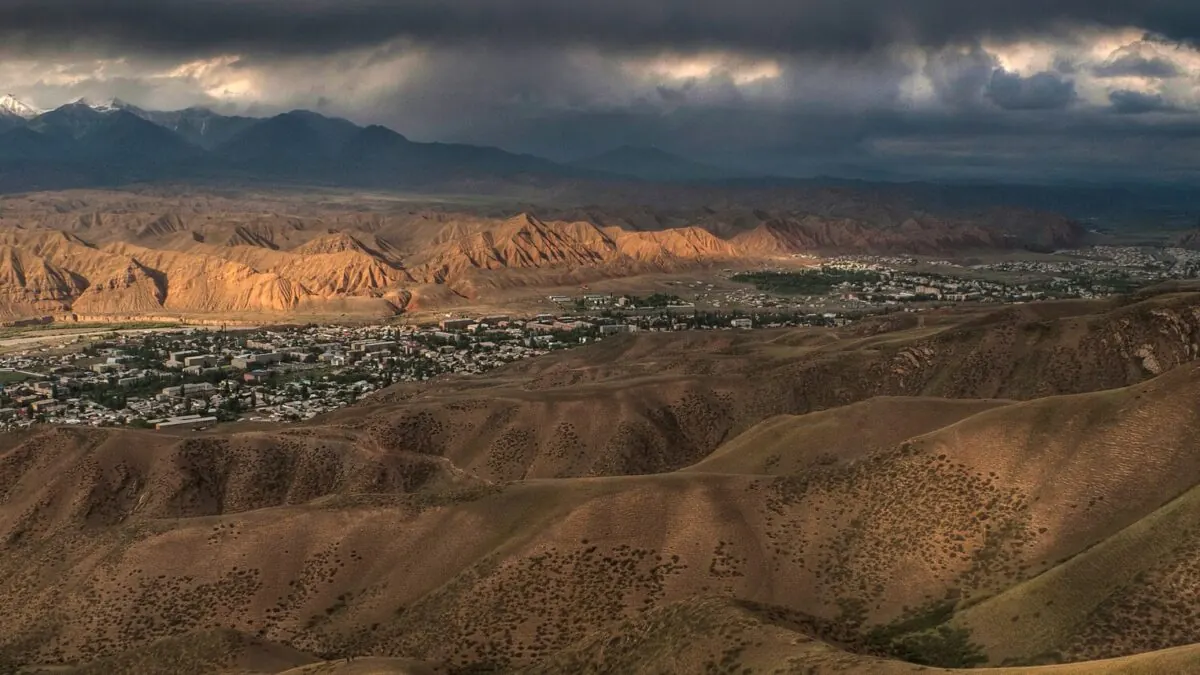
Naryn is long and thin — essentially one main street shadowing the river for several kilometers, hemmed by bare hills that glow gold in the evening. The altitude keeps summers mild and nights cool even in July, and winters here are long and hard. It's a working Kyrgyz town, not a tourist set-piece: Soviet-era apartment blocks, a bazaar, a couple of mosques, and the surprise of a modern glass-and-stone university campus at the western edge.
That campus is the University of Central Asia, founded by the Aga Khan Development Network and the three Central Asian republics. Its arrival has quietly lifted the town — better cafes, more English spoken, a younger energy along the main drag. You won't spend a day sightseeing in Naryn itself, but the mix of herders, students, and traders passing through gives it more character than its plain streets suggest.
Practically, that youthfulness matters to travelers. Where a decade ago you might have struggled to find a decent coffee or an English speaker, you can now handle most logistics without a guide, and the guesthouse owners are used to helping foreigners piece together onward trips. It's still a small provincial town — don't expect nightlife or a supermarket to rival Bishkek’s — but it's comfortable, safe, and easy to spend a night in while you sort what comes next.
Why you actually stop here: CBT and permits
The single most useful address in town is CBT Naryn (Community-Based Tourism). This is where the practical trip-planning happens: hiring cars and drivers to Tash-Rabat or Kel-Suu, arranging yurt-camp stays, booking horse guides, and — crucially — sorting the border-zone permits that several of the region’s headline sights require.
This matters more than first-timers realize. Kel-Suu and the approach to Chatyr-Kul lie inside a military border zone, and reaching them legally means a permit arranged one to two weeks ahead through an operator like CBT. Turning up and hoping to sort it same-day doesn't work. If either lake is on your list, contact CBT Naryn before you leave Bishkek, and read our Kel-Suu lake guide for the permit lead times.
CBT also solves the harder half of any southern trip: transport. There is no public bus to Tash-Rabat, Kel-Suu, or the yurt camps, so you're hiring a car and driver either way, and CBT’s posted rates spare you the roadside haggling. Ask them to bundle several destinations into one multi-day hire — it costs little more than a single point-to-point run and saves you backtracking to Naryn between each. This is also the place to confirm road conditions, which change with weather and can close the higher passes without notice even in summer.
Where to stay and eat
Accommodation is homestays and modest guesthouses rather than hotels, and that is a feature, not a flaw — your hosts double as your best local fixers for drivers and permits. Beds run roughly 800–1,500 KGS ($9–17) including breakfast, and many places will cook dinner on request, which is your most reliable evening meal. Book a night or two ahead in July and August, when Torugart overlanders and lake-bound travelers fill the better-known guesthouses.
For eating out, the main street has cafes and canteens serving the Central Asian staples — laghman, manty, plov, shashlik, and lately a few student-friendly coffee spots near the university. It is simple, cheap, and filling. Stock up at the bazaar too: once you head toward Tash-Rabat or Kel-Suu, shops thin out fast and most yurt camps are cash-only with no resupply, so buy snacks, water, and any specialty food here.
This is also your last reliable chance for ATMs and a strong phone signal. Naryn has bank machines and mobile coverage in town, but both vanish once you head up the side valleys, so draw all the som you expect to need — with a margin for horse hire and unexpected extra nights — before you leave. Download offline maps here as well. Treat the drive south as going properly off-grid, because for the better sights, it's.
Getting to Naryn
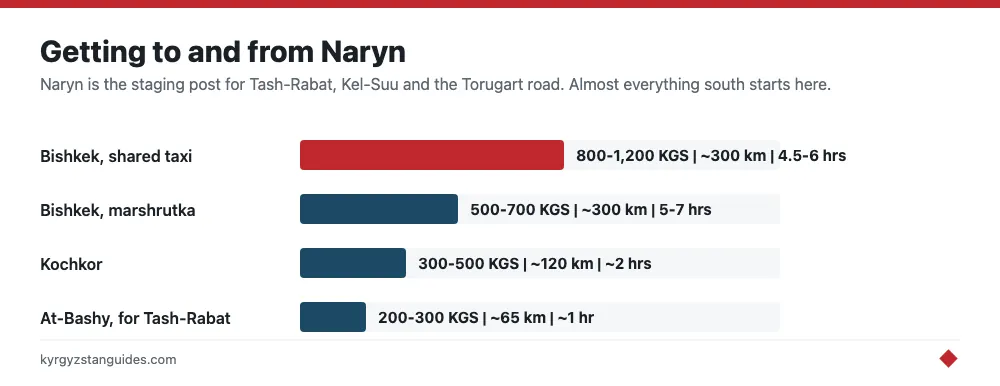
Naryn connects to the rest of the country by road only — there's no passenger rail or airport in normal use. Shared transport leaves from Bishkek’s main bus station on Alma-Atinskaya 1/1 through the day; the earlier you go, the more likely vehicles fill and depart on time.
| From | Distance | Time | Cost (approx) |
|---|---|---|---|
| Bishkek (marshrutka) | ~300 km | 5–7 hrs | 500–700 KGS |
| Bishkek (shared taxi) | ~300 km | 4.5–6 hrs | 800–1,200 KGS |
| Kochkor | ~120 km | ~2 hrs | 300–500 KGS |
| At-Bashy (for Tash-Rabat) | ~65 km | ~1 hr | 200–300 KGS |
The drive from Bishkek climbs over the Dolon pass (~3,000 m) and passes the Kochkor and Song-Kul turnoffs, so many travelers stitch Naryn into a larger southern loop rather than a there-and-back. For the mechanics of shared taxis, marshrutkas, and hiring drivers, our getting around Kyrgyzstan guide covers it.
Using Naryn as a base
The smart way to treat Naryn is as a hub with radiating day trips and overnights, sharing one hired driver across several destinations to keep costs down. From here you can reach:
- Tash-Rabat — the 15th-century stone caravanserai near At-Bashy, best done as an overnight in a nearby yurt camp; see our Tash-Rabat guide.
- Kel-Suu — the dramatic border-zone lake, permit and 4WD required, usually a 2–3 day trip.
- Salkyn-Tor National Park — a forested gorge just a few kilometers north of town, easy to reach for a half-day walk, picnic, or first-night acclimatization amble. It is the one genuinely local outing that needs no permit and no long drive.
- Song-Kul — the high alpine lake and yurt-stay classic, reachable via Kochkor and often combined with Naryn on a loop; details in our Song-Kul lake guide.
Our verdict: don't judge Naryn on its main street. Judged as a launchpad — the place where you land the permits, the driver, and the last hot shower before Kyrgyzstan’s wildest corners — it's close to indispensable. Give it a night, sort your logistics, walk Salkyn-Tor to shake off the drive, and let the town do the job it is good at.
Twenty minutes from Naryn town there is a national park that survived four privatisation auctions: see Salkyn-Tor.
FAQ
Is Naryn worth visiting?
As a destination, not really; as a staging post, absolutely. It is the last town with ATMs, hot showers and a real choice of food before the roads turn to gravel and the border zone begins. Used that way — resupply, permits, a driver, a night's sleep — it earns its stop.
How high is Naryn and how far from Bishkek?
About 2,000 metres, roughly 300 kilometres and a five to seven hour drive south of Bishkek. It is the administrative capital of Kyrgyzstan's largest region.
What is Naryn the gateway to?
Tash-Rabat, Kel-Suu, Chatyr-Kul and the Torugart pass to China. Anything in the far south of Naryn oblast is reached through here.
Can I get permits in Naryn?
Naryn is where people sort border-zone paperwork and hire drivers before heading further south, which is one of the main reasons to stop rather than pass through. Arrange it before you commit to onward travel, since the permits take working days rather than hours.
Are there ATMs in Naryn?
Yes, and they matter: Naryn is the last place with reliable ATMs before the roads deteriorate and the border zone starts. Draw cash here rather than assuming you will find more further on.
What is there to do in Naryn town?
The town itself is long and thin, essentially one main street following the river. The nearest real attraction is Salkyn-Tor national park, twenty minutes away up the valley, which is where people from Naryn go for a day out.