CBT, Community Based Tourism, is a network of small local offices across Kyrgyzstan that connects travelers directly with village families for homestays, yurt stays, horse treks, guides, and transport, all at fixed and openly published prices. It was set up around 2000 with support from the Swiss development agency Helvetas, and it is coordinated nationally by the Kyrgyz Community Based Tourism Association under the brand “Hospitality Kyrgyzstan.” For independent travelers, it is quietly the most useful institution in the country.
Here is why it matters in one sentence: in a country with thin tourism infrastructure and very little English outside Bishkek, CBT lets you walk into an office in a small town at 4 p.m. and walk out with a family homestay for the night and a three-day horse trek starting tomorrow. No haggling, no middleman markup, no guesswork about what a fair price is.
The backstory explains the design. When the Soviet Union collapsed, Kyrgyzstan’s state tourism apparatus collapsed with it, and the villages around the country’s most spectacular landscapes had livestock, empty rooms, and no way to reach the trickle of foreign hikers showing up. The CBT model (built village by village through the early 2000s) solved both sides of that problem at once: it gave families a direct income from travelers, and it gave travelers a trustworthy front door to places that have never had hotels and never will. Two decades on, the network has outlasted every attempt to replace it.
How CBT actually works
Each CBT office is a cooperative of local service providers (host families, horsemen, drivers, cooks, guides) from that town and its surrounding villages. The office acts as dispatcher and quality gate. You tell the coordinator what you want; they match you with a member family or guide and quote the standard rate. The bulk of the money goes to the family providing the service, with a small commission sustaining the office. Prices are fixed per season and generally posted on a board or a laminated sheet, which removes the negotiation theater that wears travelers down elsewhere.
A concrete example makes it clearer. Say you arrive in Kochkor wanting two days at Song-Kul on horseback. The coordinator pulls out the price sheet: horse and horseman-guide per day, yurt night with meals, transport to the trailhead village, and a total you can check line by line. She phones a member family at the lake to confirm a free yurt, calls a horseman from the rotation list — work is deliberately spread among members rather than funneled to favorites, and tells you what time to be back at the office in the morning. Fifteen minutes, no deposit drama, no mystery margins. That rotation system is also why your horseman might be a 19-year-old nephew one trip and a 60-year-old champion herder the next; it's a feature of fairness, not a bug of quality control.
The practical effect is that the hardest parts of Kyrgyzstan travel — finding a bed in a village with no hotels, arranging horses with a shepherd you share no language with, getting a lift to a trailhead 40 kilometers up a dirt road, become five-minute conversations. This is why we call CBT the backbone of independent travel here: it isn't a tour company you surrender your trip to, it's a booking desk for the countryside.
What you can book through a CBT office
- Homestays. A room in a family home with breakfast, typically around 800-1,200 KGS (about $9-14) per person; dinners around 300-400 KGS more
- Yurt stays, summer yurt camps at jailoo pastures like Song-Kul, usually $15-22 with meals
- Horse treks — the signature product: horse plus local horseman-guide from roughly 1,500-2,500 KGS per day, multi-day routes with yurt or tent nights
- Trekking guides and porters, day guides for passes and route-finding, hired per day
- Transport, drivers to trailheads and between towns at published per-car rates
- Extras: eagle hunting demonstrations, felt-making workshops, folklore dinners in some towns
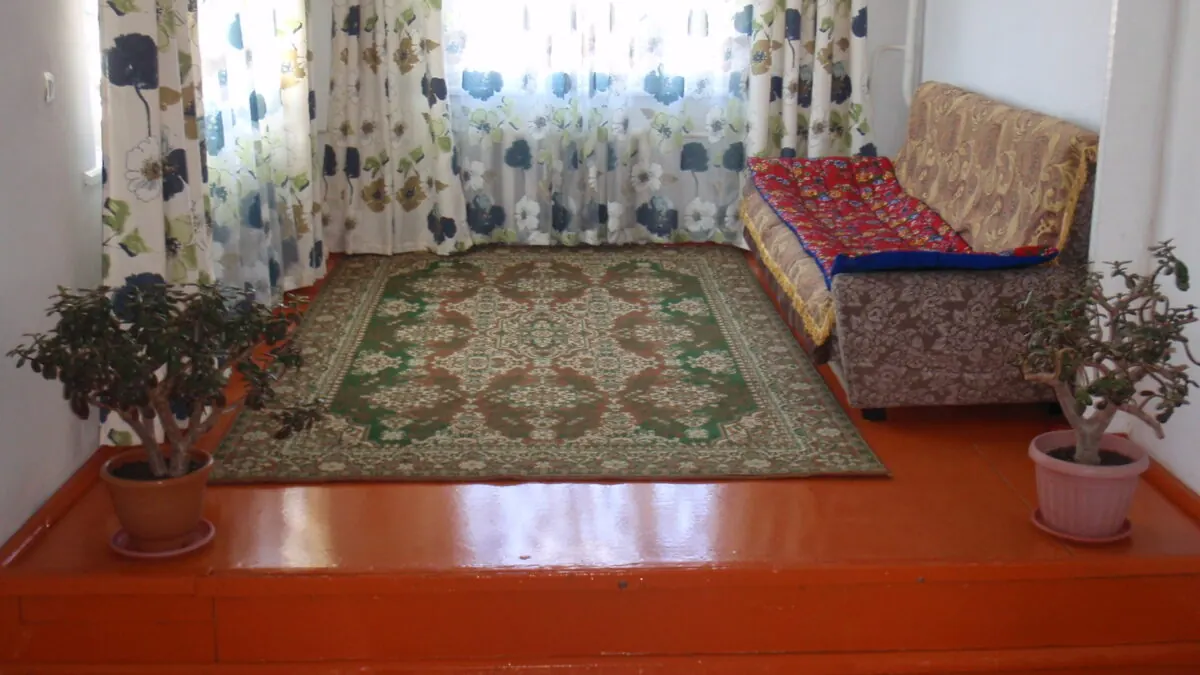
Quality is honest rather than polished. A homestay means a mattress on a raised platform or a spare room, a shared squat toilet in the yard, and enormous home cooking. That is what you are paying for. Travelers expecting hotel amenities at these prices are missing the point of the country.
The offices that matter most
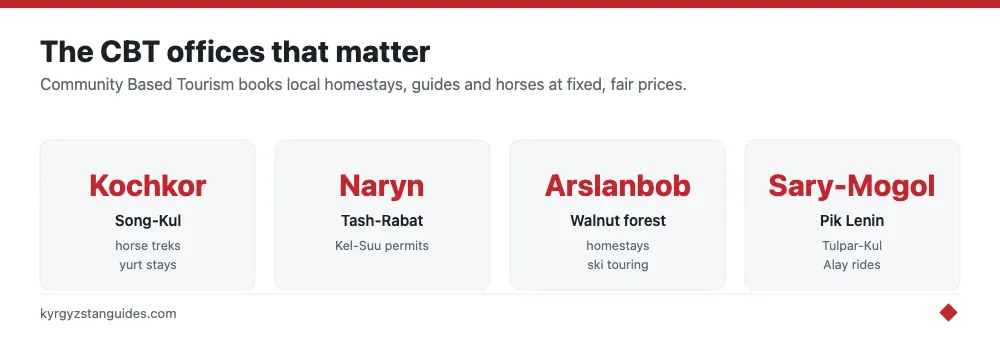
There are more than a dozen CBT offices, but four do the heavy lifting for most itineraries, with a few others worth knowing.
| Office | Best for |
|---|---|
| CBT Kochkor | Song-Kul horse treks and yurt stays, the busiest and slickest office |
| CBT Naryn | Tash-Rabat caravanserai, Kel-Suu border permits, treks toward the Chinese border |
| CBT Arslanbob | Walnut-forest homestays, waterfalls, winter ski-touring in the south |
| CBT Sary-Mogol | Pik Lenin viewpoints, Tulpar-Kul yurt camps, Alay Valley horse treks |
| CBT Karakol / Jyrgalan area | Trailhead logistics for Ala-Kul, Altyn-Arashan, and Jyrgalan valley |
Kochkor is where most travelers meet the system, since it's the gateway to Song-Kul lake and can put together a two- or three-day horse trek on a day’s notice in summer. Naryn is the one to contact ahead of time, because its border-zone paperwork for Kel-Suu takes one to two weeks to process. Arslanbob’s office is the model everyone cites, the coordinator there has run homestay tourism in the walnut forest villages for two decades — and Sary-Mogol is indispensable in the far south, where it's essentially the only organized tourism service between Osh and the Tajik border.
CBT versus a tour agency
The comparison travelers actually face is CBT against a Bishkek-based tour agency, so here's the honest split. Agencies win on convenience and English: one email thread, cars with seatbelts, itineraries stitched across regions, and certified guides for technical terrain. CBT wins on price, often by 40-60 percent for the same yurt, the same horses, the same valley, and on where the money lands, since you're paying the family that hosts you rather than an office in the capital that subcontracts to them. Agencies make sense for border-zone permits, tight schedules, and groups who want everything handled. For everything else, the CBT price sheet is the benchmark; if an agency quote is triple it, you know exactly what you're paying for and can decide if it is worth it.
How to book
In July and August, email or WhatsApp the specific regional office a few days to a couple of weeks ahead, especially for Song-Kul yurts and anything needing a border permit. Contact details are listed on the national association’s site and on each office’s social pages; replies can be slow, so send your dates and group size in the first message. Outside peak season, walking in usually works. Offices keep street signs and coordinators are used to same-day requests. Payment is cash in som, settled either at the office or directly with the family. Bring enough cash from a bigger town; the villages that host you rarely have working ATMs.
One structural quirk to understand: the offices are independent cooperatives, not branches of one company. Service standards, English levels, and responsiveness vary from town to town, and a booking made through one office doesn't carry over to the next region. Plan each leg with the office that covers it.
The honest limitations
CBT isn't flawless. Some offices are energetic and superbly organized; others are a part-time coordinator with a notebook. Fixed prices, the system’s greatest feature, also mean you occasionally pay slightly above rock-bottom market rate — a private deal with a shepherd might cost less, if you have the language and the appetite for it. Guides booked through CBT are local horsemen who know their valleys intimately but aren't certified mountain guides; for glacier travel or technical routes you need an alpine agency instead. And in shoulder season, some offices effectively hibernate. None of this changes the verdict — see our horse trekking guide for how consistently CBT beats the alternatives on price. But go in with calibrated expectations.
Your CBT booking checklist
- Decide your legs first: which towns, which treks, roughly which dates
- Message the relevant regional office directly with dates and group size. Two weeks ahead in July-August
- For Kel-Suu or other border-zone trips, start the permit request 2+ weeks out via CBT Naryn or an agency
- Confirm what the quoted price includes: meals, horse for the guide, tent, transfers
- Withdraw enough som in Bishkek, Karakol, or Osh before heading to the villages
- Carry small bills, a 5,000-som note is hard to break at a jailoo
- Save the coordinator’s phone number offline; mobile signal exists in more valleys than you would expect
FAQ
What is CBT in Kyrgyzstan?
Community Based Tourism — a network of small local offices across the country connecting travellers directly with village families for homestays, yurt stays, horse treks, guides and transport, at fixed and openly published prices.
Who runs CBT Kyrgyzstan?
It is coordinated nationally by the Kyrgyz Community Based Tourism Association under the brand “Hospitality Kyrgyzstan”. It was set up around 2000 with support from the Swiss development agency Helvetas.
Why use CBT instead of booking online?
Because in a country with thin tourism infrastructure and very little English outside Bishkek, CBT lets you walk into an office in a small town at four in the afternoon and walk out with a family homestay for that night and a three-day horse trek starting tomorrow. There is no haggling and no middleman mark-up.
Are CBT prices fixed?
Yes. Prices are fixed and openly published, which is the point of the model — you are not negotiating and the money goes to the host family rather than through an intermediary.
Do I need to book CBT in advance?
Usually not, and that flexibility is its main advantage for independent travellers. Turning up at an office the day before is normally enough, though in peak season for popular routes booking ahead is safer.
What can I arrange through CBT?
Homestays, yurt stays, horse treks, guides and transport. For most independent travellers it is the single most useful institution in the country.