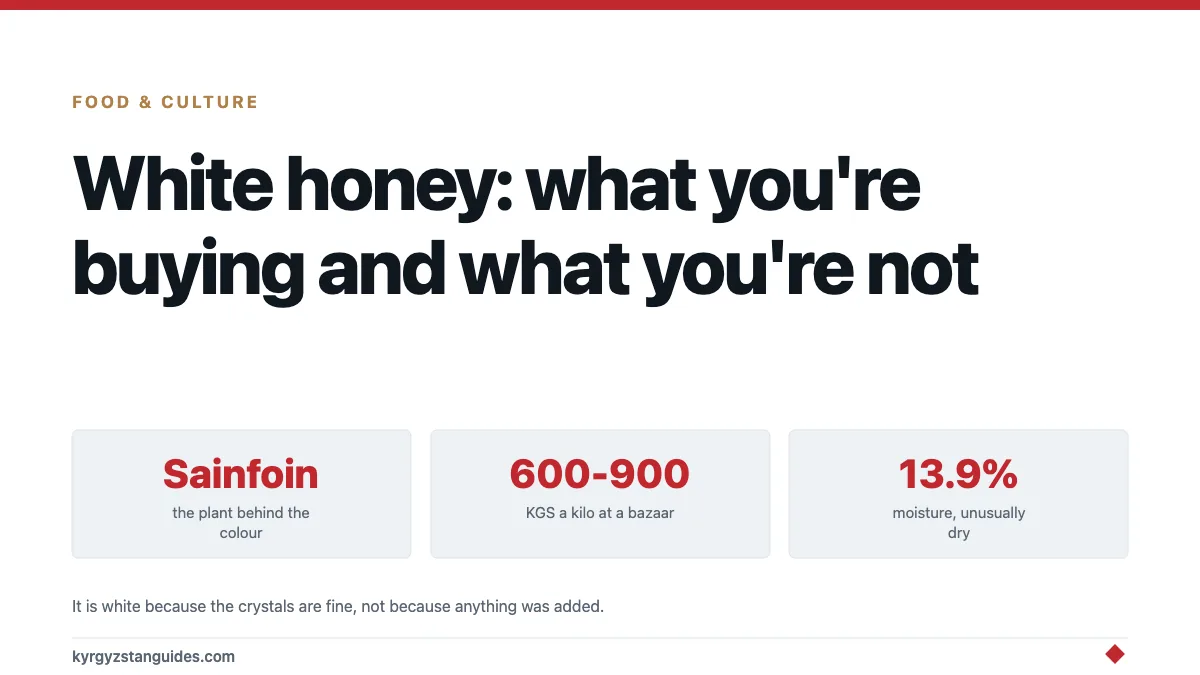
Kyrgyz white honey is real, it is genuinely unusual, and a fair proportion of what gets sold under that name, both in Bishkek's bazaars and online, isn't it. The honey itself comes from sainfoin, a mountain forage plant, and it's white because it crystallises into an extremely fine, pale, spreadable cream rather than because anything has been done to it.
If you're planning to carry a jar home, the difference between the real thing and a sugar paste in a nice jar is worth twenty minutes of reading.
What makes it white
Sainfoin (esparcet in Russian, which is the word you'll see on labels here) is a legume grown as fodder and widely naturalised across Kyrgyz mountain valleys. Bees working it produce a honey with a very particular crystallisation behaviour: instead of forming the coarse, gritty crystals most honeys do as they set, sainfoin honey sets into a mass of very fine crystals, which reads to the eye as white and to the tongue as smooth.
That's the whole mechanism. No processing, no whipping, no additive. A fine crystal scatters light differently from a coarse one.
Analysis of Kyrgyz white honey typically shows sainfoin as the dominant pollen — one importer's laboratory profile puts it at 67% sainfoin pollen with a moisture content of 13.9%, which is notably dry for honey and part of why it keeps so well.
Colour ranges from true white through pale cream to a faint pink or light amber depending on what else the bees found.
Where it comes from
Toktogul is the name attached to it most often, and the reservoir town and its surrounding valleys are a genuine centre of production. Our Toktogul guide covers the place itself.
At-Bashy, in Naryn province, is the other region that turns up repeatedly, and high mountain honey from there's sold on the herbs rather than on the sainfoin: barberry, thyme, sage, raspberry, wild flowers.
Altitude is the reason the product has a reputation. Short season, intense flowering, clean ground, no industrial agriculture within reach of most of these valleys.
The season behind the jar
Worth knowing, because it explains both the scarcity and the price.
Sainfoin flowers for a short window in early summer, and the bees have to be there for it. Kyrgyz beekeepers move hives — up to the flowering valleys as the season climbs, down again afterwards — which is the same transhumance logic that governs the herds, applied to insects. A bad spring, a wet flowering week, or hives in the wrong valley at the wrong fortnight, and that year's white honey simply doesn't happen in quantity.
The window also limits purity. A hive working sainfoin for three weeks and mixed mountain flowers for the rest of the summer produces honey that's mostly sainfoin and partly everything else, which is why laboratory profiles report a percentage rather than a clean 100. Writing on what separates good sainfoin honey from ordinary stock makes the same point about how narrow the quality window really is.
If you are buying in September, you are buying honey harvested in summer. If someone is offering you fresh white honey in March, ask what they mean by fresh.
The taste, honestly
Mild. Much milder than most people expect from something sold as a speciality.
Sainfoin honey is delicately floral, low on the sharp or tannic notes you get in forest and buckwheat honeys, and sweet in a soft, rounded way. It's a quiet honey, and anyone who likes the strong dark ones may find it underwhelming.
Texture is where it earns its money: it spreads like a soft butter straight from the jar and doesn't run off a spoon. That alone makes it a better breakfast honey than most.
How to tell if you're being sold sugar
Counterfeiting is a documented problem with this product, and the reason is simple economics, white honey commands a premium, and white sugar paste is cheap.
Things that should raise an eyebrow:
Perfect, uniform snow-white with no variation. Real sainfoin honey is white-ish, and jars vary between batches. Laboratory-flat whiteness is a manufacturing signature, not a natural one.
A texture like icing. It should be dense and fine-grained, not fluffy or aerated. Whipped, airy texture suggests something was beaten into it.
Dissolving instantly and completely in cold water into a clear solution. Real honey is slow and reluctant in cold water and clouds it.
Price that looks too reasonable. This is a niche product with a short season. If it's stacked in volume at a suspiciously low price, something is wrong.
The most reliable move in a bazaar is to taste before buying: that's normal and expected here, and nobody will be surprised if you ask. Real honey leaves a lingering floral finish; sugar paste goes flat and sweet and then stops.
Buying it without regretting it
Buy at source if your route allows. Toktogul sits on the Bishkek–Osh highway, so anyone driving south passes through, and roadside sellers there are usually selling their own.
In Bishkek, the bazaars have it — Osh Bazaar has honey rows, and a reputable specialist shop costs more and removes most of the risk. Expect to pay somewhere around 600–900 KGS a kilo for good honey by weight at a bazaar, more in a sealed jar in a city shop, and treat anything far below that as a question rather than a bargain. Our souvenirs guide has the wider price picture.
Get it sealed properly if it's going in checked luggage. A kilo of honey that has escaped into a rucksack at altitude is an experience nobody needs.
And check your own country's import rules before you buy in volume. Honey is an animal product, several countries restrict it, and Australia and New Zealand in particular do not care how good it is.
Is it medicinal?
Sainfoin honey gets marketed with health claims, and the sensible position is that it's honey.
Honey has mild antibacterial properties and is a reasonable thing to put in tea when you have a sore throat. Beyond that, claims about specific curative powers for white honey aren't supported by anything you'd want to rely on, and the marketing around premium honeys generally runs well ahead of the evidence.
Buy it because it's a genuinely distinctive regional product with a texture you can't easily get elsewhere. That's a good enough reason.
Not medical advice, and honey shouldn't be given to infants under one year old.
FAQ
Why is Kyrgyz honey white?
Because it comes mainly from sainfoin (esparcet), and sainfoin honey crystallises into very fine crystals rather than coarse ones. Fine crystals scatter light, so the set honey looks white to pale cream. Nothing is added and nothing is done to it.
What does Kyrgyz white honey taste like?
Mild, delicately floral and softly sweet, without the sharpness of darker honeys. The texture is the standout — dense and spreadable, closer to a soft butter than a runny honey.
Where is the best white honey in Kyrgyzstan from?
Toktogul is the region most associated with it, with At-Bashy in Naryn province the other name that comes up. Buying near the source, especially along the Bishkek–Osh road through Toktogul, gives you the best odds.
How can I tell if white honey is fake?
Be suspicious of perfectly uniform snow-white colour, an airy whipped texture, instant clear dissolving in cold water, and an unusually low price. Taste before you buy, it's normal at a bazaar, and look for a lingering floral finish rather than flat sweetness.
How much does white honey cost in Kyrgyzstan?
Roughly 600–900 KGS per kilo by weight at a bazaar, and more for sealed jars in city shops. Substantially cheaper than that's a reason to ask questions rather than to buy.
Can I take honey home from Kyrgyzstan?
Check your own country's rules first. Honey is an animal product and several countries restrict or ban imports — Australia and New Zealand are strict. Whatever you carry, get it properly sealed before it goes in a bag.