Across the road from the White House, on the corner of Chuy Prospect and Kievskaya Street, stands a six-storey block that most people in Bishkek know as “Ilbirs”. It was built in the 1940s to be a department store. It never opened as one. In the winter of 1941 the half-finished shell was handed to a knitting factory that had just arrived by train from Kharkov, because the Red Army needed underwear more than Frunze needed shopping. The factory is still there, 85 years later, on the third floor, selling cardigans and children’s tracksuits under the snow-leopard name.
No English account of Ilbirs exists beyond a line in a Bishkek architecture listing. The story below is put together from the company’s own history, the Kyrgyz photo archive’s notes on two 1960s and 1970s photographs, a research essay on Soviet Frunze by the project Socialism in Kyrgyzstan, a 2017 Vesti.kg report on the state of the building, and a Tazabek business survey.
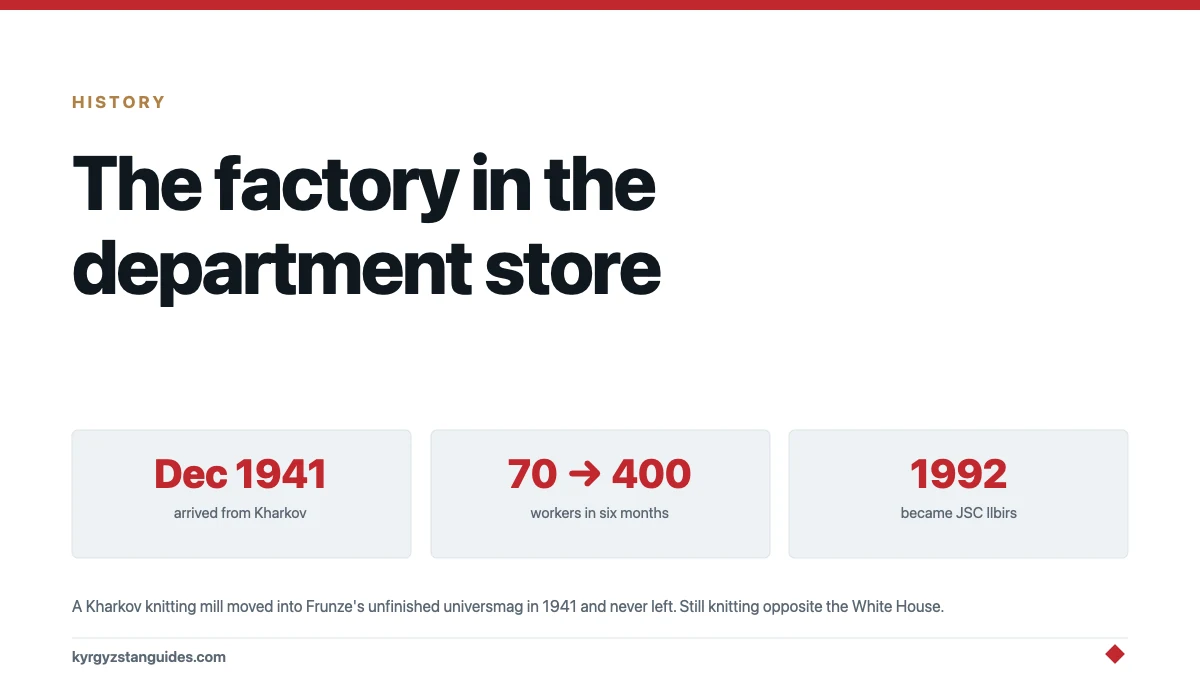
December 1941: seventy people and a train
The Soviet evacuation of industry from Ukraine began in earnest in September 1941; our piece on Kyrgyzstan in the Second World War lists the plants that ended up in the republic. Among them was the Kharkov knitting factory named after Anastas Mikoyan. According to the research essay, the enterprise in Frunze was formally created in December 1941 on the basis of that factory, and around seventy workers and engineers came with the machines.
There was nowhere ready to put them. The city had been building a central department store, a universmag, on Kievskaya Street, and it was not finished. The factory was put in it anyway. The essay’s phrasing is blunt: equipment for the front had to be produced immediately, and the factory was more necessary than a shopping centre. Vesti.kg, drawing on the building’s history, dates the workshops’ arrival to 1942; the company itself says it was “formed in 1941”. The difference is probably between the decision and the first shift.
Within six months the workforce was over 400, most of them women who had been housewives and had never worked a knitting machine. The factory trained them on site: an evening school was set up on the roof of the building. Through the war it filled military orders. Alongside it, as the photo archive notes, a cotton-spinning mill was founded in 1951 on Lev Tolstoy Street to feed it with yarn; by 1982 that mill was spinning 3,921 tonnes a year with 870 workers, and two of its women, G. Baisobaeva and S. Kulmatova, were made Heroes of Socialist Labour.
A factory in the wrong place, which was the right place
Soviet planners put factories on the edge of cities, in industrial zones, following the functional-zoning ideas that Le Corbusier’s circle had written into the Athens Charter. Ilbirs ended up in the administrative and symbolic centre of the capital, a few hundred metres from the government building and the main square, by accident of war.
The essay by Socialism in Kyrgyzstan makes an interesting observation about that accident. In the 1920s the Soviet economist Stanislav Strumilin had argued for the opposite of zoning: the “factory kremlin”, a city whose geographic centre was its production, so that the proletariat’s workplace replaced the market, the exchange and the church as the magnet of urban life. It required industry to be clean, which Strumilin thought Soviet science could arrange. Nobody built a city that way on purpose. Frunze got one by chance, with a relatively harmless trade, knitting, occupying the spot where a department store should have been. The essay calls the Ilbirs building the one real example of Strumilin’s idea.
The department store itself was built eventually, elsewhere. TsUM “Aichurek”, the one visitors know, was designed in 1970 by the architects Sobolevsky and Peresvetov and opened on 14 August 1974 on Chuy Prospect with the republic’s first escalators and 400 sales points on three floors. The 1940s universmag on Kievskaya never got its shop.
From Factory No. 1 to an association
In the Soviet directories the enterprise was Frunze Knitting Factory No. 1. In 1971 it became the head of the Frunze Knitting Association, which took in three plants: the main factory on Kievskaya, where cloth was knitted, dyed and finished from cotton, half-wool and wool yarn; the knitting factory on Salieva Street, which made underwear and outerwear from artificial fibres; and the Vasilyevka knitting factory in Alamedin district, with a further plant on what is now Deng Xiaoping Street in Kyzyl-Asker. The association ran in that form until 1989, when the Lev Tolstoy Street spinning mill was folded in and the whole thing was renamed, for a short time, the Frunze Industrial Trade and Knitting Association “Ilbirs”. By the 1980s it carried the honorific “in the name of the 60th anniversary of the USSR”.
Ilbirs is the Kyrgyz word for snow leopard. The animal is on Bishkek’s coat of arms, and the name was kept when the state let go.
1992: the only one of its kind
From 1989 the association worked on a leasehold basis, the late-Soviet halfway house between state ownership and private business. On 30 March 1992 it became the open joint-stock company Ilbirs. The research essay adds a detail the company does not: it was converted “without state participation”, which is unusual for a plant that size in Kyrgyzstan in 1992, where the state usually kept a block of shares.
What it kept was its niche. The company describes itself as the only enterprise in the republic producing knitted outerwear and underwear on warp-knitting, circular and flat-bed machines, as cloth, as panels and as cut pieces. Through the 1990s and 2000s it collected the kind of prizes that post-Soviet firms used to prove they still existed: a French cup in Paris in 1993 and a Spanish one in Madrid in 1994 “for high quality of knitted goods”, a quality cup at the Season of the East fashion festival in 1996, a Moscow cup in 2001, gold medals at the Kyrgyzexpo fairs of 2001, 2006 and 2007, and a second Paris award in 2008 “for technology and quality of the new millennium”. It says it creates about 300 new models a year, approved by an in-house art council, and that its goods have been shown in France, Spain and England.
That is the company’s own account, and it should be read as such. What can be checked is that the shop on the third floor of Kievskaya 77 is open on weekdays, the catalogue is online, and business directories list between 250 and 499 employees. For a Soviet light-industry plant in Bishkek, survival in any form is the exception; the worsted-cloth combine across town went into bankruptcy in 2013 and the knitwear industry as a whole is now a sewing industry working imported cloth, as our guide to the Kyrgyz textile trade explains.
The building, 2009 to 2017
The factory no longer fills its own building. In 2009 the government placed the International Academy of Traditional and Experimental Medicine in part of it, on condition that the academy pay utilities and do its own repairs. In September 2017 Vesti.kg reported, on complaints from people working next door, that the academy’s 1,180 square metres were half-ruined: basements needing capital repair, leaking pipes, the heating cut off by Bishkekteploset for unpaid bills, electric hotplates in offices in winter. The academy owed the Department of State Buildings about 100,000 som in rent, had 37 staff for a space several times the norm, and was said to be subletting the rest. The Audit Chamber had recommended in September 2016 that the transfer be reviewed; a year later nothing had changed.
The same report gives the building’s own history in two sentences: it appeared in the 1940s, was built as a department store, and in 1942 the workshops of a knitting factory supplying the front moved in. It calls the building historic. Whether it has formal protected status we could not establish.
Seeing it
Walk east along Chuy Prospect from Ala-Too Square and the Ilbirs block is on your right at the Kievskaya corner, opposite the government building’s grounds. There is a shop sign and a ground-floor arcade of small businesses; the factory shop is upstairs. Nothing announces that the building was meant to be a department store or that women learned to knit on its roof in 1942. The Soviet architecture walk passes it, and Factory No. 60, the other great wartime evacuation plant, is the companion story: the same trains, the same autumn, a very different afterlife.
What we could not establish
- Who designed the 1940s universmag, or when its construction began and stopped.
- The exact month production started. The company says 1941, the essay says December 1941, the building history says 1942.
- Current output and staff. Directories give a range; the company publishes no figures.
- Whether the building is a listed monument. Vesti.kg calls it historic; we found no register entry.
- What became of the Salieva Street and Vasilyevka plants after 1992.
FAQ
What is Ilbirs in Bishkek?
A knitwear factory and brand on the corner of Chuy Prospect and Kievskaya Street, founded in December 1941 from the Kharkov knitting factory named after Mikoyan, which was evacuated to Frunze with about seventy workers. It became the Frunze Knitting Association in 1971 and the joint-stock company Ilbirs on 30 March 1992. Ilbirs means snow leopard in Kyrgyz.
Why is the Ilbirs factory in the centre of Bishkek?
Because in 1941 the only building available was an unfinished department store on Kievskaya Street. The evacuated factory needed to start producing for the front immediately, so it was put into the empty shell, and it never left. Soviet planning would normally have placed a factory on the city’s edge.
Is Ilbirs still making clothes?
Yes, on a smaller scale. The company sells women’s, men’s and children’s knitwear wholesale and retail from its shop on the third floor of Kievskaya 77, and business directories list several hundred employees. It describes itself as the only producer of warp-knitted and circular-knitted garments in Kyrgyzstan.
Was the Ilbirs building ever a department store?
No. It was built in the 1940s to be one, but the knitting factory moved in during the war. Bishkek’s actual central department store, TsUM Aichurek on Chuy Prospect, was designed in 1970 and opened on 14 August 1974.
What was made at the factory during the war?
Military orders, mainly knitted underwear and garments for the Red Army. Within six months of arriving the workforce had grown from about 70 to over 400, most of them local women trained on site in an evening school set up on the factory roof.
Who occupies the building today?
The factory and its shop, ground-floor businesses, and since 2009 the International Academy of Traditional and Experimental Medicine, whose 1,180 square metres Vesti.kg described in 2017 as half-ruined and in rent arrears to the Department of State Buildings.
Sources: OJSC Ilbirs: about us (Russian), Foto.kg: at the Frunze knitting factory, 1972 photo with archive note (Russian), Foto.kg: the Frunze cotton-spinning mill, 1960 photo with archive note (Russian), Socialism in Kyrgyzstan: scientific-technical utopianism in the urban space of Bishkek (Russian), Vesti.kg, 6 September 2017: the Ilbirs building suffers from bad tenants (Russian), Tazabek: 25 years on the Kyrgyz market, brands in industry and trade (Russian)