Bishkek is a Soviet city that has not yet decided what to do about being one. Most of what you will walk past downtown was designed between 1936 and 1987 by architects whose names are recorded and almost never put on a plaque. This is a walk with the names attached.
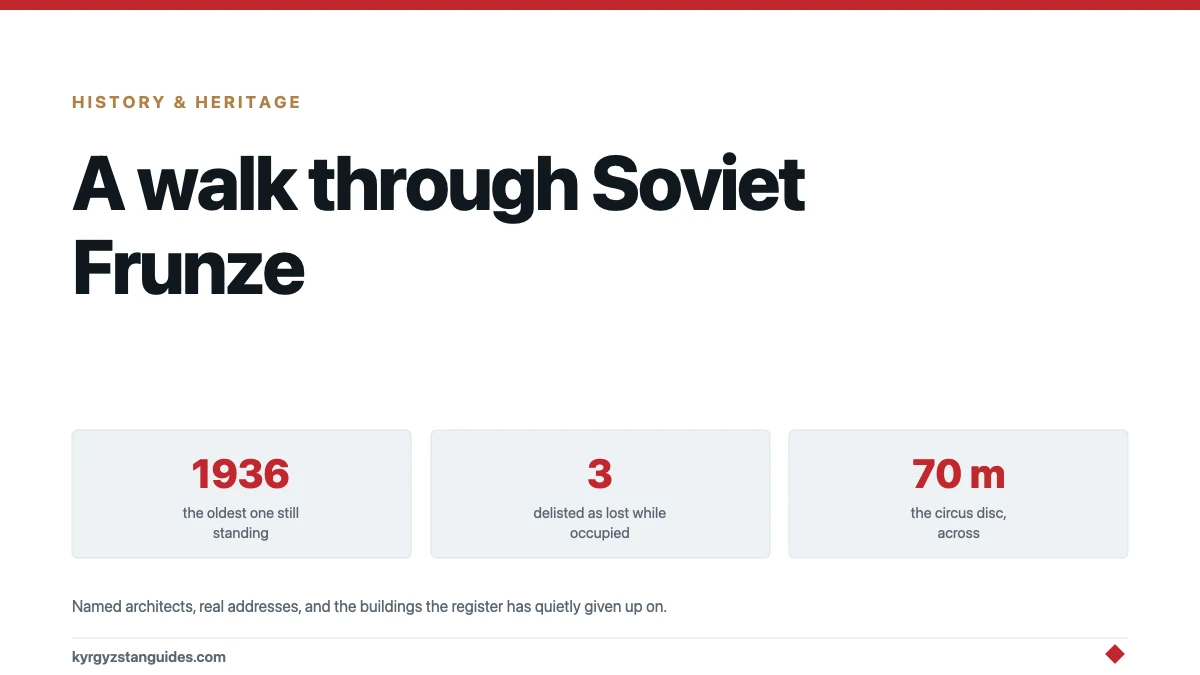
One thing to know before you start. In July 2025, three buildings were struck off the republican-significance monuments list as "lost" — despite physically standing and being occupied by state bodies at the time. That is the condition of heritage protection here, and it colours everything below.
Start at Ala-Too Square
The White House. Built for the Central Committee of the Communist Party of the Kirghiz SSR and the Council of Ministers, begun in the early 1980s and finished around 1984. Seven storeys. Moscow allocated 10 million rubles, which turned out not to be enough, and the republican budget made up the difference.
The architect list depends on who you ask. One account names Urmat Alymkulov, Alexander Zusik, Rafgat Mukhamadiev, Oleg Lazarev and Saparbek Sultanov. A shorter attribution credits Mukhamadiev and Alymkulov. We are giving you both rather than tidying it up.
Its later history is more dramatic than its architecture. It was seized during the Tulip Revolution on 24 March 2005 and stormed and partly burned in April 2010. In March 2013 a court hearing about the April events was held on its roof. Since 2010 it has housed the Jogorku Kenesh, the parliament, with the president occupying part of the seventh floor.
The State Historical Museum, at Chuy Avenue 112 on the same square, was completed in 1984 as the Frunze branch of the Central Lenin Museum, timed to the sixtieth anniversary of the Communist Party of Kyrgyzstan.
Here the attributions conflict outright. One source lists S. Abyshev, R. Asylbekov, A. Kudelyey, V. Ivanov and M. Satybaldiyev. Another says the winning open-competition design was by Rafgat Mukhamadiev and Urmat Alymkulov, working at the Kirgizgiprostroi institute, and that the building went up in under five years under political deadline pressure. The same two names appear elsewhere attached to the White House instead. Somebody has confused two projects and we cannot tell you which.
Walk west along Chuy Avenue
The Kyrgyz National Philharmonic, Chuy Avenue 251, architect A. Pechenkin. Dated 1980 by some sources and 1981 by others.
TsUM Aichurek, the central department store, at Chuy Avenue 155, by B. Sobolevsky and Yu. Peresvetov. One source dates it 1974 to 1976; a newspaper archive puts the opening at 14 August 1974. It had the first escalators in the republic, which was the thing people actually talked about.
The Central Telegraph and its city clock, at Chuy and Abdrakhmanov, 1985, by Adar Isayev, Irsysbek Ishenov and Orozbek Zhanekov. The clock tower has been sold to a bank and is on the list of things people worry about.
The three big round and odd ones
The Kyrgyz State Circus is the building you cannot mistake. A disc over 70 metres across and 20 metres high, with a dome assembled from 140 prefabricated reinforced-concrete sections and a 2,000-seat auditorium. The design came from Moscow's institute for entertainment and sports buildings and was adapted locally by Frunzegorproekt under Aleksey Nezhurin. Construction finished in 1976 and it was commissioned at the end of that year, but the first mass public performance was not until 1978. Other sources add Leonid Segal, I. Shadrin and D. Leontovich to the credits.
The Palace of Sports, named after Kaba uulu Kozhomkul, at Togolok Moldo 40. Built in 1974 by V. Marukov and N. Kostin of the Soyuzsportproekt institute. At the time it was among the largest sports complexes in the USSR, with an Olympic-standard pool and a concert hall seating around 3,000.
The Central Wedding Palace, Abdrakhmanov 197. Architects Alexander Klishevich and Alexander Loginov — sources also spell the second name Logunov and give a different initial. Dated 1986 or 1987 depending on the source.
This is the best building in the city and the story behind it is the reason. The form is a druse of mountain rock crystal: spires rising upward, accordion-folded side glazing, the whole thing set about three metres above ground level. The architects' own line was that anything connected with the mountains could confidently be considered theirs. There were genuine fears it would be mistaken for a Catholic church, and to get the project approved at all it was registered on paper not as a palace but as a consumer-services combine. More than 75,000 marriages have been registered in it.
The older layer, 1936 to 1957
These are lower, plainer and easy to walk past.
| Building | Architect | Year |
|---|---|---|
| House of Government (now AUCA / Supreme Court) | Yury Dubovoy | 1936 |
| Ala-Too Cinema | Vladimir Kalmykov | 1938 |
| Passenger Railway Station | E. Limar's Kharkov group | 1938 |
| Kyrgyz Institute of Education | Pavel Ivanov | 1938 |
| Palace of Pioneers, now the Youth Theatre | Vladimir Nusov | 1951 |
| Polytechnic Institute | G. Nazaryan | 1954 |
| Old Frunze Airport, Mira Avenue | Evgeny Pisarskoy | 1956 |
| City Council, on the former Soviet Square | Pavel Ivanov | 1957 |
The railway station is the one to go inside. It opened ceremonially on 1 May 1938, it is a monument of republican significance, and the interior has ceiling paintings and moulded plaster decoration. The city's urban planning directorate has published its condition problems openly: the roof needs repair, the foundations need waterproofing, the basement is damp with concrete corrosion, and the perimeter drainage was removed during earlier paving works.
The small, strange ones
The souvenir shop Ulitka, "The Snail", 1971, by Rafkat Mukhamadiyev and Kanybek Alykulov. The Planetarium, 1974. Café Bermet in Druzhba Park, from the seventies or eighties. The bus station, 1962, architect unrecorded. Restaurant Naryn, 1984, by Viktor Borovikov and Zamirbek Shambetov — and that one is gone, de-listed in 2016 and demolished in 2017.
The Garrison Officers' House, now the Kyrgyz-Russian Slavic University, 1987, by Urmat Alymkulov and Saparbek Sultanov. Victory Square, 1985, by Lyzenko and Bukhaev.
What the register actually does
The framework is a government regulation of 20 August 2002 on the registration, protection and restoration of historical and cultural heritage. Protection runs in tiers: republican significance, approved centrally, and local significance, approved municipally.
In practice, de-listing is the mechanism by which buildings disappear. On 2 July 2025, Resolution No. 394 excluded three Bishkek buildings from the republican-significance list as "lost":
- The Chuy oblast administration building of 1936 at Abdymomunov 205, now the Supreme Court - The KyrgyzKABAR news agency building of 1940 at Sovetskaya 175 - The Jogorku Kenesh building of 1951 to 1955, rebuilt in 1965, at Abdymomunov 207, now the foreign and economy ministries
All three were standing and in use. They were recorded as lost anyway.
A 2021 study of the city's register found 270 protected buildings, 74 of republican and 196 of local significance. Of the local ones, 14 had been demolished, six replaced by high-rises, ten could not be located, six were abandoned and 28 had been de-listed.
Doing the walk
Start at Ala-Too Square, go west on Chuy past the Philharmonic to TsUM, cut north to the railway station, then east to the Wedding Palace and the circus. That is three to four hours at a normal pace with stops, all flat, all central.
Two honest limits. There is almost no signage, so you are reading this on your phone in front of the buildings. And several of the attributions above are contested, which we have flagged rather than smoothed over — the reliable account of who designed Bishkek does not exist in a single place, in any language.
For the decorative side of the same era, see Bishkek's Soviet mosaics, which includes one panel destroyed in 2025 while still on the register. For the buildings that never made it to the city, Soviet sanatoriums.
FAQ
What Soviet buildings should I see in Bishkek?
The Central Wedding Palace on Abdrakhmanov, designed as a druse of rock crystal; the State Circus, a 70-metre concrete disc; the White House and the State Historical Museum on Ala-Too Square; the 1938 railway station, which is a monument of republican significance and worth going inside; and TsUM on Chuy Avenue, which had the republic's first escalators.
Who designed Bishkek's White House?
Sources differ. One names Urmat Alymkulov, Alexander Zusik, Rafgat Mukhamadiev, Oleg Lazarev and Saparbek Sultanov; another credits Mukhamadiev and Alymkulov alone. Construction began in the early 1980s and finished around 1984, for the Communist Party Central Committee and the Council of Ministers.
Is Bishkek's Soviet architecture protected?
Partly, and weakly. Kyrgyzstan has republican and local tiers of heritage protection under a 2002 regulation, but buildings are regularly de-listed and then demolished. In July 2025 three standing, occupied Bishkek buildings were struck off the republican list as "lost".
Why does the Wedding Palace look like a church?
It was designed as a druse of mountain rock crystal, with upward spires and folded glazing, and the architects were aware at the time that it might read as a Catholic church. To get approval, the project was registered on paper as a consumer-services combine rather than as a wedding palace.
How long does a Soviet architecture walk in Bishkek take?
Three to four hours at an unhurried pace, covering Ala-Too Square, Chuy Avenue west to TsUM, the railway station, the Wedding Palace and the circus. The route is entirely flat and central. There is essentially no interpretive signage on any of it.
When was Bishkek's circus built?
Construction was completed in 1976 and the building was commissioned at the end of that year, but the first mass public performance took place in 1978. The dome is assembled from 140 prefabricated reinforced-concrete sections and the auditorium holds 2,000.
One of the strangest survivals of that era is on Toktogul Street: see Kyrgyzstan and the Soviet space programme, a 1,500-person bureau whose instruments reached Venus, Mars and Halley’s Comet.
The administrative sequence behind all of this — oblast, ASSR, union republic — is set out in how the Kyrgyz SSR was formed.
The city has had three names, and what the current one means is genuinely unsettled: see Pishpek, Frunze, Bishkek.
The man the city was named after was born here and died at forty: see Mikhail Frunze, including the house-museum and its prices.