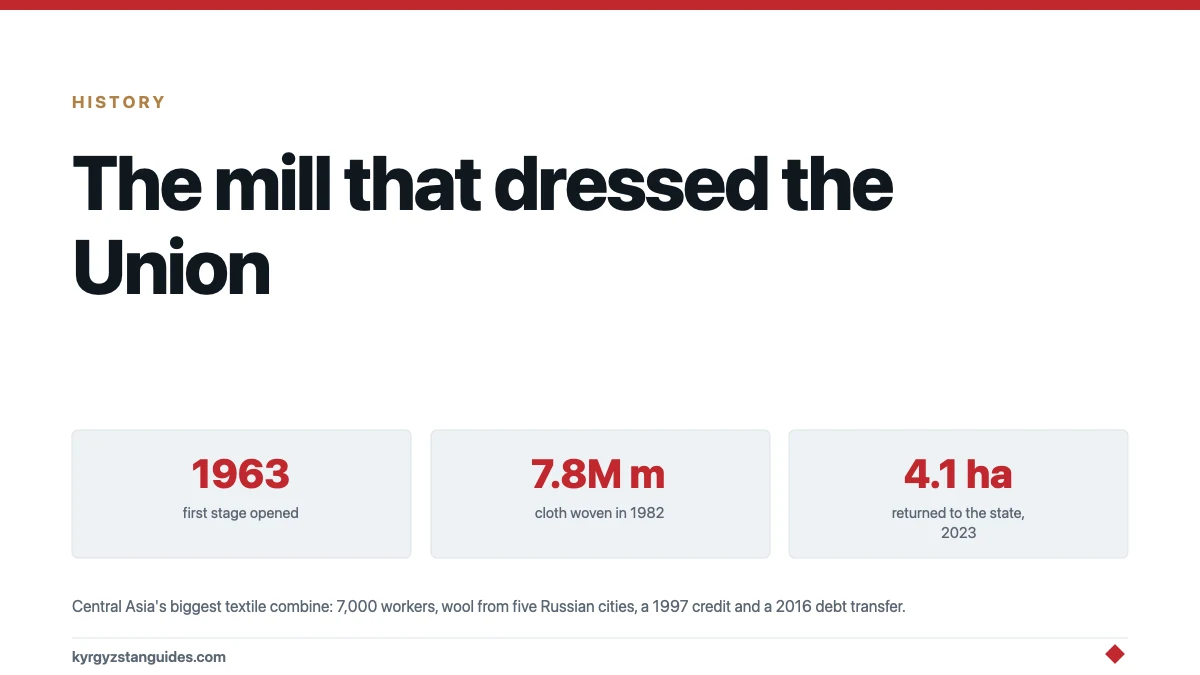
On the eastern edge of Bishkek, between the power station and the Madina market, there is a 40-hectare site that once employed more than seven thousand people. The Kyrgyz Worsted-Cloth Combine, KKSK in its Russian initials, wove wool for suits and coats that went to every Soviet republic and several socialist countries. At its 1982 peak it turned out 7.8 million metres of woollen cloth a year.
Today it is a bankrupt joint-stock company that was renamed “Bitex Company”, and its land is the subject of a security-service case against one of the country’s best-known businessmen. In September 2023 the State Committee for National Security announced it had returned the combine’s property and 4.1 hectares to the state.
Nothing about this plant has been written in English. What follows is drawn from the archive of the Frunze house-museum, the Soviet-era encyclopedia entry reproduced by the Kyrgyz photo archive, a 2014 newspaper feature that tracked down the first women trained for it, Kyrgyz business press on the bankruptcy, and the security service’s own 2023 statement. Dates clash in one place and we say where.
Built in the seven-year plan
Frunze had made cloth before. A woollen mill named after the Czechoslovak communist Klement Gottwald had operated in the city since 1927. The combine was something else in scale. According to the archive note held by the Frunze house-museum, it rose on the eastern outskirts of the capital during the Soviet seven-year plan of 1959 to 1965, as “the largest enterprise in Central Asia” of its kind. In 1962 the old Gottwald mill was merged into the half-built combine. The first stage, a cloth-spinning line with 7,080 spindles, entered service in 1963, with nearly seven times the capacity of the Gottwald mill.
The specification reads like a Soviet brochure because it comes from one. A main production building of 60,000 square metres. Twenty-five air-conditioning plants to hold temperature and humidity steady in the spinning halls, which wool processing needs. Shuttleless looms in the weaving shop. A finishing line for crease-resistant cloth. A roving shop with equipment the note calls “literally unique”. Around the main building: central repair workshops, an administrative block, warehouses, a 13-hectare orchard, and squares of trees on the west and east sides.
Then the town around it. A housing estate, a children’s complex, a Palace of Culture, and a vocational school with its own hostel, canteen and gym. Soviet planners did not build a factory; they built a district. The combine is the reason that stretch of Chuy Prospect looks the way it does.
The first thirty
The workforce was trained before the machines arrived. A January 2014 feature in Megapolis, marking the combine’s fiftieth anniversary, found some of the first women who worked there. Their training ran from 1962 to 1964 at Vocational School No. 17 in Frunze, with the state covering housing, food and even clothing. The second year was spent at large combines in Russia: groups went to Bryansk and Minsk, and one group of thirty travelled by train to Losino-Petrovsky near Moscow to learn the trade. They came home on 31 July with certificates as fifth-grade roving-frame operators.
Valentina Kurganskaya, one of that first thirty, described the early months: the women started as general labourers, helping fitters assemble the machines they would later run, and then trained the next intake themselves. She remembered Saturday tree-planting shifts around the plant, and the pride of a combine whose cloth “was known across the whole Union”. By the time of the interview she and her classmates were 66 and 67, and the company they were congratulating was in bankruptcy proceedings and, the paper noted, had not acknowledged its own anniversary.
Megapolis dates the start of work to 1964, fifty years before its article. The archive note says the first stage opened in 1963. The simplest reading is that the plant was commissioned in 1963 and the first trained cohort started production in 1964; both sources can be right.
What it made
The encyclopedia entry lists the output. Suiting and dress fabrics using synthetic blends, coat cloth, half-wool heavy cloths, blankets and yarn. Thirty cloth articles in 250 patterns, with up to 30 per cent of the range renewed each year. Designed annual capacity was 6,500 tonnes of woollen yarn, 8.6 million linear metres of grey cloth and 8.3 million of finished cloth. In 1982 the combine produced 7.8 million metres of woollen cloth and 5,709 tonnes of yarn, and 22.8 per cent of its cloth carried the Soviet State Quality Mark.
One detail matters for anyone who has read about Kyrgyzstan’s wool problem. The combine did not run on Kyrgyz sheep. Its raw material came as processed wool from combines in Barnaul, Balakovo, Saratov, Kamensk and Kalinin, and from the wool-scouring plant at Dzhambul in Kazakhstan. Kyrgyz greasy wool went out of the republic for washing and combing; finished tops came back. The combine sat at the end of a union-wide supply chain, and its cloth went back out along the same chain to clothing factories across the USSR. A photo-archive note adds that by the end of the Soviet period more than 7,000 people worked in workshops covering over six hectares, and that in the early 1990s the plant was still producing up to three million metres a year, with buyers from other republics queuing for contracts. Alexei Kosygin, the Soviet premier, toured its halls; the photograph survives.
Two of Bishkek’s Soviet mosaics are on the site, Sagynbek Ishenov’s “Weaver Women” of 1970 and a sports panel by Herzen from the same year. Our guide to the city’s mosaics explains why you probably cannot get to them: the territory is closed.
After 1991: credits, courts, a seized building
The supply chain broke in both directions at once. The Russian combines that sent wool and the clothing factories that bought cloth were now in other countries with their own currencies. The plant was privatised and, in the archive’s phrase, “could not withstand the waves of successive crises”, with frequent changes of owner.
In 1997 it took on two technical credits for equipment, one through the Japanese government and one through Germany’s KfW bank. The Kyrgyz Ministry of Finance acted as creditor and signed a debt obligation with the combine for 916,137 Deutschmarks and $5,246,600. That debt is the thread that runs through everything after.
By 2009 the plant owed the tax service 4.5 to 5 million som. With penalties the claim grew to 26 million. The tax service had earlier taken one of the combine’s buildings; the Supreme Court ruled in 2009 that the building was the combine’s and ordered an eviction, but the district tax office stayed, and in 2012 the Bishkek city court ordered the tax service to pay the combine 17 million som in rent. The combine’s chairman, Kubanychbek Minbaev, told Vecherny Bishkek in 2013 that the two sides were still in court over it.
In June 2013, on the tax service’s application, the Bishkek interdistrict court declared the combine insolvent and appointed a special administration. On 19 July 2013 the city court upheld the ruling. Minbaev called it unjust, said the court had not notified the company, and accused the temporary administration of buying the judge. The board chairman had asked the government for six months to save the plant. Its outstanding technical-credit debt was put at about $6 million.
In 2016, 24.kg reported that the government was still offering the combine to investors under a programme to relocate Chinese plants to Kyrgyzstan, while the company’s management argued that bankruptcy was “a veiled form of raiding” and that no Kyrgyz enterprise had ever restarted after it.
2014 to 2016: how the land changed hands
What happened next was laid out by the security service, the GKNB, in a statement on 19 September 2023, reported by Kloop, Kaktus.media and Tazabek.
In 2014, according to the GKNB, people affiliated with Sharshenbek Abdykerimov, the founder of the Ayu holding and a former member of parliament, acquired a controlling stake in the combine and in a company called KPF Kasiet in Tokmok. In 2015 the combine pledged its technological equipment and 4.1 hectares of land at Chuy Prospect 4 to the Ministry of Finance’s credit fund as security for the 1997 debt.
In 2016 the officers of both companies wrote to the prime minister asking that the credit agreement and the pledged property be moved from the combine to KPF Kasiet. A government order of 8 July 2016 did exactly that: the combine’s debt on the 1997 credits, now 519 million som, was transferred to KPF Kasiet, which offered the state other collateral, and all encumbrances were lifted from the combine’s property. The combine was then re-registered as Bitex Company. In the GKNB’s account, that is how Abdykerimov’s affiliates came to own the land at Chuy 4 free of the debt that had sat on it for nineteen years.
We have not seen a response from Abdykerimov or Bitex to these specific claims. His lawyer commented publicly on the wider case at the time, according to Kaktus.media, but the article we could access does not quote him on the combine.
2023: returned to the state
On 12 September 2023 the Pervomaisky district court in Bishkek ordered Abdykerimov’s arrest in absentia on charges including money laundering, forging excise stamps and organising a criminal group; his whereabouts were not public. In April 2023 the state had already confiscated the Ayu holding’s alcohol plants, with the president saying the company had not paid taxes and had forged excise stamps. A week after the court order, on 19 September, the GKNB said the combine’s property complex and the 4.1 hectares had been “returned to state revenue”.
What the state does with 4.1 hectares of former mill between the power station and the city’s biggest clothing bazaar is the open question. The site sits in the district that now sews most of the country’s exports; the informal garment industry that grew up around the Madina and Dordoi markets is the successor, in a sense, to the plant that once dressed the Union. In March 2026 Abdykerimov was still writing to the presidential administration about another seized asset, a Bishkek shopping centre, according to Economist.kg, so the wider dispute was not over.
Can you see it?
From Chuy Prospect, east of the power station’s chimneys, the long low halls and the water tower are visible behind a wall. The territory is closed and there is nothing to visit. The old workers’ district behind it is ordinary Bishkek housing now. If the city’s industrial past is what you came for, the Soviet architecture walk covers what is open, and Factory No. 60 tells the story of the machine-building plant that shares the same arc. The Kaindy cable plant, an hour west, went the same way by a different route.
What we could not establish
- The exact opening date. 1963 for the first stage in the archive note; 1964 in Megapolis; a forum post cites 30 December 1968, which we could not source and may refer to a later stage.
- The owners between privatisation and 2014. The archive says only “frequent changes”.
- Whether anything is produced on the site today. A business directory lists a “Kyrgyz Cloth Combine (KKSK) Ltd” making woollen cloth and blankets; we could not confirm it operates.
- Abdykerimov’s reply to the GKNB’s account of the 2016 transfer.
- The current status of the 2023 case.
FAQ
What was the Kyrgyz Worsted-Cloth Combine?
A Soviet woollen textile mill in Frunze, now Bishkek, whose first stage opened in 1963 on a 40-hectare site on the eastern edge of the city. It made suiting, coat cloth, blankets and yarn; in 1982 it produced 7.8 million metres of cloth. More than 7,000 people worked there by the end of the Soviet period.
Is the Bishkek worsted-cloth combine still working?
Not as a mill. The company was declared bankrupt in 2013, renamed Bitex Company, and in September 2023 the security service said its property and 4.1 hectares of land had been returned to the state. A directory lists a small cloth business under the old initials, but we could not confirm it operates.
Where was the combine?
At Chuy Prospect 4, on the eastern edge of Bishkek, near the thermal power station and the Madina market. The site is closed to visitors. Two 1970 Soviet mosaics, including “Weaver Women”, are inside the territory.
Did the combine use Kyrgyz wool?
Mostly not. Its raw material arrived as processed wool from combines in Barnaul, Balakovo, Saratov, Kamensk and Kalinin in Russia and from the Dzhambul scouring plant in Kazakhstan. Kyrgyz raw wool was washed and combed elsewhere in the Union.
Why was the combine’s land taken back by the state?
Because, according to the security service’s 2023 statement, a 2016 government order moved the combine’s 519 million som debt to another company and lifted the pledge on 4.1 hectares, after which the land passed to people linked to Ayu holding founder Sharshenbek Abdykerimov. The GKNB called the transfer illegal and returned the land and property to the state.
How big was the combine?
The complex covered 40 hectares, with a 60,000 square metre main building, a 13-hectare orchard, its own housing estate, Palace of Culture and vocational school. Designed capacity was 6,500 tonnes of yarn and 8.3 million metres of finished cloth a year.
Sources: Foto.kg: launch of the combine, with the Frunze museum archive note (Russian), Megapolis: the combine’s 50th anniversary, January 2014 (Russian), Kaktus.media: GKNB on the transfer of the combine’s property, September 2023 (Russian), Kloop: GKNB returns the combine’s property and 4.1 ha to the state (Russian), 24.kg: how to sell off the enterprises, August 2016 (Russian)