The name means “blue walnut”. Coal, not walnuts, is the reason it is there. Kök-Jangak sits on a spur of the Fergana range above Jalal-Abad, at about 1,500 metres. For most of the twentieth century it existed for one reason: there was coal in the hillside, and the Soviet Union wanted it.
Few travellers go there, and almost nothing in English describes it. What exists is scattered: a Soviet encyclopedia entry, a US Geological Survey table, a 2015 anthropology study of Kyrgyz mining towns, and a 2023 photo essay by a Kyrgyz photographer. Put together, they tell a story that is common in this part of Kyrgyzstan and still worth telling properly. This piece sticks to those sources and flags each gap in them as it goes.
A mine first, a town later
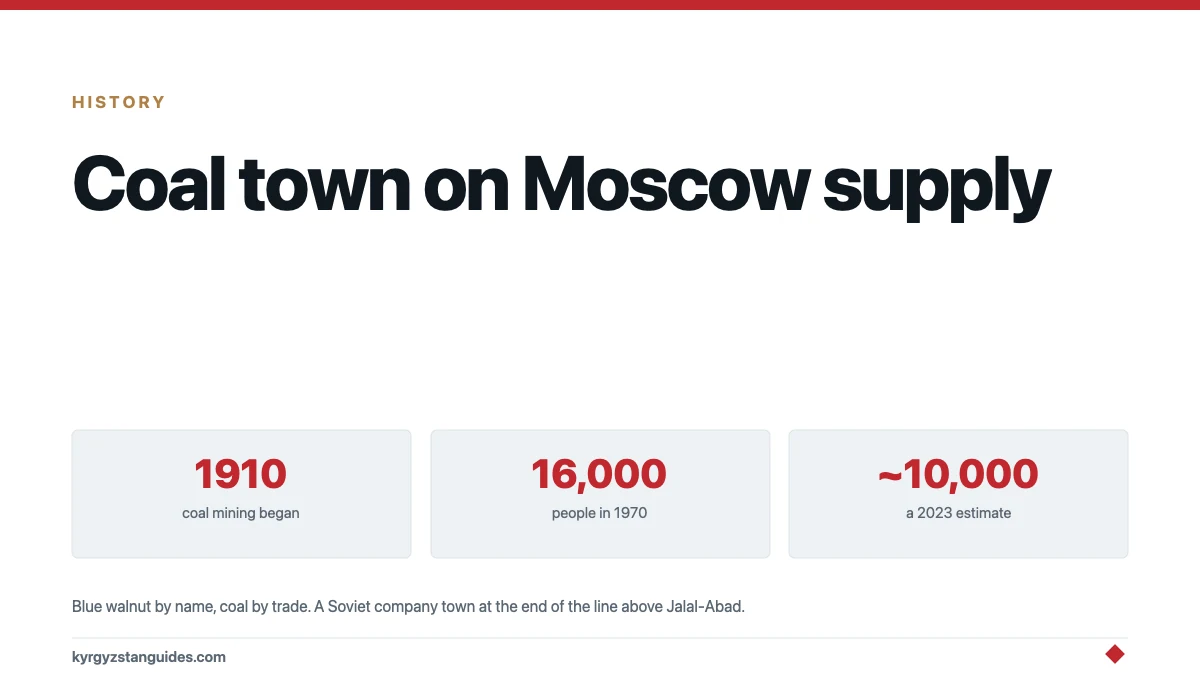
According to the Great Soviet Encyclopedia, Kök-Jangak (spelled Kok-Yangak in Russian-era sources) grew up in 1910 around the working of a hard-coal deposit. It was given town status in 1943, in the middle of the war, when coal from anywhere it could be dug mattered more than usual.
The same entry records three details that say a lot about what the town became:
- It was the end of a railway branch from Andijan. The line ran up to the mine and stopped there; the town was the terminus, not a stop on the way to somewhere else.
- It had about 16,000 inhabitants in 1970.
- Besides coal, it had a garment factory and a branch of the Kyzyl-Kiya mining technical school.
That last detail is the town in miniature. Men went down the mine. A clothing factory gave work to women. The technical school trained the next shift of miners on the spot, so young people had no need to leave.
What residents remember
In 2015 the anthropologist Emil Nasritdinov of the American University of Central Asia published a study of six Kyrgyz mining settlements, Kök-Jangak among them, in CABAR.asia. The interviews are anonymous, and they are memories rather than records, but they fill in what the encyclopedia leaves out.
One resident described the clothing factory as having worked from 1969 to 1994, employing about 800 women and making clothing and pyjamas. The same resident remembered the technical college and the dormitory where young miners lived until they were given a flat or land for a house.
The detail that came up most often was supply. “In Soviet times, Kok Jangak received provision directly from Moscow,” one resident said. Goods that could not be found elsewhere were on the shelves here, and people came from other towns to buy them. Others remembered an ice rink where they played hockey, a decorated New Year tree in the square, and a Miner’s Day celebration with music and picnics in the hills. “The mine united us all,” one said.
The same resident also recalled the mine producing “up to 200 thousand tons of coal every day”. That figure cannot be right as a daily number; it is far beyond what a mine of this kind could manage. It may be a misremembered annual figure, or a figure for a wider group of mines. We repeat it only as an example of how much the mine meant to the people who worked it, not as a measure of output.
A town on special supply
The Moscow-supply story is not only nostalgia. In April 2023 the Kyrgyz photographer Marat Sayranbaev published a photo essay on the town through AKIpress. He described the same thing in plainer terms. In Soviet times the town supplied coal to factories and stood on a special state subsidy, “on Moscow supply” as people put it. That meant Czechoslovak shoes or a Yugoslav coat could be found in its shops. It was a prestigious small town, he wrote, where people from the larger city of Jalal-Abad came to shop.
That arrangement is worth understanding, because it explains why the fall was so steep. A Soviet mining town was not paid for by its coal in any market sense. It was kept supplied because the coal was needed. When the Soviet Union ended, the coal still existed, but the supply line from Moscow did not.
After 1991
The 1990s did to Kök-Jangak what they did to most single-industry towns in Kyrgyzstan. Sayranbaev wrote that the town nearly died and could easily have joined the list of post-Soviet ghost towns, until the state stepped in again.
Nasritdinov’s study gives the human side. By the time of the interviews, many apartment blocks stood empty, and people were taking them apart for building materials. His photograph shows locals dismantling a two-storey block. The sewer system had not worked for years, and residents of the upper floors of the five-storey blocks had to use the yards. One resident put the economy of that time in a single passage:
“Today, the city has no jobs. We can earn only by dismantling the houses. One brick costs 25 tyin. Sometimes you can earn 30-40 soms per day.”
The study made a further point that matters for anyone thinking about these towns. Mining towns on the main highways, such as Tash-Kömür and Kadji-Say, at least had trade passing through. Dead-end towns like Kök-Jangak, Ak-Tyuz and Mailuu-Suu had nothing passing through at all. The railway that once made Kök-Jangak a terminus now made it a dead end.
The study also recorded a change in who lived there. Residents remembered a mixed, mostly Russian-speaking population before 1991, and the author noted that this diversity had largely gone. He also noted at least one clash in the town in which Kurdish Turks were caught up.
Kök-Jangak today
The town has not disappeared. Sayranbaev estimated its population in 2023 at about 10,000, “possibly less”, well down on the 16,000 recorded in 1970. He described it as subsidised again, now without large-scale coal mining, and as preparing to celebrate its 80th anniversary, which matches the 1943 grant of town status.
Coal has not entirely stopped either. The US Geological Survey’s 2022 yearbook on Kyrgyzstan lists Kök-Jangak (as Kok-Yangak) among the deposits worked by the country’s seven underground coal mines and five open pits. What the survey does not give is a separate output figure for the town, and we could not find one in any public source.
The study’s photographs, one of them by the anthropologist Mathijs Pelkmans, include a Lenin monument still standing in Kök-Jangak, alongside ones in Kadji-Say and Tash-Kömür. He noted that in these towns the communist past is generally treated with respect rather than torn down.
Visiting Kök-Jangak
Kök-Jangak is a short drive into the hills from Jalal-Abad, which is the natural base; our Jalal-Abad guide covers the city as a base. There is no tourist infrastructure in the town itself, and you should not expect any.
What you can see is the shape of a Soviet company town: the mine buildings, the apartment blocks, some standing and some half-dismantled, the square where the New Year tree went up, and the end of the railway line. Treat it with the tact you would bring to any small town that has had a hard few decades. Ask before photographing people or homes, and keep away from mine workings and any building that looks unsafe.
If the Soviet industrial south interests you, Kök-Jangak pairs naturally with two other stops. Mailuu-Suu is a uranium town whose second life came from a light bulb factory. Kadji-Say on Issyk-Kul extracted uranium from burned coal. And if the name has you thinking of walnuts, the real walnut forests are at Arslanbob, further north.
How it fits the wider pattern
Kök-Jangak’s story follows the same arc as much of Kyrgyzstan’s Soviet-built economy. One industry was planned for a union-wide market. It was propped up by supply from the centre, and it fell hard when that supply stopped. The details differ, but the shape repeats in the collapse of the collective farms, in the open-pit coal of Kara-Keche, and in the reason so many people from towns like this now work abroad, covered in our piece on labour migration.
What we could not establish
- Current coal output from Kök-Jangak. The USGS lists the deposit among those worked, but gives no town-level figure.
- An exact current population. The 2023 estimate of about 10,000 comes from a photographer’s caption, not a census.
- Whether trains still run on the branch line. We found no current timetable.
- The real Soviet peak output. The figure a resident gave, 200,000 tons a day, cannot be correct as stated.
FAQ
What does Kök-Jangak mean?
It means “blue walnut” in Kyrgyz: kök is blue (or green), and jangak is walnut. Despite the name, the town was built on coal, not walnuts. Older Russian sources spell it Kok-Yangak, and you will also see Kok-Jangak and Kök-Janggak.
When was Kök-Jangak founded?
The settlement grew up in 1910 around a hard-coal deposit, according to the Great Soviet Encyclopedia, and became a town in 1943. In 2023 it was preparing to mark its 80th anniversary as a town.
What was Kök-Jangak known for in Soviet times?
Coal, and a special supply status. Residents and a 2023 photo essay both describe the town as “on Moscow supply”, with goods in its shops that were hard to find elsewhere. It also had a garment factory employing about 800 women and a branch of a mining technical school.
How many people live in Kök-Jangak?
About 16,000 in 1970, according to the Great Soviet Encyclopedia. A 2023 estimate put the population at about 10,000, possibly less. We found no recent official census figure for the town.
Is coal still mined at Kök-Jangak?
On a reduced scale. The US Geological Survey’s 2022 yearbook lists the Kok-Yangak deposit among those worked by Kyrgyzstan’s coal mines, but there is no public output figure for the town. A 2023 report described it as without large-scale coal mining.
Is Kök-Jangak worth visiting?
For travellers interested in Soviet industrial history, yes, as a half-day trip from Jalal-Abad. There are no tourist facilities. What you see is a former company town in decline: mine buildings, apartment blocks, a Lenin monument and the end of the railway line.
Sources: Great Soviet Encyclopedia: Kok-Yangak (Russian), CABAR.asia: Emil Nasritdinov on Kyrgyzstan’s mining towns (2015), AKIpress Reporter: Kök-Jangak photo essay by Marat Sayranbaev (2023, Russian), USGS Minerals Yearbook 2022: Kyrgyzstan