Kadji-Say, on Issyk-Kul's south shore, was never a uranium mine in the ordinary sense. It was stranger than that: a uranium-bearing coal deposit, mined from the late 1940s to 1967, burned in a power plant on site — and the uranium was extracted from the ash.
The method sounds like a joke about Soviet resourcefulness and is simply chemistry: some coals concentrate uranium, and incineration concentrates it further. The assessment in the OSTI research database describes the arrangement plainly — a coal-fired thermal power plant and a processing plant for extracting uranium from the produced ash, operating at a lakeside village that today sells itself on beaches and apricots.
What the operation left behind, what it actually measures as, and who finally paid to clean it up is a story with more good news in it than you would guess — and it is the part of Kyrgyzstan's uranium legacy that, unlike Mailuu-Suu, almost nobody has written up.
The operation, 1948–1967
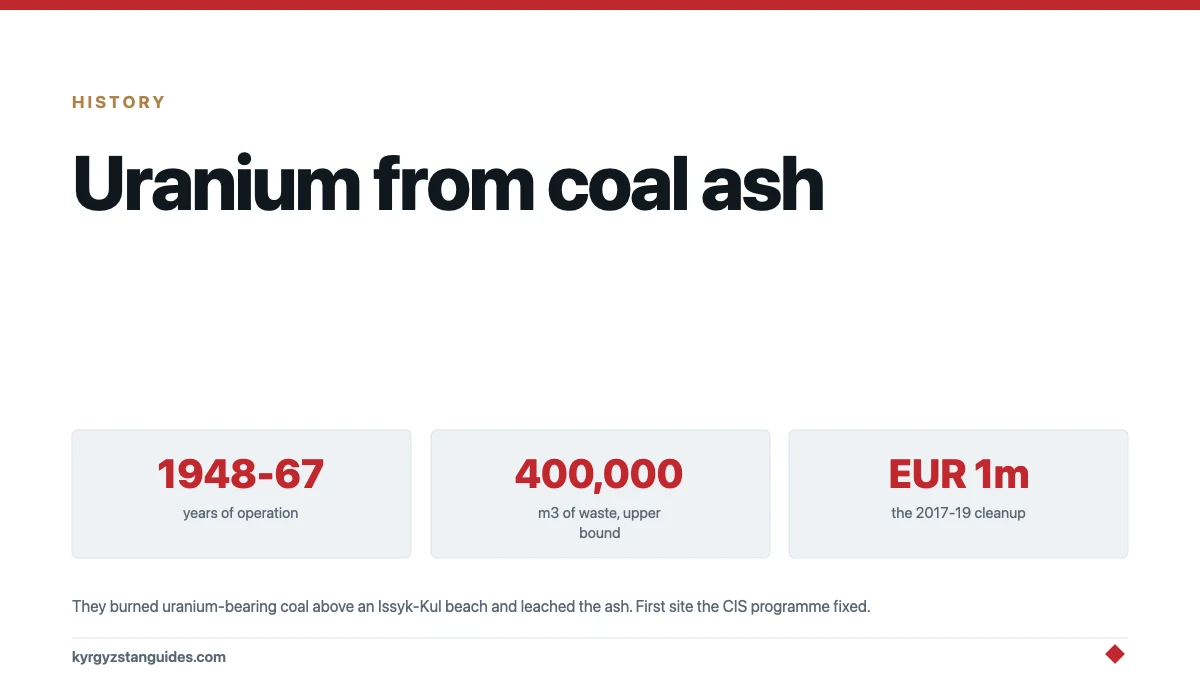
The dates come with a one-year wobble the sources never resolved: an IAEA presentation gives the site's duration as 1948–1967, the OSTI assessment as 1949–1967, so call it 1948/49 to 1967 — roughly two decades of digging uraniferous coal, burning it for power, and leaching uranium oxide out of the ash with acid.
A second OSTI record puts the legacy at up to 400,000 cubic metres of uranium waste. The tailings sat in the relief above the village, between two creek beds — which on the south shore of Issyk-Kul means above the water everything drains toward. Fish sampled in the lake showed measurable arsenic uptake, with a liver bioconcentration factor of 75 for arsenic against 1.6 for uranium: the pollutant that actually moved through the food web here was the arsenic that travels with this kind of ash, more than the uranium everyone asks about first.
The concentrate's onward journey tied the village into the larger machine: ore and product moved to the milling complex at Kara-Balta, which at its peak handled a fifth of Soviet uranium.
Why coal carries uranium at all
The chemistry deserves a paragraph, because without it the whole operation sounds invented.
Uranium dissolves readily in oxygen-rich groundwater and travels with it. What stops the journey is a reducing environment — somewhere oxygen-poor and rich in organic matter — where dissolved uranium drops out of solution and binds to the carbon. Ancient peat bogs are exactly that trap, and some of the coals they become spend millions of years quietly accumulating uranium from every drop of water that ever seeped through them. Most coals carry a trace; a few, like Kadji-Say's, carry enough to interest a weapons programme.
Burning the coal finishes the concentration job for free. The carbon leaves as gas; nearly everything else stays, so ash holds roughly ten times the mineral content of the coal it came from. A power plant fed on uraniferous coal is, from one angle, a beneficiation plant that also makes electricity — which is precisely how the Soviet atomic programme, desperate for uranium in its early years, chose to read it. The electricity went to the local grid; the ash went to the leaching plant; the lake got the view.
It also explains the arsenic. The same reducing chemistry that traps uranium in coal traps arsenic alongside it, and combustion concentrates both. Wherever uranium-from-coal was tried, arsenic came as the unadvertised second product.
The cleanup, and who paid
Here is the unusual part for this country: Kadji-Say's story has an ending.
Under the Commonwealth of Independent States' remediation programme — bankrolled three-quarters by Russia — Kadji-Say became the first legacy site in the whole programme to be remediated: work ran 2017 to 2019 and cost about €1 million. The tailings were stabilised and covered; the radiological assessment that preceded the work had already rated the site's risk as low, with its practical advice running to ventilating cellars and paying attention to arsenic.
The wider programme's scorecard, as reported at its ceremonies: five sites made radiation-safe across Min-Kush and Kadji-Say, more than 1.4 million cubic metres of material moved and about 27 hectares reclaimed — programme totals, not Kadji-Say's alone. The European side carried other sites: EBRD-managed grants of €5.7 million covered Min-Kush and Shekaftar, certified complete in December 2021 and February 2022, Shekaftar alone holding some 700,000 cubic metres of waste rock across three closed mines and eight dumps.
Put the numbers side by side and the division of labour is visible: Russia's programme took the sites of the industry it inherited; Europe's banks took a share of the rest. Kyrgyzstan, which got the tailings without ever getting a say, mostly supplied the villages.
The scale of what remains
Kadji-Say closed its file, but the country's is thick. Kyrgyzstan carries 92 burial sites holding 2.9 million cubic metres of toxic and radioactive waste, 23 of them uranium tailings — the figure the industry press uses when it surveys Central Asia's uranium legacy. Mailuu-Suu, with its 23 tailings dams in a landslide-prone valley, remains the hard case. And in 2024 parliament voted to lift the country's ban on uranium mining — a decision that makes the remediation ledger above read less like history and more like a baseline.
The pattern it belongs to
Kadji-Say was one node in a network that treated Soviet Kyrgyzstan as a uranium province: Mailuu-Suu's mines and mills in the south, Min-Kush hidden in the Naryn mountains, Shekaftar by the Uzbek border, the processing hub at Kara-Balta — each with its own waste, each in a different stage of being dealt with, and none of them chosen by anyone who lived there. The lakeside site was the odd one out only in its method. In its afterlife — decades of quiet tailings, then foreign-funded cleanup — it is the pattern in miniature, just luckier than most in its geology and earlier than all of them in its remediation date.
Standing on the beach at Kadji-Say
The village today is a quiet south-shore stop — beaches, a Soviet-era grid, the dry red hills behind. Travellers pass through on the way between Bokonbaevo's eagle hunters and Karakol without any sign that the slope above held an atomic-era industrial site; the remediated tailings are capped ground now, not a ruin to visit.
Whether to find that reassuring or eerie is a matter of temperament. The measured position is the sensible one: the assessments rate the remediated site low-risk, the lake's problem chemical was always arsenic more than uranium, and the one standing piece of advice — from the radiological survey itself — was about airing out cellars. Few places let you watch the twentieth century get folded back into a hillside quite so neatly.
What I could not establish
The lower bound of the waste volume: a range of 150,000 to 400,000 cubic metres circulates, but only the 400,000 upper figure traces to a source I could read, so the range is not in this post. The €1 million cleanup cost rests on a single trade-press account. And the exact tonnage of uranium Kadji-Say produced over its two decades appears nowhere public — Soviet production ledgers for individual sites mostly never surfaced, and this one has not.
FAQ
Was there really a uranium plant at Issyk-Kul?
Yes — at Kadji-Say on the south shore, from 1948/49 to 1967. It was not a conventional mine: uranium-bearing coal was burned in an on-site power plant and uranium was extracted from the ash by acid leaching, leaving up to 400,000 cubic metres of waste above the village.
Is Kadji-Say radioactive now?
The site was assessed as low-risk even before cleanup, and its tailings were remediated in 2017-19 — the first site completed under the CIS programme, at a cost of about €1 million. The assessment's practical advice concerned ventilating cellars and attention to arsenic rather than uranium.
Did the waste affect Issyk-Kul's fish?
Sampling found arsenic uptake in lake fish, with a liver bioconcentration factor of 75 for arsenic against 1.6 for uranium. The ash's arsenic, not its uranium, was the contaminant that measurably moved through the food web.
Who paid to clean up Kyrgyzstan's uranium legacy?
Mostly others. The CIS programme, funded three-quarters by Russia, remediated Kadji-Say and Min-Kush sites, moving over 1.4 million cubic metres programme-wide; EBRD-managed European grants of €5.7 million covered Min-Kush and Shekaftar, certified complete in 2021-22.
How much uranium waste does Kyrgyzstan still hold?
The standard figure is 92 burial sites containing 2.9 million cubic metres of toxic and radioactive waste, 23 of them uranium tailings — with Mailuu-Suu's 23 landslide-threatened dams the hardest remaining case.
Is Kyrgyzstan going back into uranium?
Parliament voted in 2024 to lift the ban on uranium mining, which had stood since 2019. Whatever follows, the remediated sites of the Soviet industry now read as the baseline for a possible second round.
Can you see anything at Kadji-Say?
Not really, and that is the point: the remediated tailings are capped ground above a beach village, not a monument. The visible Kadji-Say is a south-shore stop between Bokonbaevo and Karakol, with the atomic chapter folded invisibly into the hillside.