Most people picture Issyk-Kul as a wall of Soviet sanatoriums and beach resorts. That is the north shore. Bokonbaevo, on the opposite side of the lake, is the correction to that picture — a working Kyrgyz town where eagle hunters still fly golden eagles, felt is still made by hand, and the tourism runs through homestays rather than hotels. The south shore’s stranger history sits just down the road, too: uranium extracted from coal ash at Kadji-Say.
Bokonbaevo is the main town on Issyk-Kul’s south shore and the best base for its two headline draws: berkutchi (eagle-hunting) demonstrations and the wider Salburun hunting tradition, and easy access to Skazka Canyon a short drive east. It is reachable in about five hours from Bishkek or roughly 2.5 from Karakol, and it rewards travelers who want culture and space over a beach lounger. This guide is the work of an India-based traveler who researches Kyrgyzstan closely rather than claiming to have grown up on the lake, so treat the figures as well-sourced estimates, not stopwatch-timed gospel.
The eagle hunters and Salburun
This is the reason most travelers make the trip. Bokonbaevo is the center of a living berkutchi community, hunters who train golden eagles to take hares and foxes across the winter steppe, a practice passed down through families and now recognized as part of Kyrgyzstan’s nomadic heritage. In the warmer months, local hunters put on demonstrations: you watch an eagle released from a ridge, called back to a raised, gloved arm, and you hear the handler explain how the bird is trained, fed, and eventually returned to the wild. It's staged for visitors, yes, but the birds and the skill are entirely real.
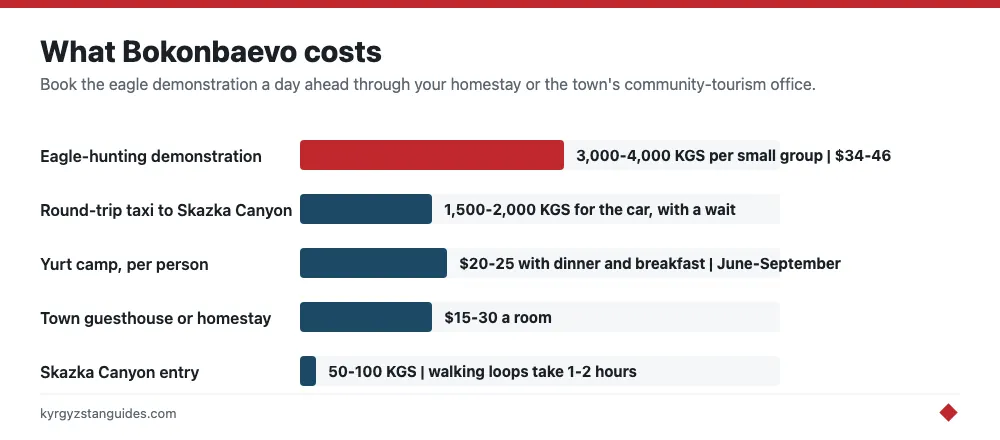
The broader tradition is Salburun: a nomadic hunting festival that bundles eagle hunting with taigan hounds (the Kyrgyz sighthound) and horseback archery. Bokonbaevo hosts Salburun events through the season, and the town is closely tied to the felt-and-falconry culture Kyrgyzstan is now known for internationally. If you want to understand where all this sits in Kyrgyz life rather than just photograph it, our nomadic culture guide gives the context. A demonstration typically runs 3,000–4,000 KGS ($34–46) per small group; arrange it a day ahead through your homestay or the town’s community-tourism office rather than expecting a fixed daily show.
One caveat: these are demonstrations, not the actual winter hunt, which happens on snow between roughly November and February when the eagles work for real. Summer visitors see the training and the flight, not the kill. That is the right trade for most travelers, but set your expectations accordingly.
It is worth understanding what you are actually watching. A berkutchi typically takes an eaglet from the nest, hand-rears it over years, and hunts with it for a decade or more before releasing it back to the wild to breed. A relationship closer to partnership than ownership. The eagle sits hooded on a wooden perch or the hunter’s arm, wearing a leather jess, and is unhooded to fly. In a demonstration the handler usually swings a lure or drags a fox pelt so the bird stoops and returns, and a good guide will let you hold the eagle on a gloved arm afterward, which is heavier than anyone expects. Tipping the hunter directly, on top of the arranged fee, is normal and appreciated.
Staying in a yurt — the right way to sleep here
Bokonbaevo does yurts better than almost anywhere on the lake, because here they are not a gimmick bolted onto a hotel. Seasonal yurt camps line the shore between the town and the beaches at Tosor and Bel-Tam to the east, and homestays in town can set you up with a family-run camp on the pastures behind. Expect roughly $20–25 per person with dinner and breakfast, running from about June to September. You sleep on layered felt and quilts inside a real, decorated boz-üy, eat what the family eats, and wake to the lake or the hills.
For travelers who have only stayed in hotels, the adjustment is real, shared or basic bathrooms, no lock on a felt door, meals on the family’s schedule, and worth it. Our yurt stay guide walks through the etiquette and what to pack. In town itself you'll also find plain guesthouses and homestays from around $15–30 a room for those who want a solid wall and a hot shower after the pastures.
Skazka Canyon, 30 minutes east
The single best half-day from Bokonbaevo is Skazka, “Fairy Tale”, Canyon, a pocket badlands of red-and-orange sandstone eroded into towers and ridges, about 30 minutes east along the south-shore road. Entry is a token 50–100 KGS, any sedan reaches the barrier, and the walking loops take one to two hours. The trick is timing: come in the last two hours before sunset, when the low light sets the rock alight, rather than at flat midday. A round-trip taxi from Bokonbaevo with a wait runs about 1,500–2,000 KGS for the car. Our Skazka Canyon guide has the full breakdown, including how to fold in the Barskoon waterfalls further east for a full south-shore day.
What else fills a day or two
Bokonbaevo is not a sightseeing town in the checklist sense; its pleasures are slower. Watch felt-carpet (shyrdak) makers at work — the town is known for its craftswomen, and a workshop visit or a bought piece supports them directly, with a good shyrdak running anywhere from a few thousand som for a small mat to considerably more for a large hand-stitched carpet. The south-shore beaches near Tosor and Bel-Tam are quieter and less developed than the north’s, good for a swim in warm months when the lake, despite being at 1,600 m, stays surprisingly mild — Issyk-Kul is slightly saline and never freezes, which is why it draws Kyrgyz families all summer. Cyclists and drivers use the town as a rest stop on the loop around the lake, and it makes a natural pairing with a night at Tash-Rabat or a push toward the Naryn region inland.
The town itself is unglamorous and that's the point: a low grid of Soviet-era houses, a bazaar, a couple of simple cafes serving lagman and shashlik, and mountains rising straight behind. Do not come expecting restaurants, nightlife, or polished tourist infrastructure — the experience is the setting and the people, not the amenities. Spend a morning at the eagle demonstration or a felt workshop, an afternoon at Skazka or on a beach, and an evening eating with your host family, and Bokonbaevo gives you a version of Issyk-Kul that the north shore, for all its convenience, can't.
If you're shaping a longer trip, the town slots neatly into the south-shore leg of most itineraries; see how it connects in our Issyk-Kul lake guide.
Getting there
From Bishkek, take a marshrutka or shared taxi heading along the south shore toward Karakol via Bokonbaevo — roughly five hours and about 450–550 KGS in a marshrutka, more in a shared taxi. From Karakol, any Bishkek-bound south-shore marshrutka drops you in Bokonbaevo in about 2.5 hours (250–300 KGS). The key thing to know is that most Karakol-bound transport runs the north shore, so you must specifically ask for the south-shore route through Bokonbaevo. Services thin out by late afternoon, so travel in the morning to be safe. Once you're on the shore, flag passing marshrutkas for short hops to Skazka or the beaches — they run every 30–60 minutes in daylight. The etiquette of all this is in our getting around Kyrgyzstan guide.
When to come, and what to budget
The season that matters is June to September. Yurt camps are open, eagle demonstrations can be arranged, the beaches are usable, and the roads are clear. July and August are the liveliest and busiest; June and September are quieter and cooler, which many travelers prefer. Outside those months the town doesn't shut, but the tourism infrastructure winds down, and the eagle hunters are focused on the real winter hunt rather than demonstrations.
Costs are modest. A yurt or homestay night with meals is $15–25, an eagle demonstration 3,000–4,000 KGS per group, a taxi day to Skazka and back a few thousand KGS. Kyrgyzstan is a cheap country and the south shore is cheaper than the resort north; two nights here barely dent a mid-range budget. Figures are 2026 estimates at around 88 KGS to the dollar and are best treated as ballparks; carry cash, because card acceptance in a town this size is patchy, and the nearest reliable ATMs are in town rather than out at the yurt camps.
Frequently Asked Questions
Can I see eagle hunters in Bokonbaevo in summer?
Yes, but as a demonstration rather than a live hunt. In summer, local berkutchi show how the eagles are trained and fly them to the glove for visitors, usually arranged a day ahead through a homestay or the community-tourism office for about 3,000–4,000 KGS per group. The actual hunting on snow happens in winter.
How do I get from Bokonbaevo to Skazka Canyon?
It is about 30 minutes east along the south-shore road. Take any marshrutka toward Kaji-Say or Karakol and ask for “Skazka” (50–80 KGS), or hire a taxi with a wait for roughly 1,500–2,000 KGS for the car, which is easier if you want to stay for sunset.
Is Bokonbaevo worth an overnight or just a stop?
Worth an overnight if the eagle hunters, felt culture, or a yurt stay interest you, those need time and a booking. If you only want Skazka Canyon, you can treat the area as a day stop between Bishkek and Karakol without sleeping over.
What does an eagle-hunting demonstration in Bokonbaevo cost?
Typically 3,000–4,000 som, roughly $34–46, for a small group, arranged a day ahead through a homestay or the community-tourism office rather than turning up for a fixed daily show. Tipping the hunter directly on top of the arranged fee is normal and appreciated.
What is Salburun?
A nomadic hunting tradition that bundles eagle hunting with taigan hounds, the Kyrgyz sighthound, and horseback archery. Bokonbaevo hosts Salburun events through the season and is closely tied to the felt-and-falconry culture Kyrgyzstan is now known for internationally.
How much is a yurt stay in Bokonbaevo?
Roughly $20–25 per person including dinner and breakfast, in seasonal camps along the shore between the town and the beaches at Tosor and Bel-Tam, running about June to September. Plain guesthouses and homestays in town run about $15–30 a room for anyone wanting a solid wall and a hot shower.
How do I get to Bokonbaevo from Bishkek or Karakol?
About five hours from Bishkek at 450–550 som in a marshrutka, or roughly 2.5 hours from Karakol at 250–300 som. The catch is that most Karakol-bound transport runs the north shore, so you must specifically ask for the south-shore route through Bokonbaevo. Services thin out by late afternoon.