Kara-Balta is the largest industrial centre of Chuy oblast, and the two enterprises that made it are both stopped.
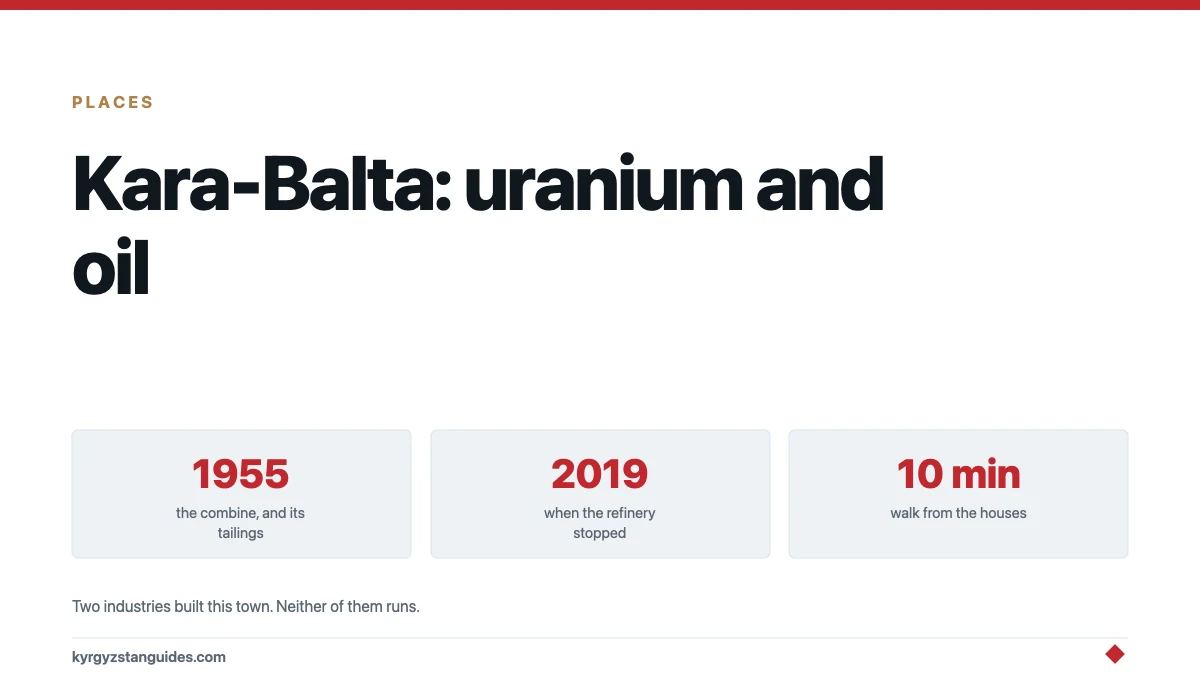
The uranium combine no longer processes ore. The oil refinery has been idle since 2019. What runs today is a precious-metals refinery on the combine's site, and the town's trade and municipal economy.
That is not a reason to skip it. It is the most legible industrial landscape in northern Kyrgyzstan, and it sits at the mouth of the gorge every traveller heading south drives through.
The basics
62 kilometres from Bishkek, at 700 to 750 metres, at the foot of the northern slope of the Kyrgyz Ala-Too in the western Chuy valley. Administrative centre of Jayyl district, and since July 2024 a city of oblast significance.
Population 59,600 at the start of 2025 — but treat that with care. The jump from 52,900 in 2023 to 57,800 in 2024 is the 2024 administrative-territorial reform, not growth. The same reform took Jayyl district from 115,600 to 59,700 as the town was lifted out of it.
Three towns in one place
The ancient one. The site held Nuzket, a Silk Road trading centre of the sixth and seventh centuries, later known as Shish-Tebe — a medieval settlement the city puts at roughly 6,000 hectares.
The sugar one. Russian settlers arrived after 1863; more than a hundred by 1874, around 2,000 residents by 1912. The Pishpek–Lugovaya railway branch, completed in August 1924, made the place viable. A major sugar factory started on 8 March 1933, with spirits production from 1943 and glycerine during the war. City status came on 9 September 1975.
The uranium one. The Kara-Balta Mining Combine was founded in 1955 to process uranium concentrates, and was described by its part-owner as the largest enterprise in Central Asia for processing uranium-bearing ore. Soviet-era throughput reached about 3,000 tonnes a year of main product. A tailings storage facility has been part of the process since 1955.
What stopped, and what did not
The combine lost its feedstock when Kazakh ore deliveries ended with the Soviet Union. It had no domestic resource base of its own. The processing units no longer operate. What does still work on the site is Kyrgyzaltyn's affinage plant, refining precious metals.
The Junda refinery, Chinese-owned, has a design capacity of 800,000 tonnes of crude a year and can produce up to 850,000 tonnes of fuel — described as half of the country's internal demand for petroleum products. It has been idle since 2019. A modernisation is under way with investment raised to US$193.75 million and completion planned for 31 July 2026, aimed at Euro-5 products and polypropylene. Whether that date was met, we could not confirm.
There is also a restart that keeps being announced at the combine. A separation line was declared ready in 2018, to run on ore from the Kyzyl-Ompol deposit. As of the most recent official statement, Kyzyl-Ompol is still at pilot stage: two licences were issued in September 2024, equipment arrived in test mode, and only one of five titanomagnetite sections has been surveyed and put on the state balance. The project became legally possible only after parliament lifted the moratorium on uranium and thorium mining in 2024. The ore is reported as 95 per cent titanomagnetite, 3 per cent phosphorus, 2 per cent zirconium, 0.22 per cent thorium and 0.17 per cent uranium, with separation to be done at Kara-Balta.
The tailings
This needs saying directly, and it is not a tourist attraction.
Kyrgyz reporting documents that the site holds one of the five largest uranium burial sites in the republic, that the tailings sit above the town so emissions blow toward it, and that radiation warning signs stand a ten-minute walk from residential houses with minimal security. Groundwater from the site reaches nearby villages that rely on communal water points. Residents and livestock have historically entered the area to fish, gather mushrooms and bathe.
Do not go and look. We are including this because it is the central fact about the town's environment and because you should know it exists, not because it is somewhere to visit. Our guides to Mailuu-Suu uranium and Khaidarkan mercury cover the same Soviet legacy elsewhere in the country.
What there actually is to see
Kara-Balta gorge, immediately south of town, is the real asset. It is the mouth of the Bishkek–Osh highway's climb, narrowing to about three car-widths between the walls before the serpentine up to the Too-Ashuu tunnel. Old Soviet rockfall galleries on concrete footings still stand along it.
Kara-Balta is the last real town before the tunnel and the Suusamyr valley. If you are driving south, this is where you stop. See Kyrgyzstan's roads and tunnels and Suusamyr valley.
In town, the city lists the Lenin City Palace of Culture — still under that name — among its institutions.
Reading an industrial town
A short case for stopping, because "the two big plants are shut" reads like a reason not to.
Kara-Balta is the clearest place in northern Kyrgyzstan to see what the Soviet economy actually built here and what happened to it. The sugar factory of 1933, the rail branch of 1924, the uranium combine of 1955, the 1975 grant of city status, the Chinese refinery of the 2010s and its 2019 stop — all of that is legible from the road in a single afternoon, laid out along one valley mouth.
Very few places make the sequence that visible. In Bishkek the layers are buried under a functioning capital. Here they are simply sitting there, in order, with the newest one already still.
What that means practically: this is a town to drive slowly through and look at, not one with an attraction to queue for. If you have an hour before the climb to Too-Ashuu, spend it on the industrial edge of town rather than looking for a centre.
Practical notes for the road
Kara-Balta is the last sensible stop before a long mountain stretch, and that is the main reason a traveller ends up here.
Fill the tank. Between here and Toktogul the options thin out, and the climb over Too-Ashuu and Ala-Bel is not a place to be calculating range.
Buy food. The bazaar and the shops along the highway are the last proper choice before Suusamyr, where you are dependent on roadside kymyz stands and whatever a guesthouse has.
Check the pass. The emergency ministry's avalanche bulletins name kilometres 121 to 138 of this road, across Too-Ashuu, as a hazard section, with an instruction to keep 500 metres between vehicles. In winter, ask in town before you commit to the climb.
Getting there
Kara-Balta is not in the intercity bus fare table, because it functions as a Bishkek commuter destination at 62 kilometres, served by frequent marshrutkas and shared taxis rather than scheduled coaches.
Any service on the Bishkek–Osh highway passes through. The ministry lists Bishkek–Toktogul at 400 som, Bishkek–Tash-Kumyr at 600 som and Bishkek–Jalal-Abad at 850 som, all on this road.
One correction that matters: departures no longer leave from Bishkek's Western Bus Station, which closed on 23 October 2024. West-direction services now go from Frunze 209.
FAQ
Is Kara-Balta safe to visit?
The town itself is an ordinary Kyrgyz industrial town. The concern is the uranium tailings above it, which Kyrgyz reporting describes as poorly secured, with warning signs a ten-minute walk from housing and contamination reaching local groundwater. Visit the town and the gorge; do not go near the tailings.
Does the Kara-Balta uranium plant still work?
Not as a uranium processor. The combine, founded in 1955 and once the largest uranium ore processing enterprise in Central Asia, lost its Kazakh feedstock after the Soviet collapse and its processing units no longer operate. Kyrgyzaltyn's precious-metals affinage plant still runs on the site.
Is the Junda refinery in Kara-Balta open?
It has been idle since 2019. The plant was built with a design capacity of 800,000 tonnes of crude a year, and a modernisation raising investment to US$193.75 million was targeted for completion on 31 July 2026. We could not confirm whether it has restarted.
How far is Kara-Balta from Bishkek?
62 kilometres, at the foot of the Kyrgyz Ala-Too in the western Chuy valley, at 700 to 750 metres. It is served as a commuter destination by frequent marshrutkas and shared taxis rather than by scheduled intercity coaches.
Why is Kara-Balta's population figure confusing?
Because of the 2024 administrative-territorial reform. The town appears to jump from 52,900 in 2023 to 57,800 in 2024 and 59,600 in 2025, but the step is a boundary change: Jayyl district fell from 115,600 to 59,700 at the same moment as the town was made a city of oblast significance.
What is there to do in Kara-Balta?
Realistically it is a stop rather than a destination: the Kara-Balta gorge south of town, the last supplies before the Too-Ashuu tunnel and Suusamyr, and a Silk Road site, Nuzket or Shish-Tebe, underneath the modern town. The Soviet Palace of Culture still stands under its original name.
One of the strangest survivals of that era is on Toktogul Street: see Kyrgyzstan and the Soviet space programme, a 1,500-person bureau whose instruments reached Venus, Mars and Halley’s Comet.
One in four inhabitants went to the Second World War, and 137,000 people were deported into the republic in the same years: see Kyrgyzstan in the Second World War.