On 12 August 2026, Kyrgyzstan's Ministry of Natural Resources announced that Madygen had been recognised as a geological and palaeontological heritage site of global significance. Most Kyrgyz people had never heard the name. Palaeontologists, on the other hand, have known it for sixty years, because a handful of hillsides in Leilek district, Batken region, preserve one of the best windows anywhere on Earth into life in the Triassic — the age just before the dinosaurs took over.
The timing matters: the site is being prepared as Central Asia's first UNESCO Global Geopark, under UNESCO's IGCP project 727. That status is in preparation, not yet granted — a distinction this post will keep, because the difference between "recognised" and "listed" is exactly the kind of thing that gets blurred.
What Madygen actually is
Roughly 230 million years ago, in the Middle to Late Triassic, this corner of what is now southern Kyrgyzstan held a lake system — lake, rivers, delta — and the fine sediments on its floor buried whatever fell in with unusual gentleness. The result, exposed today in beds near the villages about 50 km west of Batken town, is what palaeontologists call a Lagerstätte: a deposit whose preservation is so good that it records things fossils almost never record.
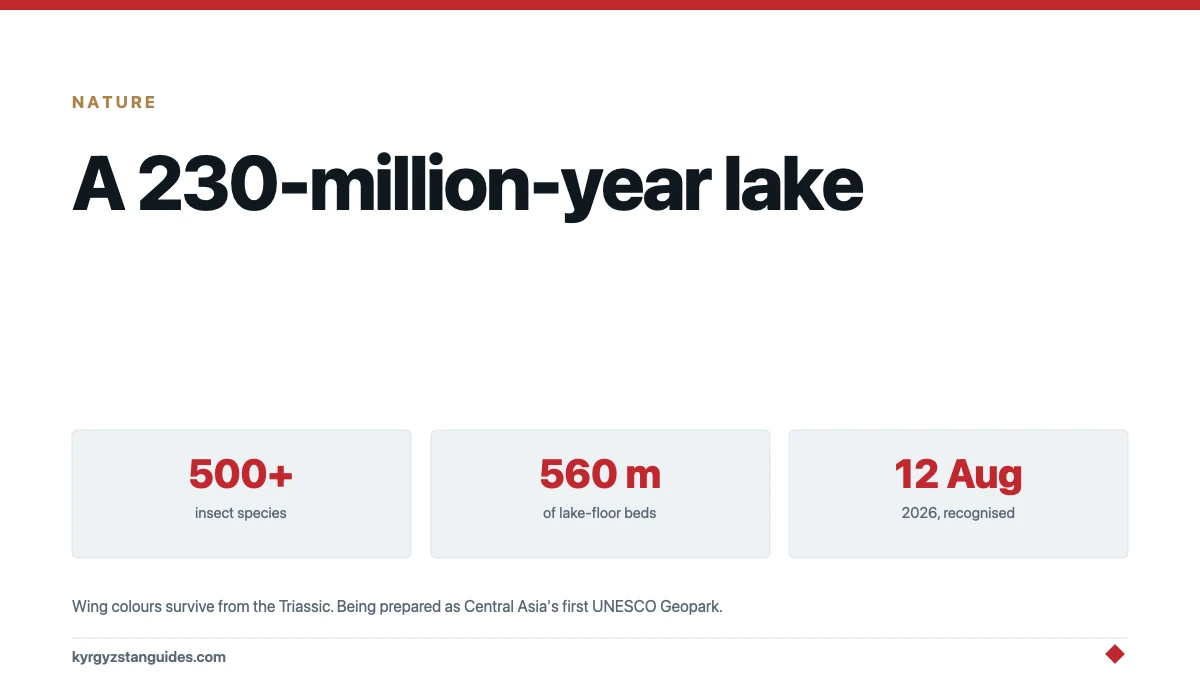
At Madygen, that means insects above all. More than 500 fossil insect species have been described from these beds — some preserving the colour patterns on their wings after nearly a quarter of a billion years. It also means one of the richest Triassic floras in Eurasia, and twelve vertebrate species found nowhere else.
Reading 560 metres of lake floor
The numbers on the deposit itself are worth having, because they explain why this place keeps producing science rather than just souvenirs.
The Madygen Formation's beds run to about 560 metres of thickness — not one lake bottom but a stack of them, lake over delta over river channel, recording the basin's whole restless life rather than a single moment. A sequence that thick is a tape, not a photograph: researchers can follow species up through the layers and watch the ecosystem change.
And the preservation quality changes what counts as data. A typical fossil bed gives you hard parts — shells, bones, wood. A Lagerstätte like Madygen gives you wing membranes, colour patterns, larval stages, the soft anatomy that lets an entomologist assign a 230-million-year-old insect to its family with confidence. That is why a site with no dinosaurs in it draws specialists from Germany, Russia and beyond: for the groups it preserves, there is more biology per slab here than almost anywhere of its age.
Geographically it is remote in the Kyrgyz way rather than the absolute way — the expedition accounts put it at roughly 270 km from Osh, in dry foothills between 900 and 1,600 metres, a long day's drive into the republic's south-western corner.
The two famous monsters
Two creatures made Madygen's name, both found in Soviet digs of the 1960s, and both strange enough that scientists argued about them for decades.
Sharovipteryx mirabilis is a small reptile that glided — on a membrane stretched between its hind legs. Flight experiments in animals are rare enough; a rear-wheel-drive glider is unique, and Sharovipteryx remains the only known vertebrate that tried powered-by-gravity flight that way round.
Longisquama insignis carries a row of long, feather-like appendages down its back, and for years sat in the middle of a genuine scientific brawl about whether those structures tell us anything about the origin of feathers and birds. The argument has cooled; the strangeness has not.
Both came out of the Dzhailoucho outcrops here, from expeditions led by the Soviet palaeontologist Aleksandr Sharov — the glider carries his name. More recently, German-led work under Sebastian Voigt reconstructed the whole lake ecosystem, which is why a site in Batken is better known in Freiberg than in Bishkek.
Why a Triassic lake matters
Because of what comes just before it in the rock record. The end of the Permian, about 252 million years ago, was the worst mass extinction in Earth's history — far worse than the one that later killed the dinosaurs. Madygen's beds record the world a few million years after that catastrophe: land and freshwater life rebuilding, experimenting, producing things like gliding reptiles and proto-feathered oddities.
That is the scientific case for the "global significance" in the ministry's announcement, and for once the phrase is not inflation. Sites of this quality from this exact interval can be counted on fingers.
The geopark, and what is actually decided
The recognition announced in August 2026 is national. The UNESCO Global Geopark bid is the next step, in preparation under IGCP project 727, and if it succeeds it would be the first such geopark in Central Asia. The planned geopark area is larger than the fossil beds alone — the surrounding district has mining history and older rocks besides — and one news account reached for a "500 million years" span that belongs to that wider geology, not to the Triassic lake. Keep the two apart: the fossil beds are about 230 million years old; the region's rocks run deeper.
Madygen also has interesting neighbours. The same corner of Batken holds Kan-i-Gut, the "Mine of Perdition" of medieval silver legend, and the apricot country our Batken post covers — a reminder that the republic's most overlooked region is overlooked for access reasons, not for lack of things in it.
Can you actually go?
Here is the honest answer this post exists to give: no documented visitor access exists. No published opening arrangements, no site infrastructure described anywhere I could reach, no ticket, no trail. Expedition accounts describe reaching the area by four-wheel-drive on reasonable foothill roads at 900 to 1,600 metres, which tells you it is physically reachable and administratively undefined — and Batken is a border region where permits and local conditions are their own subject.
So treat Madygen, for now, as a reason to pay attention rather than a destination with a gate. If the geopark happens, that will change, and this post will change with it.
What I could not establish
Specimen numbers: a figure of more than 15,000 insect specimens from the 1960s digs circulates alongside the 500-species count, but I could not reach the underlying source, so this post uses only the species figure. Any date or budget for geopark infrastructure. And the current condition of the outcrops themselves — whether six decades of collecting have left the famous beds depleted is exactly the kind of thing a geopark assessment would establish, and nothing public says.
FAQ
What is Madygen?
A Middle-to-Late Triassic fossil site about 50 km west of Batken town in southern Kyrgyzstan, roughly 230 million years old, preserving lake, river and delta deposits of exceptional quality — including over 500 described fossil insect species and twelve vertebrates found nowhere else. In August 2026 it was recognised as a heritage site of global significance.
What is Sharovipteryx?
A small Triassic reptile from Madygen that glided on a membrane stretched between its hind legs — the only vertebrate known to have evolved gliding that way round. It was found in Soviet excavations of the 1960s led by Aleksandr Sharov, whom it is named after.
What is Longisquama?
Another Madygen reptile, carrying long feather-like appendages along its back. For years it sat at the centre of a scientific argument about the origin of feathers; its true relationships remain debated, which is part of why the site keeps drawing researchers.
Is Madygen a UNESCO site?
Not yet. It was recognised nationally in August 2026 as a geological and palaeontological heritage site of global significance, and a bid to become Central Asia's first UNESCO Global Geopark is in preparation under IGCP project 727. Recognition and listing are different stages, and only the first has happened.
Can tourists visit Madygen?
There is no documented visitor access — no infrastructure, tickets or published arrangements. Expedition accounts describe four-wheel-drive access through foothills at 900-1,600 metres. Until the geopark project produces something concrete, it is a site to know about rather than one to plan around.
Why are the Madygen fossils so well preserved?
Fine lake sediments buried organisms gently and quickly, creating what palaeontologists call a Lagerstätte. Preservation is good enough that some insect wings retain their colour patterns after roughly 230 million years.
Why does the Triassic matter?
Because it follows the end-Permian extinction, the worst in Earth's history. Madygen records land and freshwater life a few million years into the recovery — evolution experimenting in the space the catastrophe cleared, which is exactly when gliding reptiles and feather-like structures start appearing.