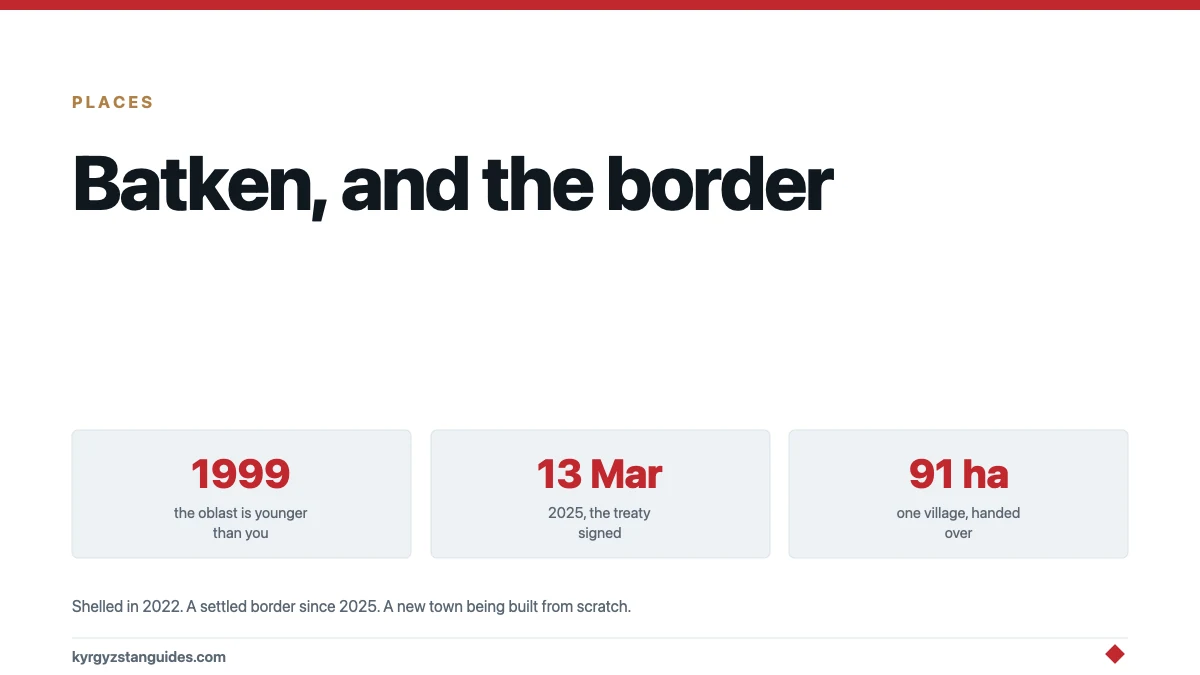
Batken oblast is younger than most of the people reading this. It was created on 13 October 1999.
The town at its centre was a farming village in the apricot belt until the oblast was built around it. In September 2022 it was shelled. In March 2025 the border that caused that was finally settled by treaty. And a few kilometres away, a new town is being built from nothing.
The basics
Administrative centre of Batken oblast, in the western Fergana fringe. It became a town in February 2000, was a district-subordinate town until February 2009, and then became a city of oblast significance under a law of 1 December 2008 and a government decree of 19 February 2009.
Municipal area 43,484 hectares — which is the first thing to understand about its population figures.
The population is disputed between two official bodies. The city hall gives 36,852 at 1 January 2025. The National Statistical Committee gives 30,300 at the start of the same year. And for 2023 the statistics office split its figure into 19,700 urban and 9,300 rural.
So the town proper is under twenty thousand people. Anyone describing "Batken, a city of 37,000" is describing a municipality that stretches to the Tajik border.
We are not going to give you an altitude. The oblast administration's own page says the oblast lies at 400 metres, which is an oblast low point rather than the town, and the figures around 1,000 to 1,100 metres in circulation are unconfirmed.
The oblast
Area 17,000 square kilometres, 8.5 per cent of the country. Population 583,362, of whom 76.2 per cent are rural.
The ethnic composition is the crucial context: Kyrgyz 77.5 per cent, Uzbeks 14.5 per cent, Tajiks 6.9 per cent. This is the most ethnically mixed oblast in the country and the one where the borders run through villages rather than around them.
Note that the oblast administration labels 583,362 as "1 January 2025" while the statistics committee files the same number under 2024 and gives 594,700 for 2025. The two official bodies are a year out of step with each other.
September 2022
This needs stating factually and without softening.
On 14 September 2022 at 08:00, fighting began on the Kyrgyz–Tajik border. The Tajik side used firearms and mortars south of the Vorukh enclave; Samarkandek village in Batken district was hit and three civilians including an eleven-year-old were wounded.
The town of Batken itself came under fire. The Kyrgyz border service reported that the surroundings of Batken airport and objects on the edge of the town were struck by multiple-launch rocket systems.
Over 14 to 17 September: 62 killed and 198 wounded on Kyrgyz territory, most of the dead military, and more than 136,000 people evacuated from border villages of Batken and Leylek districts.
March 2025: the treaty
On 13 March 2025 presidents Japarov and Rahmon signed the Treaty on the State Border in Bishkek, closing roughly 23 years of negotiation over a line of about 970 to 1,000 kilometres. Kyrgyzstan ratified it on 25 March 2025. On 31 March, Kyrgyzstan, Tajikistan and Uzbekistan signed the agreement on the junction point of the three borders.
What was actually exchanged is public, and it is not abstract:
Dostuk village, 91 hectares, transferred entirely to Tajikistan. Kyrgyzstan received 30 hectares at Lakkon to resettle it.
The Vorukh enclave reduced from 19,000 to 14,500 hectares. Kyrgyzstan granted 1,000 hectares of pasture around it and received 1,000 hectares at Karagan-Sai in Chon-Alai district.
In Leylek district Kyrgyzstan received 155 hectares at Kairagach plus the 35-hectare Kairagach enclave; Tajikistan received about 90 hectares across seven named localities, plus 65 hectares at Batken and 35 at Maity.
The Golovnoy water intake — the thing many of the disputes were actually about — had its three gates split 1.5 to 1.5. Three roads were designated neutral.
A village was moved. That is what settling this border cost.
Why an enclave is different from a border
Worth explaining, because "border dispute" undersells what was actually going on here.
A normal border is a line with two sides. The Fergana fringe is not that. Vorukh is a piece of Tajikistan entirely surrounded by Kyrgyzstan; Sokh is a piece of Uzbekistan in the same position. People living inside them have to cross another country to reach their own, and people living around them have roads, canals and pastures that were drawn when all of this was one state and none of the lines meant anything.
That is why the disputes were about water intakes and pasture rather than about territory in the abstract, and why the treaty's contents read like a land registry rather than a peace deal. Splitting the gates of the Golovnoy intake 1.5 to 1.5 is not symbolic. It is the actual thing two villages were fighting over.
It also explains why Kyrgyzstan has spent heavily on roads that go the long way round. A bypass that adds ninety kilometres but never leaves the country is worth more than a direct route that depends on a neighbour's goodwill every day.
What the treaty does not settle
Two honest caveats.
A signed and ratified treaty is a line on a map. Implementation — resettling Dostuk's people onto the 30 hectares at Lakkon, marking the ground, reopening and running the crossings — is a separate and slower process, and we could not establish its current state.
And the treaty does not change the composition of the oblast. Batken remains 14.5 per cent Uzbek and 6.9 per cent Tajik, with three quarters of its population rural and living along those lines. The border is settled; the geography is not going anywhere.
The roads built to avoid enclaves
Batken's geography explains its infrastructure. The Osh–Batken–Isfana highway has been progressively rebuilt to keep traffic inside Kyrgyzstan: the Pulgon–Burgondu–Batken stage, 92 to 97 kilometres, exists to route around the Uzbek Sokh enclave entirely on Kyrgyz ground.
A flyover at Min-Oruk–Samarkandek is being built to bypass Tajik villages.
See Kyrgyzstan border crossings for the wider picture and Sulukta for what the same geography does further west.
What is being built
Three mortgage housing complexes — Asman Residence 1, 2 and 3 — totalling 4,116 apartments under the state housing programme. A wholesale trade complex is under construction, funded from the 500 million som a year the republican budget allocates to Batken oblast.
And "Batken City": an entirely new town planned east of Bujum village on 760 to 800 hectares, 120 of them a central administrative zone, with 4,250 apartments and a target of 1,500 to 2,000 handed over by autumn 2025. Whether that target was met, we could not confirm.
The population is growing steadily — 27,900 in 2021 to 30,300 in 2025 on the statistics committee's figures. The out-migration story in this oblast belongs to the western towns, not to the capital.
Getting there
Osh to Batken is 307 som, with departures at 07:30, 08:30, 10:30, 11:15, 12:30, 14:00, 15:15 and 16:30 from Osh bus station. Road distance is given as anywhere from 236 to 288 kilometres depending on route and source.
Onward: Osh to Isfana is 500 som, passing Batken for the Leylek salient.
Batken airport has operated since 1958, with a terminal from 1967 and an 1,800-metre paved runway laid in 1984 replacing gravel. It handled 23,023 passengers in 2015 and 22,451 in 2016, and was reconstructed in 2017. Asman Airlines now serves it, with up to six weekly departures reported from Bishkek.
Should you go
Batken is an administrative capital with new-build housing, a trade complex and apricot orchards around it. We found no museum, mosque or bazaar of note in any source we would cite, and we are not going to invent one.
Go if the border geography interests you, or if you are travelling the southern route to Isfana. Do not go expecting sights. See Batken apricots for the thing the region is genuinely known for.
FAQ
Is Batken safe to visit?
The border was settled by treaty on 13 March 2025, ending roughly 23 years of dispute, and Kyrgyzstan ratified it on 25 March. That followed serious fighting in September 2022 in which 62 people were killed on Kyrgyz territory and the town itself was shelled. The situation is materially different since the treaty, but check current advice before travelling.
How big is Batken?
Disputed between official sources. The city hall says 36,852 at 1 January 2025; the National Statistical Committee says 30,300. The statistics office's 2023 breakdown gives 19,700 urban and 9,300 rural, so the town proper is under 20,000 people and the larger figures describe a municipality of 43,484 hectares.
What happened at Batken in 2022?
Fighting began on 14 September 2022 on the Kyrgyz–Tajik border south of the Vorukh enclave. The surroundings of Batken airport and the edge of the town were struck by multiple-launch rocket systems. Across 14 to 17 September, 62 people were killed and 198 wounded on Kyrgyz territory, and more than 136,000 were evacuated.
Has the Kyrgyz–Tajik border been settled?
Yes, by a treaty signed on 13 March 2025 and ratified by Kyrgyzstan on 25 March. Dostuk village, 91 hectares, was transferred entirely to Tajikistan; the Vorukh enclave was reduced from 19,000 to 14,500 hectares; and the contested Golovnoy water intake had its three gates split between the two countries.
How do I get to Batken?
From Osh bus station for 307 som, with eight departures between 07:30 and 16:30. Road distance is given as between 236 and 288 kilometres depending on the route. Batken also has an airport, operating since 1958 with an 1,800-metre paved runway, served by Asman Airlines from Bishkek.
Is there anything to see in Batken town?
Not much, and we would rather say so. It is an administrative capital created around a village after the oblast was formed in 1999, with new mortgage housing and a trade complex under construction. The region's real signature is its apricots.