In Batken, the far south-western corner of Kyrgyzstan, they don't pick the apricots and then dry them. They leave them on the branch through the heat of late June and let them dry in place, until the fruit is dark brown, wrinkled and concentrated. The result is called kandek, it is on Slow Food's Ark of Taste, and it is quite unlike anything sold as a dried apricot in a European supermarket.
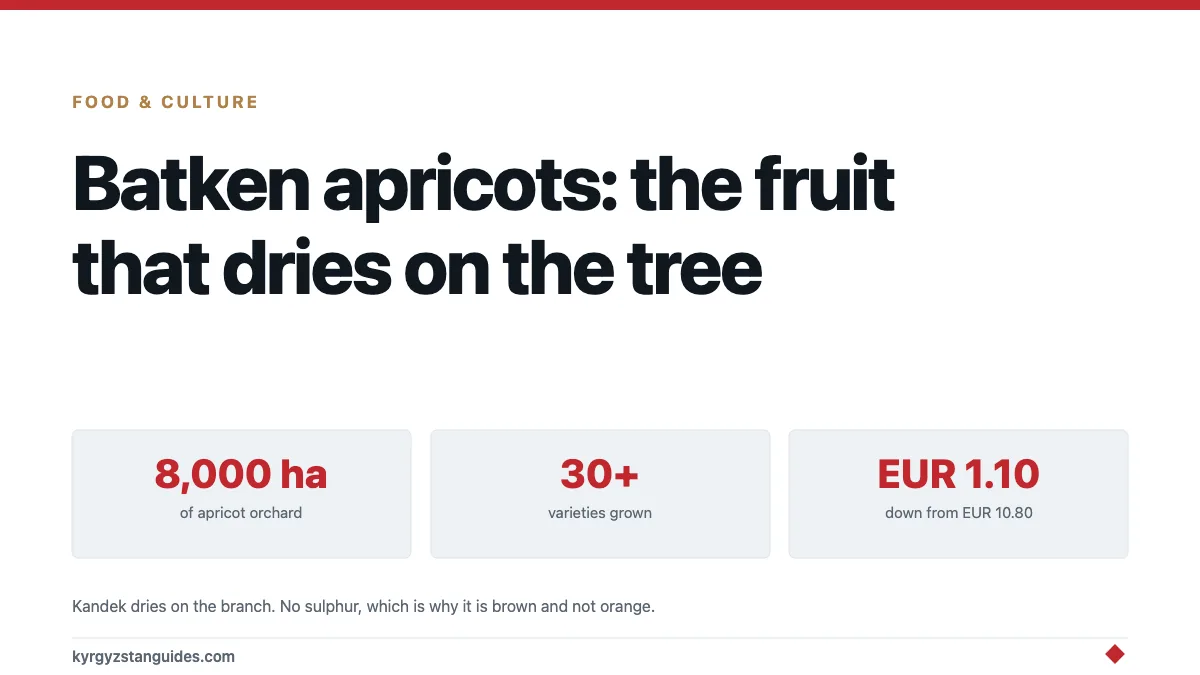
Around 8,000 hectares of Batken are apricot orchard, with more than thirty varieties grown. The region exports thousands of tonnes a year. And the farmers growing it are having a bad time.
What makes kandek different
Two things: the variety, and the method.
Commercial dried apricots elsewhere are usually picked ripe, halved, stoned, treated with sulphur dioxide to keep them orange, and dried in a controlled setting. They stay bright, soft and uniform.
Kandek is left hanging. The fruit dehydrates on the tree in the dry summer heat of the Fergana fringe, which means the sugars concentrate slowly while the fruit is still attached and the stone stays in. No sulphur, no colour preservation. Slow Food's entry on dried kandek apricot from Batken records the process, which begins around late June.
What you get is dark brown, dense, chewy, intensely sweet with a sour edge, and nothing like the pale orange discs most people picture. Anyone who has only eaten sulphured apricots will not immediately recognise it as the same fruit.
The trouble with the price
The economics of this are grim and worth stating, because they affect what you should do as a visitor.
Dried apricots are a principal income source for Batken households. But prices for the premium dried varieties have collapsed — bargek, one of the best grades, has been reported selling for around €1.10, down from roughly €10.80 the previous year.
A tenfold fall in the price of your main crop is a catastrophe at household level. The causes are the usual combination. Regional oversupply, market access, the bargaining position of small growers against traders, and a product that competes with heavily processed alternatives.
There has been work to change that. The UNDP has documented efforts to get Batken apricots into international markets on better terms, which is the sort of thing that only matters if it reaches the growers.
The practical upshot for a traveller: buy directly, buy in the region, and don't haggle hard over a bag of dried fruit that took a year to produce.
The calendar
Late March to April — blossom. The whole region flowers, and Batken holds an Apricot in Blossom festival in spring. This is the prettiest time and it coincides with wild tulip season further along the same southern belt.
Late June onwards — drying. Fruit is left on the tree and the harvest follows.
Summer, the fruit markets. Fresh apricots move through the bazaars of the south and then across the country.
Summer on Issyk-Kul. The south shore holds its own apricot festival, which runs as a relay moving from village to village over about a week. That's a long way from Batken and is its own thing, but it tells you how far the fruit's cultural reach goes. Our Bokonbaevo guide covers that shore.
Thirty varieties, and what that tells you
More than thirty apricot varieties are grown in Batken, which is a startling number for one province and a clue about how old the cultivation is.
Fruit diversity on that scale doesn't come from a breeding programme. It comes from centuries of farmers keeping the tree that ripened early, the one that dried well, the one that survived a late frost, the one that tasted best fresh, and grafting from it. Each variety is somebody's answer to a specific local problem, kept because it worked.
The region sits on the edge of the Fergana valley, which is among the oldest continuously farmed landscapes in Central Asia. Apricots have been here a very long time, and Central Asia is close to the fruit's centre of origin in the same way it's for the wild tulip and, further east, the apple.
That diversity is also the thing most at risk from a collapsed market. A grower who cannot sell stops replanting, and the varieties that go first are the awkward ones, the low-yielding, the late, the ones that only make sense dried a particular way.
Getting to Batken, honestly
This is the most remote province in the country and it isn't a casual detour.
It sits in the far south-west, wrapped around by Uzbek and Tajik territory in a tangle of enclaves left by Soviet border-drawing. Access is via Osh, and our Osh guide is the starting point.
Check current travel advice before going. The Kyrgyz–Tajik border in this region has seen periodic tension and closures, and conditions change. That is a real consideration rather than a formality, and it's the reason Batken doesn't appear on standard itineraries.
For most visitors, the realistic encounter with Batken apricots is not in Batken. It's at a bazaar in Osh or Bishkek, where they're sold by weight alongside walnuts from Arslanbob and honey from Toktogul.
Buying them
At a bazaar, by weight, from the dried-fruit rows. Ask for Batken specifically — sellers distinguish by origin and will tell you.
Look for dark brown, not orange. Bright orange means sulphur. That isn't dangerous, but it isn't kandek either, and it's usually imported.
Taste first. Standard at any bazaar, expected, and the only way to judge.
They travel well. Dried fruit is light, robust and generally straightforward to carry home, though check your own country's rules on plant products. Our souvenirs guide covers what else is worth the luggage space.
Pair them with walnuts and a chunk of white honey and you have the three things southern Kyrgyzstan does better than anywhere else, all of which fit in a rucksack.
Why any of this matters
Because a dried apricot is the clearest illustration available of what this country's rural economy actually is.
Not tourism, not mining, not the things visitors see. It's households growing something on a few hectares, processing it with the sun, and selling into a market that sets a price they have no influence over. Our piece on the Jumgal coal basin makes the same point from the industrial side.
Buying a kilo of kandek at a bazaar isn't development economics. But it is a more direct transfer to a Batken household than most things a traveller spends money on, and the fruit is genuinely excellent.
FAQ
What are kandek apricots?
A Batken variety dried on the tree rather than picked and processed — the fruit dehydrates in place through the summer heat, leaving it dark brown, wrinkled, dense and intensely sweet. It's listed on Slow Food's Ark of Taste.
Why are Batken dried apricots brown rather than orange?
Because they're dried naturally without sulphur dioxide. Bright orange dried apricots have been sulphured to preserve the colour. Brown is the natural result and usually indicates the genuine article here.
When is apricot season in Batken?
Blossom is late March into April, with an Apricot in Blossom festival in spring. Drying on the tree begins around late June, with the harvest and the markets following through summer.
Can tourists visit Batken?
It's the most remote province in Kyrgyzstan, reached via Osh, and the Kyrgyz–Tajik border region has seen periodic tension. Check current travel advice before planning a trip. Most visitors encounter Batken apricots at bazaars in Osh or Bishkek instead.
Where can I buy Batken apricots?
At the dried-fruit rows of any large bazaar, sold by weight. Ask for Batken by name: sellers distinguish by origin. Taste before buying, which is normal and expected.
Why are apricot prices so low in Batken?
Premium dried grades like bargek have dropped sharply. Reports put bargek at around €1.10 against roughly €10.80 a year earlier. Oversupply, weak market access and small growers' poor bargaining position against traders all contribute.
The oblast capital, the 2022 shelling and the border treaty that finally settled the line in March 2025 are covered in our Batken guide.
Further west again is Sulukta, a coal town mining 600 metres beneath its own houses, with a narrow-gauge railway running into Tajikistan.