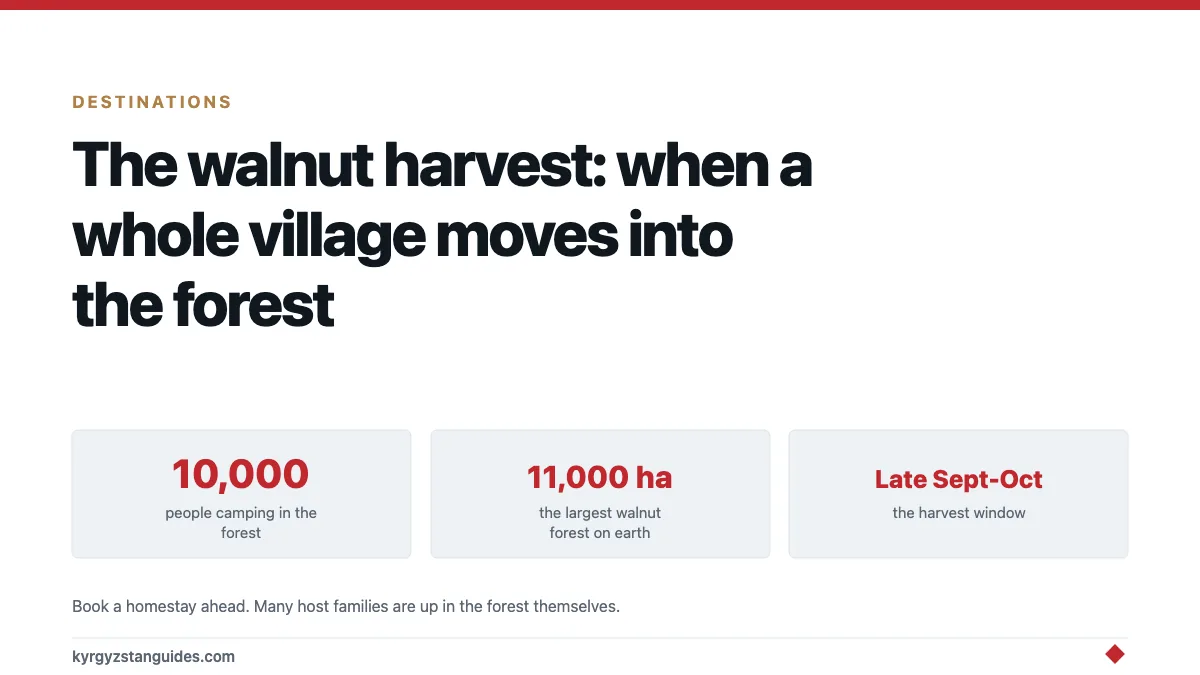
For a few weeks in late September and October, Arslanbob empties. Something like ten thousand people move up into the walnut forest with tents, tarpaulins and towed wagons, and stay there until the crop is in. It's the largest natural walnut forest on earth, roughly 11,000 hectares of it, and once a year the village relocates inside it.
This is the most interesting time to visit and the hardest time to find a bed, which is the trade-off worth planning around.
What actually happens up there
Families have allotted patches of forest, worked for generations. They go up, build a camp, and stay.
The mechanics are simple and unchanged: men and older boys climb into the trees and shake the branches, and women and girls work the ground below, gathering what falls. Walnuts come down in a green husk that has to be removed, and the hulling stains hands a deep brown that doesn't wash off for weeks. You will notice it on everyone in the village by mid-October.
Camps are modest — canvas tents, mud-walled shelters, wagons towed up and parked for the season, much as Caravanistan's account of the village describes them. Fires, bedding, cooking, children, dogs. Some families are up there for several weeks continuously.
What comes down gets sorted, cleaned and dried, then sold locally, exported, or pressed for oil. Walnut oil is a genuine cottage industry here, and it's one of the better things to buy while you're standing in front of the person who made it.
Timing it
Late September to the end of October, with early-to-mid October the usual peak. Like everything in Kyrgyzstan, it shifts with the season — a warm autumn pushes it later, a cold snap brings it forward.
Which means you cannot book this precisely from abroad six months out. If the harvest is the point of your trip, aim for the first two weeks of October and accept some uncertainty.
Our autumn in Kyrgyzstan guide covers what else works in those weeks, and the answer is: quite a lot in the south, much less at altitude, since the high passes are closing at exactly the same time.
Finding somewhere to sleep
Here's the practical problem nobody mentions until you arrive.
Arslanbob runs on a CBT homestay network, and during the harvest a good share of the families who host are themselves in the forest. Beds get tighter, and turning up unannounced in the second week of October is how people end up on a sofa or back on a marshrutka.
Book ahead through the CBT office rather than assuming. A homestay with breakfast and dinner runs roughly 800–1,200 KGS per person, and a guide for the forest or the waterfalls is about 1,500–2,000 KGS for a half day. Our Arslanbob guide has the full logistics, and the CBT guide explains how the network operates.
Getting there hasn't changed for the harvest: shared taxi or marshrutka from Osh to Bazar-Korgon, change for Arslanbob, about 3.5–4 hours in total. From Jalal-Abad it's roughly half that.
Can you join in?
Yes, genuinely, and this is the part that makes it worth the trip.
Families do take guests up to their camps, and the work is not performed for anyone's benefit. You're handed a sack and you gather walnuts, or you're given tea and you sit. Arrangements are made through your homestay or the CBT office rather than booked online, and they depend on which family you're staying with and whether they're up there.
A few things that make you a good guest rather than an awkward one:
Go for a day, not an hour. The camps are a walk or a drive up and the visit doesn't work as a drop-in.
Actually work if work is offered. Standing and photographing while a family collects is the version of this that everyone dislikes and nobody says so.
Ask before photographing people. This is somebody's workplace and their kitchen at the same time.
Buy something. Walnuts by the kilo, or oil. It's the simplest way to make your presence worth their trouble, and the product is good.
Why there's a walnut forest here in the first place
A reasonable question, since nowhere else on this scale exists.
The stand survives because of a specific combination: a south-facing slope at the right altitude, enough rainfall off the Babash-Ata range, and winters mild enough for a nut tree that wouldn't make it through a Naryn one. Plus several centuries of people having every reason to protect it rather than cut it down — a walnut forest that feeds a village is worth more standing.
There is a story, repeated locally and in a lot of travel writing, that Alexander the Great's army carried nuts from here back west and that this is how the walnut reached Europe. It is a good story. It is not something anyone has demonstrated, and you should enjoy it as folklore rather than history.
What is documented is that the forest is under pressure now, grazing inside the stand, firewood cutting, and young trees not replacing old ones at the rate they need to.
What the forest is the rest of the year
Worth saying, because the harvest is not the only reason to come and plenty of people arrive in June and wonder what the fuss is.
The forest is around 1,600 metres, on the slopes of the Babash-Ata range, and it is green, cool and shaded through the summer when the valley cities below are at 35°C. There are two well-known waterfalls, a short one and a much bigger one, and walking routes up towards the holy lakes above the village. Arslanbob is also an Uzbek village culturally, not a Kyrgyz one, which gives it a different feel. Different food, different architecture, different rhythm, from anywhere on the Issyk-Kul circuit.
The trees themselves are the point in any season. Some are very old, and a walnut forest at that scale is a strange, orderly, cathedral-like kind of woodland, quite unlike the juniper and spruce you get further north.
Our Jalal-Abad guide covers the wider region if you're building a southern loop.
Is it worth changing your itinerary for?
If you're in the south in October, unambiguously yes, it's a two-hour detour from Jalal-Abad for something you cannot see anywhere else.
If you're planning a trekking trip built around Ala-Kul and Song-Kul, understand that the harvest happens exactly when the high country is shutting down. October means the yurt camps have closed, the passes are icing, and a north-focused itinerary is running out of road. Arslanbob is one of the best reasons to point the trip south instead.
FAQ
When is the walnut harvest in Arslanbob?
Late September through October, usually peaking in the first half of October. The exact timing shifts with the weather each year, so build in some flexibility rather than booking to a fixed date.
How many people take part in the Arslanbob walnut harvest?
Around ten thousand people camp in the walnut forests of the Fergana valley region during the season, with most Arslanbob families moving up to their allotted patches for several weeks.
Can tourists join the walnut harvest?
Yes, through a CBT homestay or the local CBT office rather than an online booking. Families take guests up to their forest camps, and the expectation is that you help rather than watch. Go for a full day.
Where do I stay in Arslanbob during the harvest?
CBT homestays, at roughly 800–1,200 KGS per person with breakfast and dinner. Book ahead, many host families are themselves in the forest during the season, so beds are tighter than usual.
How do I get to Arslanbob?
From Osh, take a shared taxi or marshrutka to Bazar-Korgon and change for Arslanbob — about 3.5–4 hours all in. From Jalal-Abad it's roughly 1.5–2 hours by the same junction.
Is October a good time to visit Kyrgyzstan?
For the south, yes — Arslanbob is at its most interesting and the lower valleys are pleasant. For high-altitude trekking, no. The Song-Kul yurt camps have closed and the high passes are icing up or already shut.
Tulips are the famous ones, but they are a small part of it: see Kyrgyz wildflowers beyond the tulips for the foxtail lilies, the endemic irises and what the Red Book actually protects.
Out of harvest season the village is at its emptiest: see Arslanbob in winter, where the skiing is done on horseback and there is no ski base at all.