Most Kyrgyzstan itineraries cram themselves into July and August, when the jailoos are green, the yurt camps are full, and every trailhead has a queue of 4WDs. We think that logic is backwards. September delivers the most stable trekking weather of the year, October turns the southern walnut forests gold, and prices drop across the board. Autumn is the season almost nobody plans for, and it rewards the few who do.
The short version: come in September if you want to trek, come in early October if you want golden valleys and the walnut harvest around Arslanbob, and skip November unless you have a specific reason to be here. Below we break the season down month by month, cover what shuts and when, and explain why photographers in particular should be paying attention.
Why September Is the Sleeper Pick
If we had to pick one month for Kyrgyzstan, it would be this one. September behaves like late August without the crowds: the summer thunderstorm cycle that soaks afternoon hikers in July largely burns out, skies clear, and the air turns crisp rather than hazy. You get long runs of dry days, the most settled weather window of the whole year in many valleys, and the sharpest mountain views of the calendar once summer dust and heat haze die down. Daytime temperatures in Bishkek and around Issyk-Kul sit around 22–27°C early in the month, sliding toward the high teens by the end. The nights are the story at altitude: temperatures fall sharply after dark and dip below freezing high up as the month goes on, so a proper sleeping bag and warm layers are non-negotiable for any camping trek.
Every major summer trek is still in play through roughly the third week of September. The Ala-Kul trek is usually snow-free on the pass into late September and often at its clearest all year, the lake’s turquoise reads even stronger against the first dusting on the peaks above it, in exactly the stable air that makes the crossing photogenic rather than punishing. Song-Kul is quieter and colder; most yurt camps at the lake pack up as the month ends, so treat the last week as a gamble there. The rule is simple: do your big high-altitude treks in the first half of the month, and always check current conditions before committing to anything above 3,500 meters.
The practical wins stack up quickly. Guesthouses that were fully booked in August have space, horse-trek guides negotiate, marshrutkas are less rammed, and prices ease back toward the lower end of the usual ranges — see our best time to visit guide for how autumn costs compare across the year. You can be spontaneous about where you sleep in a way mid-summer never allows, and because restaurants and transport still run on their summer rhythm early in the month, you get the quiet without the reduced services of true off-season. It's the rare window where the country is both fully functional and genuinely calm.
Issyk-Kul deserves its own September mention. The lake holds its summer warmth deep into autumn, so early-month swimming is still on the table while the resort towns have emptied of the July crowds — arguably a better version of the beach experience than peak season. As the month goes on, the focus shifts from swimming to the shore itself: crisp days, dramatic light on the water against the first snow-dusted peaks, and near-empty promenades in Cholpon-Ata. It also makes a comfortable low-altitude base to balance the cold nights of any high trek. If we could only give one month to Kyrgyzstan and trekking was the priority, September would beat July without much argument.
October: Golden Valleys and the Walnut Harvest
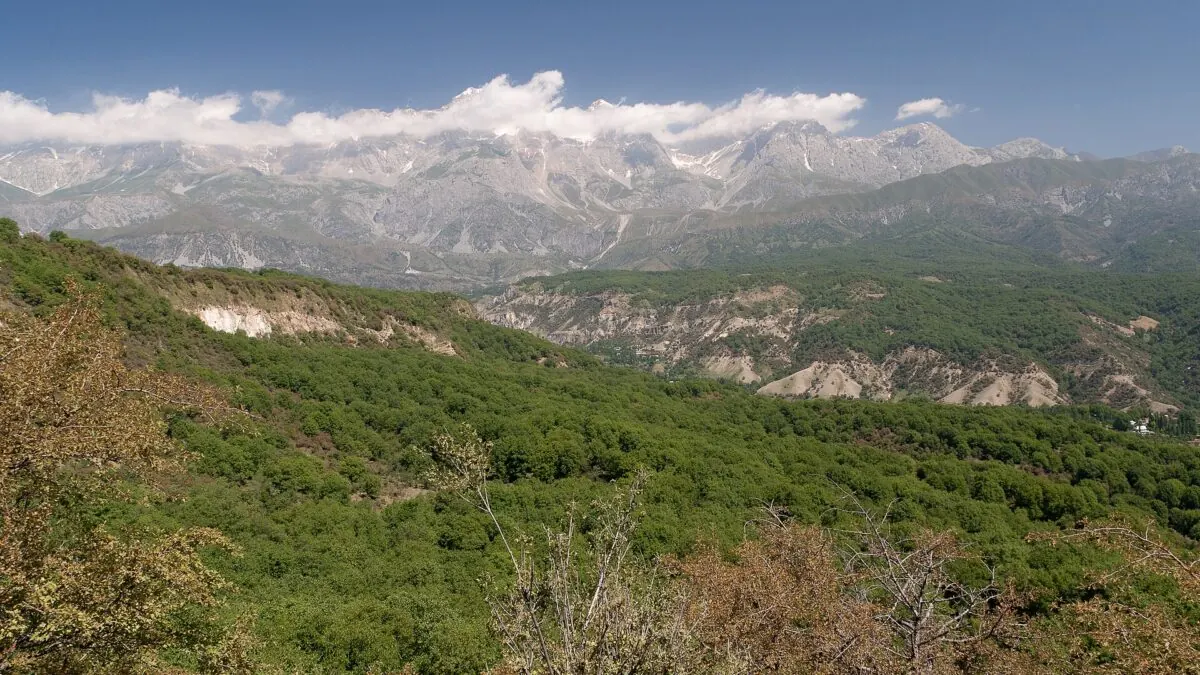
October is when Kyrgyzstan changes color. Poplar-lined village roads around Issyk-Kul go bright yellow, the birch and rowan in valleys like Jeti-Oguz turn orange against red sandstone, and the whole country photographs like a different place than it did six weeks earlier. The trade-off is altitude: high passes start collecting real snow, nights drop below freezing in the mountains, and multi-day treks above 3,500 meters become a mountaineering proposition rather than a hiking one.
The event that anchors the month is the walnut harvest in Arslanbob, home to one of the largest natural walnut forests on earth. From late September through October, entire families move into the forest, camp among the trees, and spend weeks knocking down and gathering nuts. It's a genuine working harvest, not a festival staged for visitors, and homestay hosts will often simply bring you along. Walking through miles of golden walnut canopy while the harvest is underway is, for our money, one of the most distinctive things you can do in Central Asia in any season.
Elsewhere in the south, October stays surprisingly mild. Osh and the Fergana fringe hold daytime temperatures near 20°C well into the month, and the bazaars are stacked with the year’s produce, melons, grapes, pomegranates, and sack after sack of fresh walnuts. A north-to-south route that starts with September trekking near Karakol and finishes with the October harvest in the south is arguably the smartest shoulder-season itinerary in the country.
What Closes in October and November
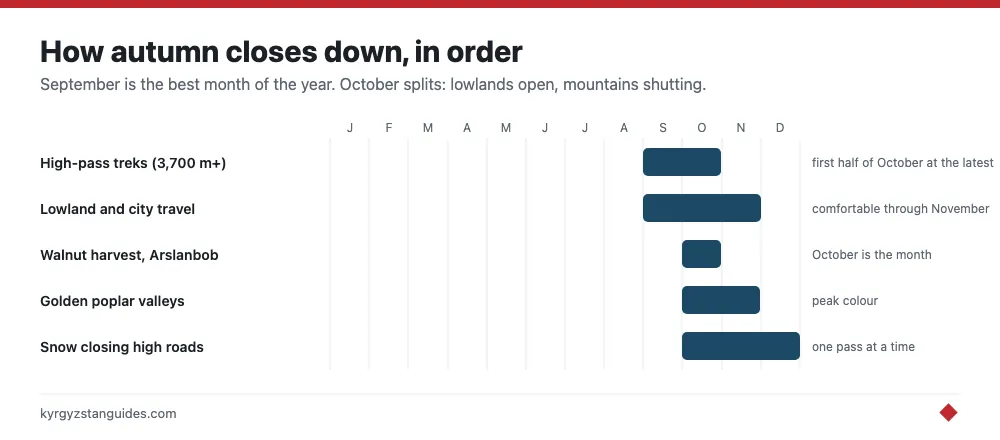
Kyrgyzstan’s tourism infrastructure is seasonal in a way that surprises people used to Europe. Things don't gradually wind down; they fold up and disappear. Here is the honest rundown of what you lose as autumn deepens:
- Yurt camps at Song-Kul, Kel-Suu, and other high jailoos dismantle from mid-September; by early October almost none remain.
- High-pass treks (Ala-Kul, Boz-Uchuk, anything over ~3,700 m) become snow routes by mid-October and need winter experience.
- Seasonal 4WD transfers to remote lakes stop running once the passes ice over, typically October.
- Some guesthouses in trekking villages like Jyrgalan and Altyn-Arashan close or move to advance-booking-only from November.
- Horse-trekking operators wind down through October as stock is moved to lower winter pasture.
What stays open: everything urban. Bishkek, Karakol town, and Osh function normally year-round, hot springs like Altyn-Arashan remain reachable (with effort), and lower valley walks stay doable on most days. The country doesn't close in autumn: the high country does.
November: The Honest Assessment
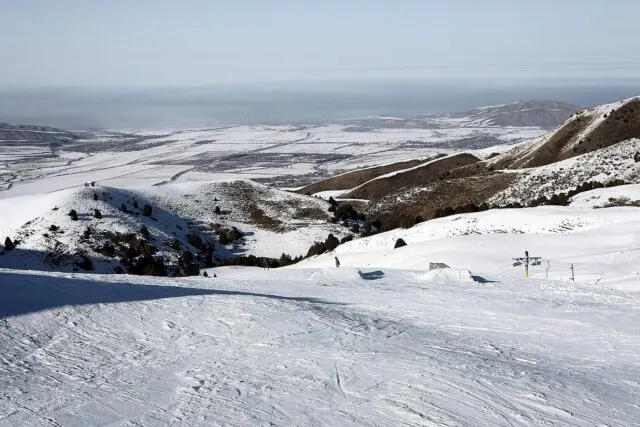
November is the weakest month in the Kyrgyz calendar and we won't pretend otherwise. The gold is gone by the first week or two, the ski lifts have not started spinning, and the weather is gray, cold, and indecisive: rain in the cities, wet snow in the hills. Daytime temperatures in Bishkek hover around 5–10°C early in the month and fall from there.
That said, November is not worthless. It is the cheapest month to be in the country, museums and bazaars are crowd-free, and it suits travelers who are passing through on a longer Central Asia overland route rather than flying in for a headline trip. If you can shift your dates even two weeks earlier into late October, do it. If you can't, aim your November at cities, food, and hot springs, and keep expectations modest.
The Photography Case for Autumn
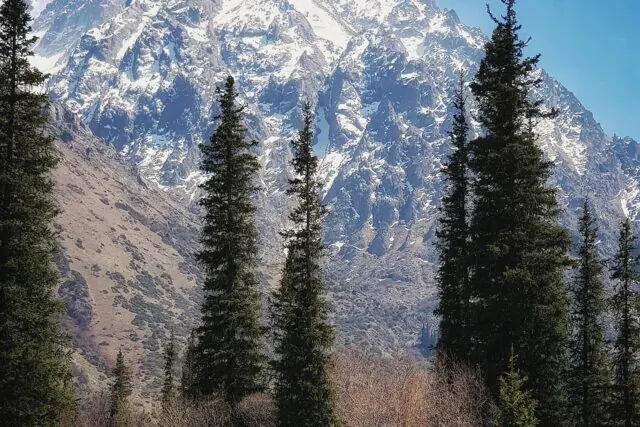
Summer light in Kyrgyzstan is harsh. The sun sits high, haze builds over the ranges by mid-morning, and the classic green-jailoo shots all start looking the same. Autumn fixes most of this at once. The lower sun angle means golden hour stretches longer at both ends of the day, the first snows put white summits behind every composition, and the air over the valleys clears noticeably once summer dust and heat haze die down.
Specific combinations worth planning around: red rock and orange birch in Jeti-Oguz in early October, fresh snow above the still-turquoise water at Ala-Kul in mid-September, golden poplar avenues along the south shore of Issyk-Kul, and the walnut canopy at Arslanbob any time the harvest is running. Bring more warm layers than you think you need for dawn shoots — standing still at altitude in October is a different sport than hiking in it.
Who September Suits, and How to Sequence It
September rewards the traveler who values conditions over guarantees. Someone happy to carry a warm bag, watch the forecast, and aim the big treks at the early weeks. It's ideal for photographers chasing autumn light, for anyone who found July too busy, and for hikers whose enjoyment hinges on not being rained on; the rain days that plague June and early July become rare. It's a slightly worse pick if your single must-do is a late-season Song-Kul yurt stay or a guaranteed snow-free crossing of the very highest passes. For those, mid-summer is safer.
If autumn has convinced you, build the trip early-to-late by altitude: front-load the high treks and Song-Kul while they are still open, then let the lower valleys, the lakeshore, and the golden forests carry the back half as the nights cool. Watch the forecast, book nothing rigid past mid-September up high, and the trip will likely be the best-timed one you take to the region.
Autumn Month by Month at a Glance
- Early-mid September: full trekking season, stable weather, yurt camps open, crowds gone. The best all-round window of the year.
- Late September: high camps closing, first real snow on passes, gold starting in the south. Trek early, then head down.
- Early-mid October: peak color, walnut harvest, mild south, cold high country. Valleys and villages, not passes.
- Late October: color fading in the north, still pleasant in Osh and Arslanbob. Last comfortable window.
- November: gray shoulder. Cities, museums, hot springs, low prices. Or come back in December for snow.
Our Verdict
Autumn in Kyrgyzstan is really two seasons and a dead zone. September is a elite trekking month that deserves far more traffic than it gets; the first three weeks of October are the country’s most beautiful and most underrated stretch, especially in the walnut south; and November is a month to transit, not to target. Plan around that split and autumn will quietly outperform the August trip everyone else took.
FAQ
Is autumn a good time to visit Kyrgyzstan?
It is arguably the best and almost nobody plans for it. September delivers the most stable trekking weather of the year, October turns the southern walnut forests gold, and prices drop across the board.
Should I visit Kyrgyzstan in September or October?
September if you want to trek, because the weather is at its most stable. Early October if you want golden valleys and the walnut harvest around Arslanbob.
Is November a good month in Kyrgyzstan?
Skip it unless you have a specific reason to be here. It falls between the autumn colour and the ski season, with much of the mountain infrastructure already shut.
Are yurt camps open in autumn?
They come down as the season ends, so the later you go the fewer are standing. That is the main practical limit on an autumn itinerary and the reason September is easier to plan than October.
Is autumn cheaper in Kyrgyzstan?
Yes, prices drop across the board once the July and August peak passes — which is part of why the season is worth planning for rather than avoiding.
Why do most itineraries use July and August?
Because that is when the jailoos are green and the yurt camps are full. The cost is that every trailhead has a queue of 4WDs, which is exactly what autumn avoids.