Steam rising off a concrete pool while snow settles on your hair: that image, more than any other, sells travelers on Kyrgyzstan’s hot springs. The country sits on a geologically restless stretch of the Tien Shan, and hot mineral water surfaces all along the ranges — some of it captured in Soviet-era sanatoriums, some in village bathhouses, and some in rough pools a full day’s trek from the nearest road.
If you want the one-line answer: Altyn-Arashan is the best all-around hot spring experience in Kyrgyzstan if you can walk or jeep in, Issyk-Ata and Alamedin are the easiest soaks from Bishkek, and Jeti-Oguz is the place to taste the Soviet sanatorium tradition intact. Below we run through every spring worth planning around, compare them honestly, and cover the etiquette nobody tells you about until you get it wrong.
Altyn-Arashan: The Famous One
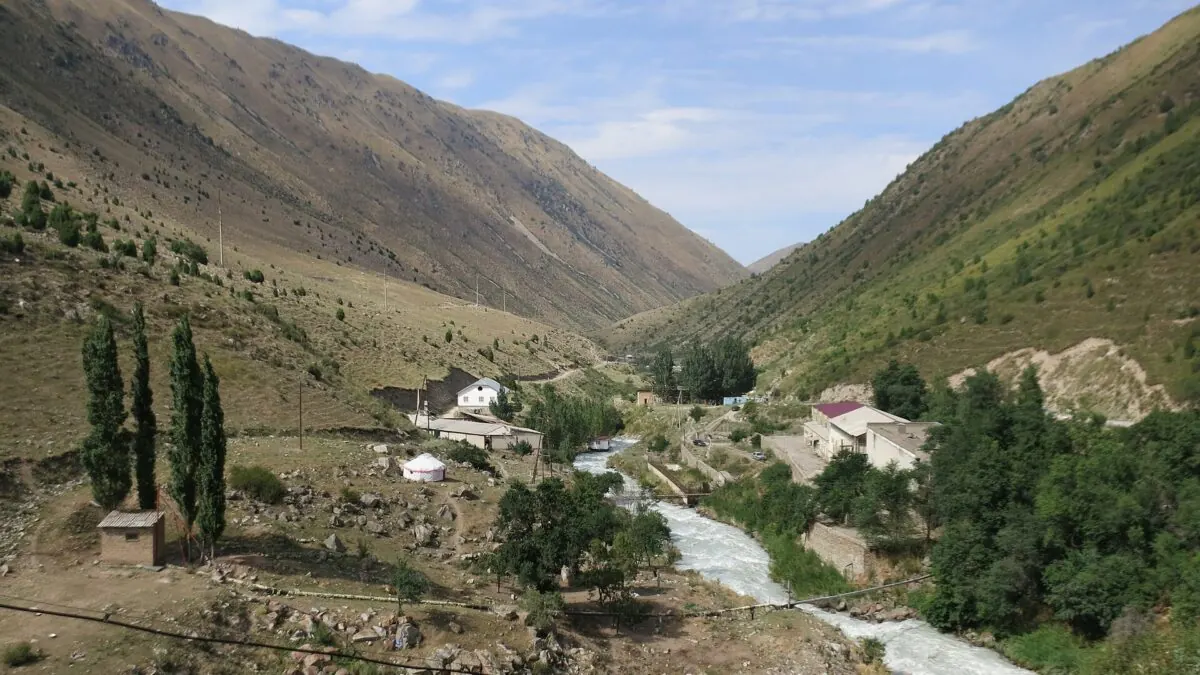
Altyn-Arashan (“golden spa”) is a high valley above Karakol at about 2,500 meters, reached by a half-day hike or a violent jeep track that has rearranged many spines. Several guesthouses in the valley pipe hot spring water into small indoor and outdoor concrete pools, which you rent privately by the hour for a few hundred som per person. The setting is the point: you soak looking up at fir slopes and, in clear weather, the pyramid of Palatka peak. It is also the classic recovery stop after the Ala-Kul trek, and most visitors combine the two. Everything you need to plan the trip — routes, guesthouses, jeep prices — is in our dedicated Altyn-Arashan guide.
Two honest caveats. First, the pools are small, plain concrete tubs, not landscaped Japanese onsen — the magic is the valley, not the tilework. Second, summer weekends get busy with local groups, so aim for a weekday or an evening soak if you want quiet.
Issyk-Ata and Alamedin: Bishkek’s Day-Trip Soaks
Both of these sit in mountain valleys within about 1.5 hours of the capital, which makes them the easiest hot water in the country to actually reach.
Issyk-Ata is a working balneological resort dating to the Soviet era, built around springs used for centuries before that — a carved Buddha figure on a boulder near the entrance testifies to just how long. There is a large outdoor pool fed by the springs (entry a few hundred som), treatment buildings for those on prescriptions, and pleasant walking up-valley. The vibe is faded-institutional rather than scenic-wild, and that is precisely its charm or its problem, depending on your taste.
Alamedin (the Tyoplye Klyuchi complex at the mouth of the Alamedin gorge) is smaller and simpler: hot pools, a café serving decent trout, and a gorge walk that gets alpine fast. Locals treat it as a weekend outing; on weekdays you may have a pool nearly to yourself. Combine either spring with an afternoon in the city — they slot neatly into a Bishkek stay when the mountains proper are out of reach.
Jeti-Oguz: The Sanatorium Time Capsule
Above the famous red rock formations near Karakol, the Jeti-Oguz sanatorium has been dispensing radon-mineral baths since the 1930s, and cosmonaut Yuri Gagarin famously rested here. Today it is gloriously unrenovated: tiled individual bathtubs filled on a timer, attendants in white coats, a price list of treatments taped to the wall. A soak costs very little — think a few hundred som — and takes about fifteen minutes, which is all the attendants will allow for the hot radon water. Come for the cultural experience as much as the bath, and pair it with the valley’s rocks and hikes covered in our Jeti-Oguz guide. Note that radon baths come with contraindications; pregnant travelers and anyone with heart conditions should skip them.
Juuku: The Quiet Alternative
The Juuku valley, southwest of Kyzyl-Suu on Issyk-Kul’s south shore, hides small hot pools partway up a long, beautiful gorge that eventually leads toward high passes. A rough road reaches the springs — basic concrete tubs in huts, plus newer guesthouse-style pools lower down — and almost no foreign traffic finds them. If Altyn-Arashan’s popularity puts you off, Juuku is the same idea with the volume turned down: less dramatic, far quieter, and best done with a driver from Karakol or Kyzyl-Suu as a half-day outing on the south shore circuit.
Jyrgalan: Banya Culture Instead of Springs
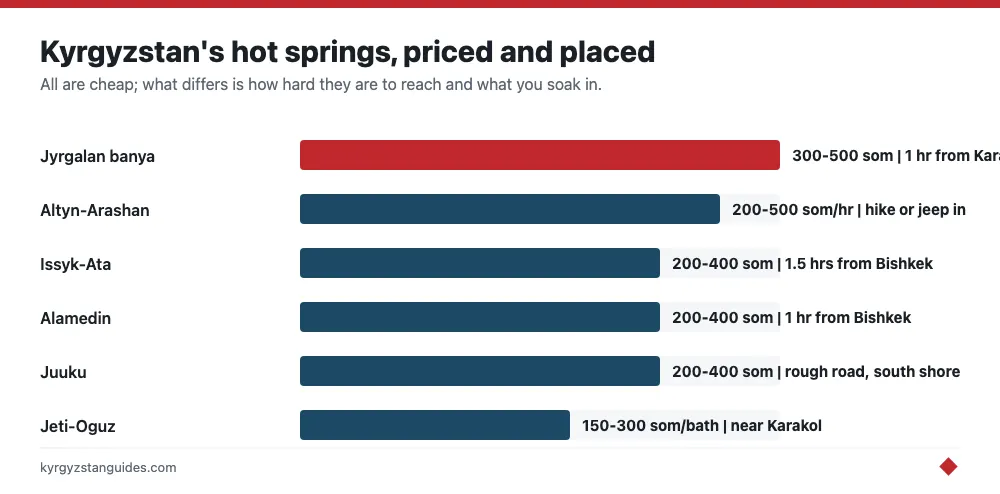
Jyrgalan village, east of Karakol, deserves a place in this roundup with an asterisk: its hot water comes from wood-fired banyas rather than geothermal springs. Nearly every guesthouse in this former mining village runs its own banya, and after a day of winter freeriding or summer trekking, the ritual — dry heat, birch-branch thwacking if you dare, a bucket of cold water, repeat — delivers everything a hot spring does plus a social dimension the concrete tubs lack. Banya sessions typically cost 300-500 som per person at guesthouses. If your route already includes the village (see our Jyrgalan guide), do not skip the banya; it is the closest thing Kyrgyzstan has to a national bathing tradition still lived daily.
Comparing Your Options
| Spring | Access | Typical cost | Setting |
|---|---|---|---|
| Altyn-Arashan | Half-day hike or rough jeep from Karakol | 200-500 som/hour | Alpine valley, guesthouse pools |
| Issyk-Ata | ~1.5 hr drive from Bishkek | ~200-400 som | Soviet resort, big outdoor pool |
| Alamedin | ~1 hr drive from Bishkek | ~200-400 som | Gorge mouth, simple pools |
| Jeti-Oguz | Short drive from Karakol | ~150-300 som/bath | 1930s sanatorium, indoor tubs |
| Juuku | Rough road, south shore of Issyk-Kul | ~200-400 som | Remote gorge, basic huts |
| Jyrgalan (banya) | ~1 hr drive from Karakol | 300-500 som/session | Village guesthouse banyas |
Hot Springs in Winter
Winter is when this whole category is worth the money. Altyn-Arashan runs year-round — the approach becomes a snowshoe, ski-tour, or horse-sled trip, and the contrast of 40°C water and minus-15 air is the single best argument for visiting Kyrgyzstan in the cold months. Issyk-Ata and Alamedin stay open and become moody, steamy, and nearly empty on weekdays. Jeti-Oguz operates through winter as well, since its clientele comes on medical vouchers rather than tourist seasons. Build a soak into any cold-season plan; our Kyrgyzstan in winter guide shows where the springs fit alongside the ski bases.
Etiquette and Practical Notes
- Swimwear is standard in shared pools everywhere. Private hourly pools (Altyn-Arashan, Juuku) are yours to use as you like; banyas among strangers usually split by gender, often bathed without swimwear — follow your hosts’ lead.
- Rinse before entering shared pools where a shower exists. Where it does not, nobody expects miracles.
- Respect the timer. Sanatorium attendants limiting your radon bath to 15 minutes are following medical protocol, not rushing you.
- Bring everything: towel, flip-flops, water bottle, and a dry warm layer for afterward. Only the Bishkek-adjacent resorts rent towels reliably.
- Cash, small notes. No spring in this article takes cards.
- Alcohol and hot water is a beloved local combination and a genuinely bad idea at altitude. At minimum, hydrate double.
Kyrgyzstan Hot Springs FAQ
Which hot spring in Kyrgyzstan is the best?
Altyn-Arashan, for the combination of alpine setting and functional pools — provided you are up for the hike or jeep ride in. For pure convenience from Bishkek, Issyk-Ata wins; for atmosphere and history, the Jeti-Oguz sanatorium is unmatched.
Can you visit Kyrgyzstan’s hot springs in winter?
Yes — winter is arguably the best season. Altyn-Arashan is reachable by snowshoe, ski tour, or horse-sled and its pools run all year, while Issyk-Ata, Alamedin, and Jeti-Oguz operate year-round with far fewer visitors than summer.
How much do hot springs cost in Kyrgyzstan?
Very little. Expect roughly 150-500 som (about $2-6) per person for pool entry, an hourly private pool, or a sanatorium bath. Banya sessions at Jyrgalan guesthouses run 300-500 som.
Do I need to book hot springs in advance?
Generally no. Altyn-Arashan guesthouses assign pool hours on arrival, and the Bishkek-area resorts sell walk-in tickets. The exceptions are summer weekends at Altyn-Arashan and banyas at busy Jyrgalan guesthouses, where asking a day ahead is smart.
Are the springs natural pools or built structures?
Almost all developed springs feed built concrete pools or tubs; free-flowing natural rock pools are rare and mostly found at undeveloped sources in valleys like Juuku. If you are picturing wild terraced pools, adjust expectations — in Kyrgyzstan the wildness is the landscape around the tub.