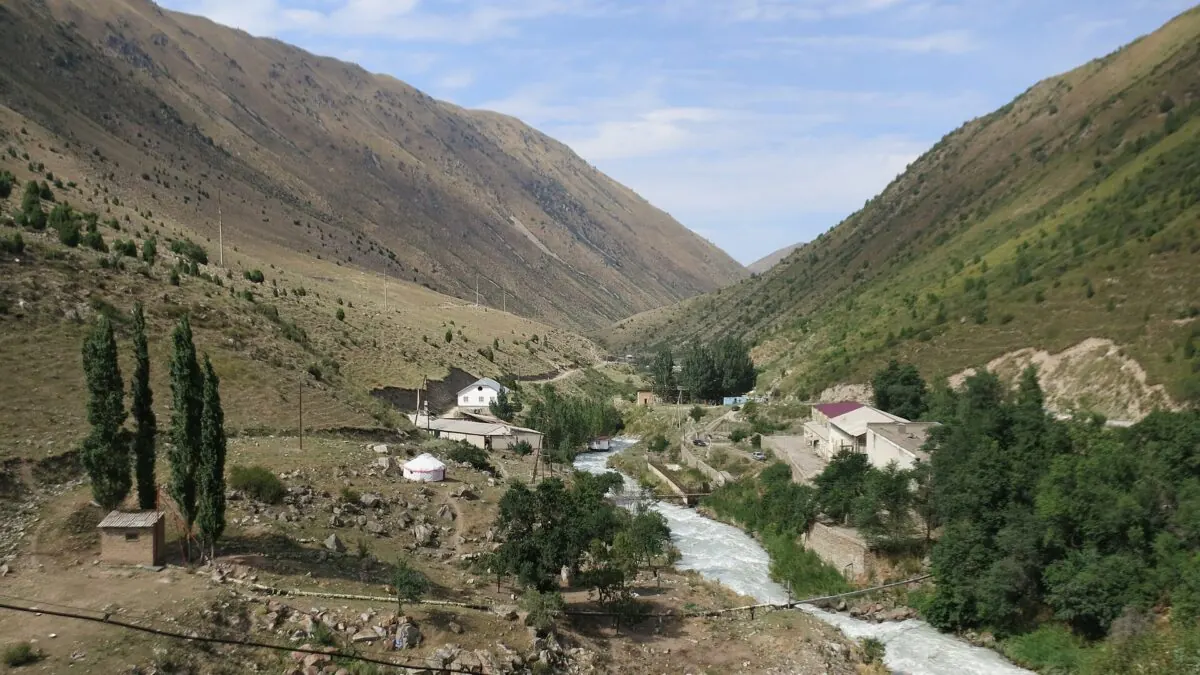
Altyn-Arashan gets the trekkers, Jeti-Oguz gets the tour buses, and Juuku gets almost nobody. Which is exactly the argument for going. This long valley on Issyk-Kul’s south shore combines natural hot springs, a red-rock gorge, and an old Silk Road pass route in one drive, and on most weekdays you will share it with shepherds, not crowds.
The essentials up front: Juuku valley runs south into the mountains between the villages of Saruu and Kichi-Jargylchak, roughly 30-45 minutes from Tamga or Kaji-Say by car. The hot springs sit partway up the valley on a rough but usually passable track, entry to the developed pools costs a few hundred som, and the trip works best as a half-day or full-day outing from any south shore base. No permits, no guides required.
The hot springs
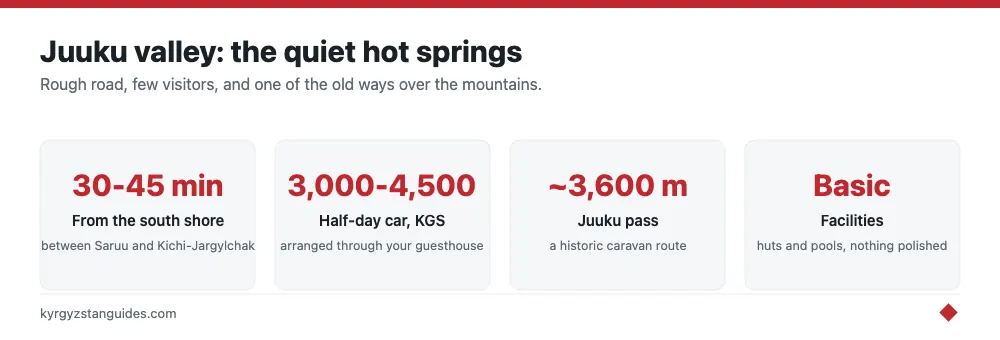
Juuku’s springs emerge hot enough for a proper soak, and development is refreshingly modest: a small bathhouse complex with concrete pools of different temperatures, plus simpler outdoor pools that locals prefer. Facilities are basic. Changing sheds, an attendant collecting a small fee, maybe a kettle of tea if you are lucky — and that's the appeal. This is where families from Saruu and Karakol come on weekends, so a Saturday visit doubles as people-watching; a Tuesday visit can mean a pool to yourself. Bring a towel, flip-flops, and water, because the springs dehydrate you faster than you notice at altitude. If you have compared it to the busier soak at Altyn-Arashan, the water is just as good; the walk-in requirement is simply zero.
The red rock gorge
The lower valley’s signature is its red sandstone: rust-colored cliffs and eroded towers that glow at golden hour, framing the river where it cuts toward the lake. It's the same geology that made Skazka canyon famous, but stretched along a living valley with poplars, grazing horses, and beehive stands instead of a parking lot. Stop wherever a formation catches your eye: there are no marked viewpoints, which keeps it feeling found rather than served. Photographers should time the lower gorge for late afternoon.
Up-valley toward Juuku pass
Beyond the springs the track climbs toward Juuku pass at around 3,600 meters. One of the historic caravan routes that once linked the Issyk-Kul basin with the Naryn plateau and, ultimately, Kashgar. A high-clearance vehicle in dry summer conditions can get well up the valley past waterfalls and juniper slopes; the full crossing is 4WD-and-experience territory and genuinely remote once committed. For most visitors the right move is simpler: drive or walk as far up as time allows, picnic where the valley opens out, and turn around. Even an hour above the springs, the landscape shifts from red rock to proper alpine and the silence gets serious.
Making it a day trip
From Tamga, Kaji-Say, or Tosor, arrange a car through your guesthouse, expect around 3,000-4,500 KGS for a half-day round trip depending on how far up the valley you push, less if you only want the springs. A taxi from Karakol works too but adds over an hour each way. The classic combination day pairs a morning soak and gorge wander with an afternoon at Skazka or the Barskoon waterfalls, then a lakeside dinner. There is no cafe infrastructure in the valley itself, so carry lunch, cash in small notes, and a warm layer. Full south shore logistics, where to base, marshrutka realities, which beaches deserve you. Are in our Issyk-Kul guide.
When to go
June through September is prime: the track is dry, the upper valley is green, and beekeepers set up stands along the lower gorge selling honey straight from the frame. May and October are gambles that often pay off — colder soaks-to-air contrast, better light, nobody around, as long as you accept that rain can end the driving portion early. Winter narrows the trip to the springs themselves, which is arguably when hot water makes the most sense. Two timing rules hold all year: weekday mornings beat weekends by a wide margin at the pools, and late afternoon beats midday in the red gorge, when low sun sets the sandstone glowing and the harsh overhead light finally relents.
One caution applies in every season: this is still a mountain valley with a single rough road. Cloudbursts can cut the track for a few hours, and there's no phone signal beyond the lower gorge, so tell your guesthouse where you're headed and do not schedule the valley on the same day as a flight or a border run.
What is actually known about the water
Kyrgyz travel sites will tell you the Juuku springs are radon-rich and that you should not soak longer than half an hour. Treat both claims carefully: no measured values exist in anything published. There is no figure in becquerels per litre, no hydrogen-sulphide concentration, no geological paper on this particular spring. It is advice that has been copied between websites until it acquired the shape of a fact.
The temperature is better attested, though still a range rather than a number. Published figures run from 34 °C at the low end to 40-45 °C at the high end, which is a wide enough spread that you should expect the pools to feel warm rather than hot, and to vary. The developed pools are two flow-through basins inside an open-air, yurt-shaped concrete structure. It is not a spa.
For context on what these waters plausibly are, the Issyk-Kul basin's thermal springs generally run 20-60 °C with mineralisation of 1-5 g/L, rising to around 15 g/L at Jeti-Oguz. And Jeti-Oguz, 40-odd kilometres west, is the one south-shore system that has been studied properly: a 2026 paper in Water characterises it as a chloride-sodium-calcium brine reaching 32 °C at the surface with dissolved solids up to 12.8 g/L, meteoric in origin, circulating to about 3 km depth through Middle Carboniferous carbonates with a reservoir temperature near 105 °C. Juuku has not had that treatment. Assume it belongs to the same family and leave it there.
The pass, and what it was actually a route to
Juuku pass sits at 3,633 m in the main ridge of the Terskey Ala-Too, linking the Juuku gorge to the Arabel-Suu river and the Arabel plateau. The gorge below it runs about 50 km, which makes it the longest on the south shore.
The line you will hear is that Juuku was for a long time the only way from the Issyk-Kul valley to China. That is how the sources phrase it, and it is worth a small correction before you repeat it: the pass delivers you onto the Arabel plateau and the Naryn headwaters, not to Naryn town and not directly to a Chinese frontier post. It was a link in a longer chain, and an unforgiving one.
Getting in without your own vehicle is more doable than the remoteness suggests. A marshrutka from Karakol to Darkhan costs in the region of 70-100 som, and the valley is about a two-hour walk from there. The valley mouth is 70-75 km from Karakol depending on which source you use.
FAQ
Can you visit Juuku valley without a 4WD?
Yes, as far as the springs in dry weather. Drivers do it in ordinary Ladas and minivans, slowly. After rain, or for anything beyond the springs, you want clearance and a driver who knows the track.
Are the hot springs open year-round?
The bathhouse pools generally operate year-round for locals, and a winter soak with snow on the red cliffs is a quiet highlight. The limiting factor is the track, which snow can close for days at a time, check conditions from Saruu before committing.
Is Juuku worth it over Jeti-Oguz if I only have one valley day?
Pick Jeti-Oguz for iconic formations and easy infrastructure; pick Juuku for hot water, solitude, and the feeling of having the south shore to yourself. On a second visit to the region, Juuku wins.
How hot are the Juuku hot springs?
Published figures disagree, running from about 34 °C to 40-45 °C. Expect warm rather than hot, and expect variation. The developed pools are two flow-through basins in an open-air concrete structure shaped like a yurt.
Are the Juuku springs radioactive or radon-rich?
No published measurement supports it. The radon claim and the 30-minute soaking limit circulate on travel sites with no becquerel figures, no hydrogen-sulphide values and no geological study behind them. Treat them as unverified.
How high is the Juuku pass?
3,633 metres, in the main ridge of the Terskey Ala-Too. It links the Juuku gorge with the Arabel-Suu river and the Arabel plateau, not with Naryn town directly.
Can you reach Juuku valley without a car?
Yes. Take a marshrutka from Karakol to Darkhan, roughly 70-100 som, then walk about two hours into the valley. It is a longer day than driving, but the route works.