Every traveler in Kyrgyzstan eventually stands in front of something old. The Burana tower leaning over the Chuy plain, a carved stone balbal, a Lenin statue nobody took down. And realizes they have no framework to hang it on. Central Asian history rarely makes it into school curricula anywhere else, so most visitors arrive knowing roughly nothing. This is the ten-minute version: enough to make the sites talk, without pretending to be a textbook — for the full chronology, Britannica’s history of Kyrgyzstan goes as deep as you want.
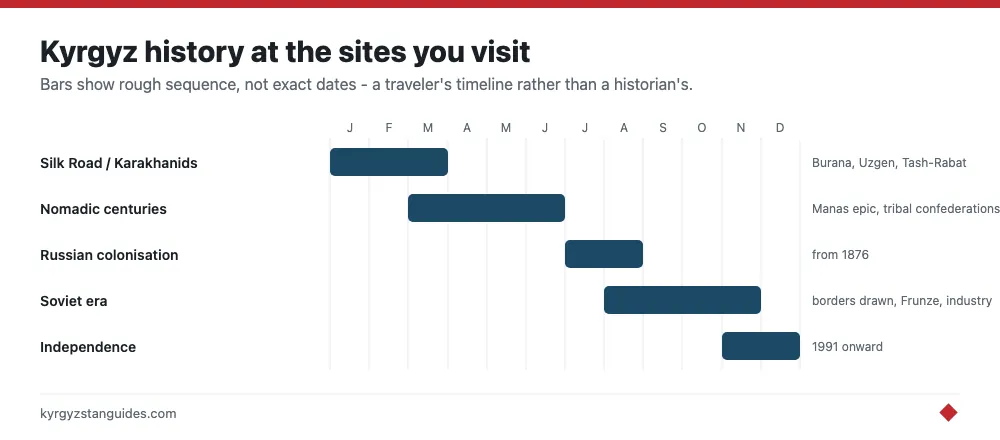
The compressed answer, if you want it in two sentences: Kyrgyzstan’s territory spent two millennia as a corridor and pasture for successive nomadic powers and Silk Road states, was absorbed by the Russian Empire in 1876, was assembled into a defined republic by the Soviets, and became an independent state (somewhat to its own surprise) in 1991. Everything you will see, from caravanserais to concrete apartment blocks to the yurts still on the summer pastures, maps onto one of those four layers.
The Silk Road Layer: Karakhanids, Burana, Uzgen
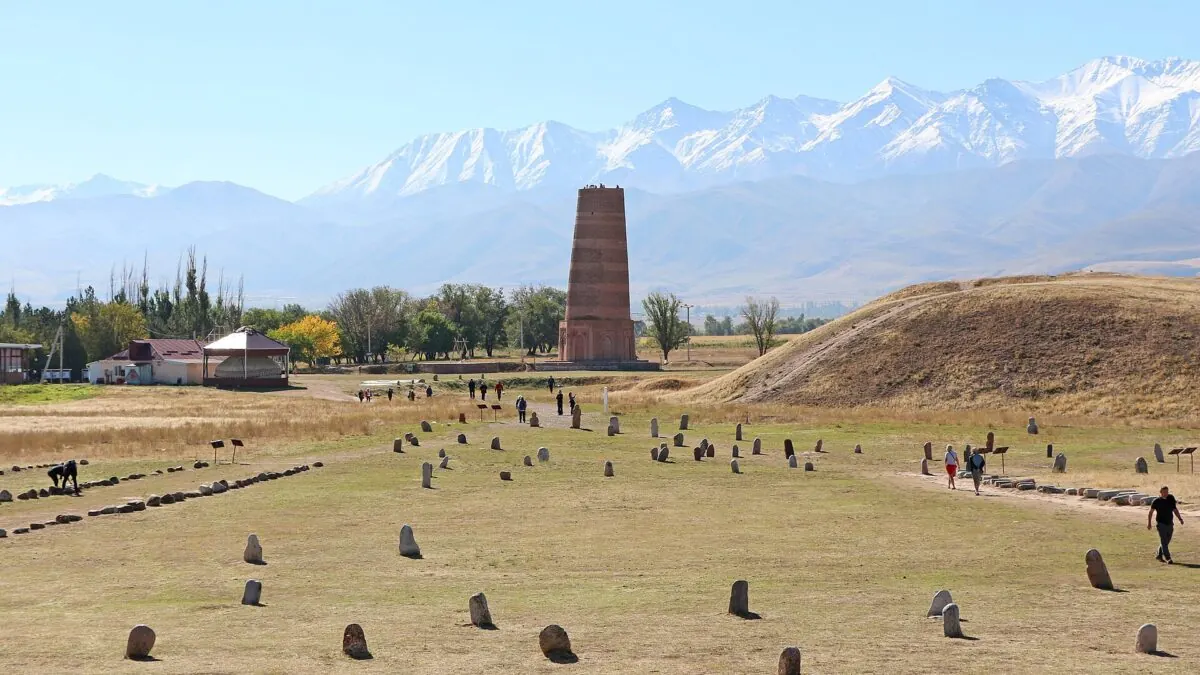
From roughly the 8th to the 12th centuries, the valleys of what is now Kyrgyzstan held real cities. The Karakhanids (a Turkic dynasty that converted to Islam in the 10th century) ruled a state stretching across the Tien Shan, with Balasagun in the Chuy valley among its capitals. The Burana tower, 80 kilometers from Bishkek, is the surviving minaret of that city: an 11th-century brick stump (earthquakes took the top half) surrounded by a field of balbals, the carved grave markers of earlier Turkic nomads. Down south in Uzgen, near Osh, three exquisitely brick-patterned Karakhanid mausoleums and another minaret mark what was once a dynastic center of the Fergana valley.
This is also the layer of the caravan trade itself. The routes between China and the west threaded the Tien Shan passes, and stone waystations sheltered the traffic — the best preserved being Tash-Rabat, a 15th-century caravanserai sitting improbably intact in a side valley at 3,200 meters near the Chinese border. If you make it to Tash-Rabat, you're standing in the most tangible piece of Silk Road infrastructure in the country. The Mongol invasions of the 13th century largely ended the urban story; the cities declined, and the mountains returned to the herders.
The Nomad Centuries and the Manas Epic
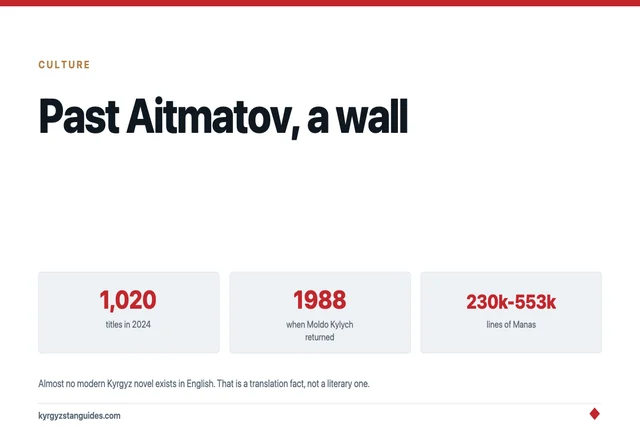
The Kyrgyz themselves are relative newcomers to these mountains, at least under that name. Most historians trace major migrations from the Yenisei river region of Siberia between the 10th and 15th centuries. What followed was half a millennium of tribal, pastoral life: no state in the modern sense, but a sophisticated society organized around clans, seasonal migration between winter valleys and summer jailoos, and a phenomenal oral culture. Its centerpiece is the Manas epic, a poem of hundreds of thousands of lines about a unifying warrior-hero, still performed today by reciters called manaschi who work themselves into a genuine trance. UNESCO lists it; Kyrgyz treat it as something closer to scripture.
This period had its dark stretches, raids, wars with the Oirat Mongols (the “era of great calamity” in Kyrgyz memory), and by the 19th century, heavy-handed domination by the Khanate of Kokand, which built forts across the region including one called Pishpek. The nomadic layer is the one you can still sleep inside: the yurt, the felt-making, the horse games, the entire aesthetic explored in our nomadic culture guide descends from these centuries, and the World Nomad Games are its modern festival form.
1876: The Russians Arrive
Russia absorbed the region piecemeal. Northern Kyrgyz tribes, squeezed by Kokand, accepted Russian protection from the 1850s onward; the empire then crushed Kokand itself and annexed the south in 1876, the date usually given for the full incorporation of Kyrgyz lands. Russian and Ukrainian settlers followed, taking some of the best valley land for farms — a slow-burning grievance that exploded in 1916, when a wartime conscription decree triggered a Central Asia-wide revolt. The Tsarist reprisals were catastrophic: a large share of the northern Kyrgyz population fled over the passes to China, and many thousands died on the way. The episode, known as the Ürkün (“the exodus”), remains the deepest wound in Kyrgyz historical memory, and you'll find memorials to it around the country.
The Soviet Layer: Borders, Frunze, Factories
The Soviets did something no one had done before: they drew a line around “Kyrgyzstan.” In the 1920s and 30s, Moscow carved Central Asia into national republics, and the Kirghiz SSR got its borders — including the tangled, enclave-riddled boundary through the Fergana valley that still causes friction with Tajikistan and Uzbekistan today. Pishpek became Frunze, renamed for the locally born Bolshevik general Mikhail Frunze, and grew from a garrison town into a planned capital of oak-lined grids and monumental squares. The Bishkek you walk today is overwhelmingly this city.
The Soviet transformation cut both ways, and honest travelers should hold both halves. Collectivization forcibly settled the nomads in the 1930s, killing herds and people and breaking a way of life; the purges took much of the young republic’s intelligentsia, a tragedy memorialized at Ata-Beyit outside Bishkek, where Stalin-era victims were exhumed from a mass grave. At the same time, the era brought mass literacy, universities, hospitals, hydropower, and industry: mining towns, the Frunze machine works, the torpedo test facility on Issyk-Kul that kept the lake region closed to foreigners for decades. When the USSR dissolved, Kyrgyzstan was left with that entire industrial skeleton and almost no economy to animate it, which explains the half-abandoned factory belts you pass on any long drive.
1991 and After: Independence, Two Revolutions
Kyrgyzstan voted to preserve the USSR in a March 1991 referendum and found itself independent by December anyway, when the union dissolved from above. The decades since have been turbulent by Central Asian standards. And, notably, more open. Where neighboring states settled into durable strongman rule, Kyrgyzstan removed presidents by street revolt twice: Askar Akayev fled in the 2005 Tulip Revolution amid anger over corruption and rigged elections, and Kurmanbek Bakiyev fell in April 2010 after security forces killed dozens of protesters in Bishkek; that summer also saw deadly inter-ethnic violence between Kyrgyz and Uzbeks in Osh and Jalal-Abad. Since then the country has cycled through further upheavals and constitutional rewrites, and its politics remain noisy, personal, and unpredictable: but this history is precisely why Kyrgyzstan feels different to visit: people argue about politics openly in a way you won't encounter in most of the region.
Why Any of This Matters at the Sites
History here isn't confined to museums; it is the explanation for almost everything you will look at. A quick decoder:
- Burana tower and the Uzgen mausoleums: the Karakhanid city layer, proof these valleys once held urban, literate, Islamic civilization before the Mongols reset the board.
- Balbals and petroglyphs (Burana’s field, Cholpon-Ata’s boulders): the pre-Islamic nomad layer, older than the Kyrgyz themselves.
- Tash-Rabat: the caravan economy that made these mountains matter to the wider world.
- Yurts, jailoos, eagle hunters, Manas recitals: the nomad centuries, alive rather than reconstructed, settled by force in the 1930s, revived with pride since 1991.
- Bishkek’s grid, Lenin statues, sanatoriums, and mining towns: the Soviet layer, neither celebrated nor erased, just inhabited.
- Osh’s Suleiman-Too and mixed mahallas: three thousand years of Fergana valley continuity, plus the unresolved tensions the Soviet borders left behind — context worth having before you wander the bazaar with our Osh guide in hand.
One caution to carry with you: the 20th century is recent, personal memory here, not abstract history. Elderly people you meet were born in the USSR and often speak of it with real nostalgia; the 2010 events in the south are within living memory for everyone over 25. Ask questions with curiosity rather than verdicts, especially about the Soviet era and inter-ethnic relations, and you'll get better conversations, often remarkable ones, than any museum can offer.
FAQ
What is Kyrgyzstan's history in short?
The territory spent two millennia as a corridor and pasture for successive nomadic peoples, then passed through Russian imperial rule and the Soviet period before independence. That is the frame; the sites you will stand in front of belong to one or other of those layers.
Why does Kyrgyz history feel unfamiliar?
Two threads worth following from here: what the Soviet system built in science and what it did to the press. Because Central Asian history rarely appears in school curricula anywhere else, so most visitors arrive with essentially no framework to hang the sites on. That is not ignorance so much as a gap in what gets taught.
What is a balbal?
A carved standing stone, one of the things travellers most often encounter without knowing what they are looking at. They are among the oldest visible objects in the Kyrgyz landscape and belong to the nomadic layer of the country's past.
Is the Burana tower worth understanding historically?
It is the clearest surviving piece of the medieval urban layer on the Chuy plain, which is what makes it worth ten minutes of context before you climb it. Without that it is a brick tower in a field.
Why are Lenin statues still standing in Kyrgyzstan?
Because the Soviet period is treated here as part of the country's own history rather than as an occupation to be erased, and the monuments were largely left in place. You will see them in working town squares rather than in museums.
How much history do I need before visiting?
Very little, but not none. A ten-minute framework is enough to make the sites speak — who was here, in what order, and which layer a given object belongs to. Anything beyond that is optional.
The administrative sequence behind all of this — oblast, ASSR, union republic — is set out in how the Kyrgyz SSR was formed.
The armed resistance to Soviet power in the south is covered in the Basmachi movement in Kyrgyzstan, without either of the two usual labels.
The city has had three names, and what the current one means is genuinely unsettled: see Pishpek, Frunze, Bishkek.
The man the city was named after was born here and died at forty: see Mikhail Frunze, including the house-museum and its prices.
One in four inhabitants went to the Second World War, and 137,000 people were deported into the republic in the same years: see Kyrgyzstan in the Second World War.