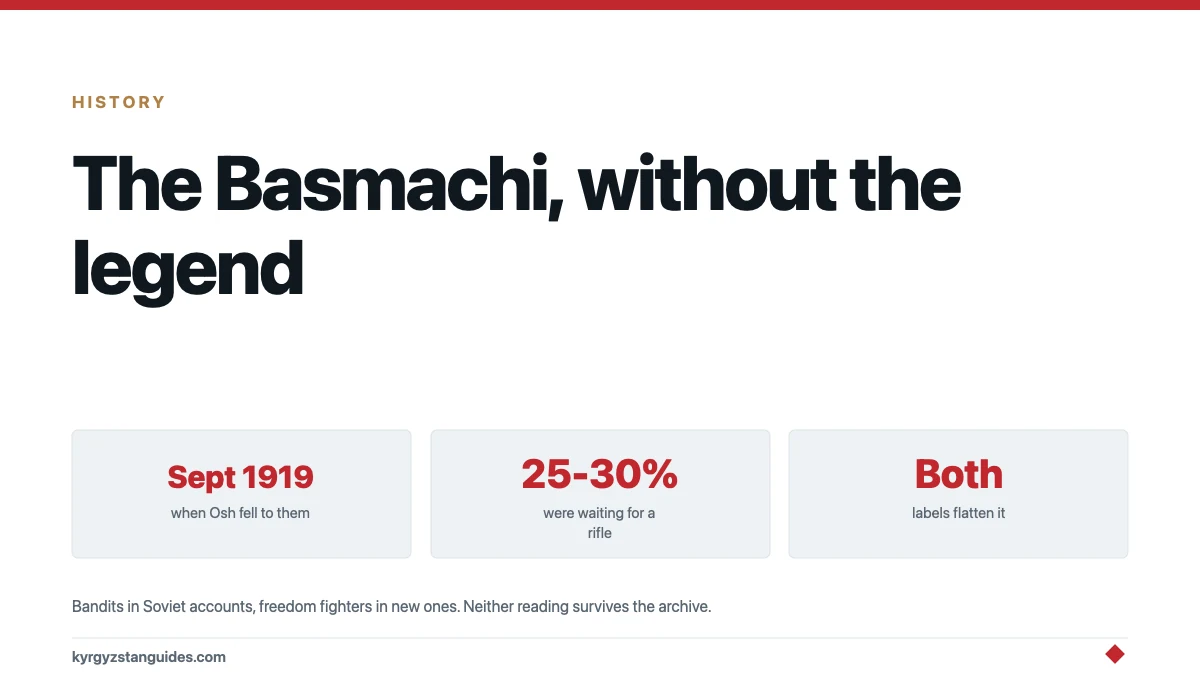
In Soviet accounts they were bandits with no ideas and no state apparatus. In a strand of modern Kyrgyz writing they are the founders of the republic. Neither label survives contact with the archive.
The Basmachi in Kyrgyzstan were real, locally rooted, religiously framed and sustained in the south for over a decade. They were also socially conservative, armed through Kashgar, willing to ally with Russian settler militias against the Bolsheviks, and predatory toward the nomadic Kyrgyz whose livestock they requisitioned.
What it was, and where
Armed resistance to Soviet power across Central Asia from roughly 1918 into the early 1930s. Basmachi came from a Turkic verb meaning to raid; it was the Soviet label. The participants used religious and clan vocabulary for themselves.
Scholarship divides the movement into four regional centres — Fergana, Bukhara, Khorezm and Samarkand. Southern Kyrgyzstan is the eastern end of the Fergana Valley, so it belongs to the Fergana focus. There was no separate Kyrgyz Basmachi movement.
Where it operated here: Osh and the Fergana fringe; Jalal-Abad, Kursahb, Bazar-Korgon; and above all the Alai valley and the Pamir-Alai ranges, where Fergana commanders repeatedly moved their bases. The Alai was separated from Soviet Fergana by hard passes and connected instead to Bukhara, to British India, and to Kashgar, from which — according to the Osh archive material — weapons and ammunition passed illegally.
The north was different. Sovietisation there was comparatively easy, and the north's major anti-Soviet episode was the Naryn revolt, not Fergana-style Basmachi activity.
The dates
8 September 1919. Basmachi, allied with a Russian settler "Peasant Army" under Colonel Monstrov, captured Osh — the only large Fergana Valley city they ever took. They formed a "people's government", restored private property in land and cotton-ginning, and with the Osh clergy called the Kyrgyz and Uzbek population to holy war against the Bolsheviks.
Hold onto that alliance. A Russian peasant militia and Muslim Basmachi taking a city together is the single fact that breaks both of the simple readings of this movement.
28 to 30 September 1919. The Red Army retook Osh and Jalal-Abad.
October 1919. A council of Basmachi leaders at Erkeshtam in the Alai created a provisional government of the "Fergana Autonomy" and elected Madamin-bek its head.
5 to 20 November 1920. The Naryn revolt in the north: leaders of the Naryn party organisation and Soviet organs arrested and many shot, state stores looted. Soviet power was restored with troops after a fortnight.
1922. Dzhanybek-kazy Sagynbaev, the principal southern figure, concluded a ceasefire, then commanded a self-defence detachment at the population's request and was appointed head of the district militia.
Late 1920s into the early 1930s. A final wave driven by forced collectivisation, whose active core the archive calls the bai-manap element — the traditional Kyrgyz aristocracy whose economic base collectivisation was destroying.
The people
Madamin-bek, Fergana commander and head of the Erkeshtam provisional government. Irgash and Kurshirmat, Fergana leaders. Maksum-Nadiya and Akbar-ali. Osman Jumabaev, an ishan who argued the religious case at a conference in January 1927.
Dzhanybek-kazy Sagynbaev is the one to understand. Soviet historiography made him a ferocious enemy of Soviet power. The archive shows he served that power, held awards for it, and had no criminal case opened against him — and that in the 1990s his fellow villagers wanted a school named after him. He also appears in our guide to Kara-Shoro, where a cave he hid in is the local attraction.
And Colonel Monstrov, commanding the Russian settlers who fought alongside them in 1919.
How thin it was
One figure from the archive says more than any narrative. Twenty-five to thirty per cent of Basmachi were "candidates" — men waiting for a rifle to become available from a fallen comrade.
That is what the movement's material base actually looked like, against the 30,000 sabres sometimes attributed to Madamin-bek at his peak. We flag that figure as reported rather than confirmed.
How it ended
Not with a battle or a treaty. By attrition: the loss of Osh in September 1919, the co-optation of leaders like Dzhanybek-kazy, the closing of the Afghan and Kashgar supply routes, and finally the suppression of the collectivisation-era revolts of the early 1930s.
No formal end date exists.
The argument now
The Soviet line was that the Basmachi were bandits — foreign-funded counter-revolution, and the war against them straightforward class struggle. It was reinforced in popular culture, including Soviet "easterns" in which the Kyrgyz actor Suimenkul Chokmorov played Basmachi.
From the mid-twentieth century an opposing reading appeared: fighters for independence and self-determination.
Post-Soviet Central Asian historiography generally treats the movement as Muslim society's reaction to crude Soviet expansion, and turns attention to the secret police as the principal instrument of terror.
A revisionist strand in Kyrgyzstan goes further, arguing the republics were not Leninist gifts but concessions extracted by armed resistance — anchoring the story in the Andijan uprising of 1898, the Turkestan Autonomy proclaimed in November 1917 and the Bolshevik storming of Kokand in February 1918. That argument appears in opinion essays rather than peer-reviewed work, and should be read as evidence of the current debate rather than as an established finding.
The gap that matters
Here is the thing to know about all of the above.
In post-Soviet Kyrgyzstan there are almost no scholarly articles on the Basmachi based on declassified archive documents. The Osh regional archive holds a mass of unpublished material that has barely been worked. The corresponding Russian military files exist and have not been mined either.
So the argument between "bandits" and "liberators" is being conducted largely without the evidence, by people on both sides who have not read it. That is worth knowing before you accept any confident account, including a shorter one than this.
What a traveller actually encounters
This is not an abstract historiographical quarrel. It surfaces in places you will visit.
Osh is where the movement had its one urban success, and the city's Soviet-era monuments were built by the side that won. See Osh.
The Alai valley, on the road south toward the Pamir, was the movement's mountain refuge. What looks like empty high pasture was a supply problem and a battlefield for a decade.
Kara-Shoro, near Uzgen, sells a cave as an attraction — the hiding place of a Kyrgyz notable who sheltered from Soviet power in the 1920s and 1930s and later founded a Kyrgyz settlement in Pakistan. That is the same period and the same conflict, presented as a curiosity.
And the collectivisation-era wave of the early 1930s connects directly to the famine and dispossession that reshaped the Kyrgyz countryside. The pasture economy you see in the summer was rebuilt after that, not continuous through it.
Reading it honestly
Three things to hold at once, because the subject punishes simple readings.
It was resistance. People with almost no weapons fought a state for over a decade in their own valleys, at enormous cost, and were not simply criminals.
It was not a national movement. It had no Kyrgyz national programme, it operated across an ethnically mixed valley, it allied with Russian settlers when useful, and its later social base was a landholding class defending property rather than a people defending sovereignty.
And the people who paid were mostly ordinary. Nomadic Kyrgyz families in the Alai lost livestock and fodder to requisition by both sides, which is the part neither the Soviet nor the nationalist account has much interest in recording.
FAQ
Who were the Basmachi?
Armed opponents of Soviet power across Central Asia from about 1918 into the early 1930s. The name was the Soviet label, from a Turkic verb meaning to raid; participants described themselves in religious and clan terms. In Kyrgyzstan the movement belonged to the Fergana focus and was concentrated in the south.
Where did the Basmachi operate in Kyrgyzstan?
Osh and the Fergana fringe, Jalal-Abad and nearby towns, and above all the Alai valley and the Pamir-Alai, which were cut off from Soviet Fergana by hard passes and connected instead to Bukhara, British India and Kashgar. The north of the country saw little of it.
Did the Basmachi ever capture a city?
Osh, on 8 September 1919, in alliance with a Russian settler militia under Colonel Monstrov. It was the only large Fergana Valley city they took, and the Red Army retook it at the end of that month.
Were the Basmachi freedom fighters or bandits?
Neither label fits. The movement was locally rooted and religiously framed, but also socially conservative — its later core was the landholding class resisting collectivisation — armed through Kashgar, allied at times with Russian settlers, and predatory toward nomadic Kyrgyz whose livestock it requisitioned.
When did the Basmachi movement end?
There is no formal end date. It wound down through attrition: the loss of Osh in 1919, the co-optation of leaders such as Dzhanybek-kazy Sagynbaev from 1922, the closing of supply routes, and the suppression of collectivisation-era revolts in the early 1930s.
Why is so little known about the Basmachi in Kyrgyzstan?
Because the archives have barely been worked. The Osh regional archive holds a large body of unpublished material on the movement, and post-Soviet Kyrgyz scholarship has produced almost no articles based on declassified documents, so the public argument is being held largely without the evidence.