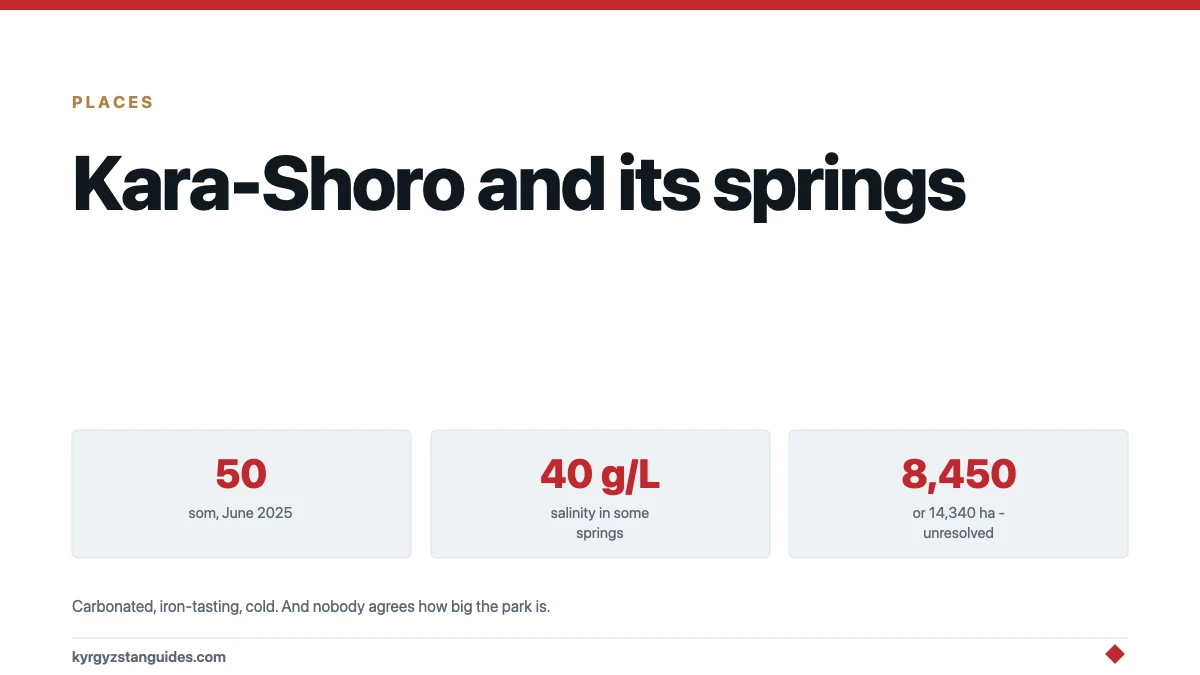
Nobody agrees how big Kara-Shoro is. The figure tied to its founding decree is 8,450 hectares. One reputable source gives 14,340.2 hectares — a number too precise to be a rounding error and too undocumented to explain.
We could not resolve it, and it is a fair introduction to a park that is genuinely popular, genuinely under-recorded, and absent from the environment ministry's own list of protected areas.
What it is
Кара-Шоро means roughly "black brine" — a direct reference to the springs, which are the whole point of the place.
It is a state nature park, established by government resolution on 2 August 1996. It sits on the slopes of the Fergana range in Osh oblast, Uzgen district. The nearest town is Uzgen, itself 54 kilometres from Osh.
The park base is at about 1,900 metres, with surrounding peaks to around 3,500. Slopes run 35 to 45 degrees and steeper. The Kara-Shoro river, also called the Yassy, runs west through the middle of it.
Of the 8,450-hectare figure, only 823.2 hectares is forest land; the remaining 7,626.8 is non-forest, mostly pasture. That ratio explains most of the park's management problems.
The springs
More than twenty carbonated mineral springs are usually claimed. Other sources give five, or twelve — the low numbers are probably the developed, named springs and the high one the total including undeveloped seeps.
The water is carbonated, gas-bubbling, with a pronounced iron taste. Salinity exceeds 40 grams per litre in some springs, with iron, zinc and barium among the microelements.
A note on terminology, because travel pages get it wrong: these are cold carbonated springs, not hot springs. If you are picturing a soak like Altyn Arashan, picture something else.
Reputed indications, as advertised locally, run to cardiovascular disease, metabolic disorders, digestive complaints, diabetes and obesity. The springs are known across Uzbekistan, Kazakhstan and Tajikistan as well as at home, and the park also runs a kymyz season — a fermented mare's milk cure, with yurt accommodation.
Drinking the water, sensibly
A practical note, because this is a place people come specifically to drink from.
Salinity above 40 grams per litre is very high — roughly the concentration of seawater. That is not water to drink casually or in quantity because it looks like a spa. The springs are used here as a cure, taken in measured amounts over days, which is a different activity from filling a bottle.
The advertised indications — heart conditions, metabolic disorders, digestive complaints, diabetes — are exactly the conditions where a sudden large mineral and salt load is least advisable without advice. We are not going to tell you the water is dangerous, because we have no evidence of that. We are telling you that "natural mineral spring" and "safe to drink as much as you like" are not the same claim, and that the people running the cure season treat dosage as the whole point.
Tap water safety in Kyrgyzstan generally is covered in our guide to drinking water.
The kymyz season
The other cure here is kymyz, fermented mare's milk, taken as a course rather than a drink.
It is seasonal by nature: mares are milked through the summer months, so the kymyz cure runs roughly June to September, which is also when the yurt camps stand and the road is comfortable. Outside that window there is no kymyz, no camps, and not much reason to make the journey.
If you have never had it, the first cup is sour, slightly fizzy and faintly alcoholic, and people's reactions divide sharply. Take a small one before committing to a course. Our dairy guide covers the wider family of Kyrgyz milk products.
Where three forests meet
Kara-Shoro's less obvious interest is botanical. It sits at the junction of three distinct Kyrgyz forest belts: Tien Shan spruce, walnut-fruit forest and juniper.
Spruce is the main forest species, on 245 hectares. Over 800 species of flowering plants are recorded across the park, with medicinals including ephedra and aconite.
Fauna counts conflict, as everything here does. Mammals: 12 species in one source, 24 in another. Birds: 21 species with 8 protected, or 51. What both agree on is the four Red Data Book mammals — brown bear, Turkestan lynx, snow leopard and roe deer — and among the birds, golden eagle, saker falcon and white-tailed eagle.
The cave
The cultural draw is the cave of Zhanybek kazy — Sagymbai uulu Zhanybek, 1861–1933 — a Kyrgyz notable who hid there from Soviet power in the 1920s and 1930s.
He later founded the first Kyrgyz settlement in the Ishkoman valley of Pakistan, which is a considerably more interesting biography than a cave usually comes with.
The cave is about ten metres deep, six wide and four high. The climb up to it is steep.
Practicalities
Entry was 50 som per person as of June 2025.
Visitors: 5,000 to 7,000 over a summer, overwhelmingly domestic and Uzbek. This is not a park foreigners have found, and the facilities reflect that — yurts in the recreation zone rather than lodges.
Season: roughly June to September.
Getting there: from Uzgen, up the Yassy valley. The park is remote from the main highways, and no source we found gives the road distance from Uzgen to the gate. See Osh and Uzgen for the approach.
No border permit needed. Uzgen district is interior Osh oblast, not the Batken frontier zone.
The pressures
Twelve cases of illegal tree-felling were recorded in one year, per Kyrgyz reporting. Set against 823 hectares of forest, that is material rather than incidental. The figure is roughly a decade old and we found no current replacement.
Grazing is structural. The overwhelming majority of the park is pasture, and the park was carved out of grazing land in the first place. There is also a documented dispute between ecologists and leaseholders inside the park zone, reported by a Kyrgyz outlet whose article is paywalled — we can confirm the conflict exists and not what it is about.
And as with Salkyn-Tor, Kara-Shoro does not appear on the environment ministry's own current list of national parks and reserves. It exists, it is staffed, it charges admission, and it is not on the list.
The record problem
Kara-Shoro is a working national park with staff, a gate and an admission charge, and it does not appear on the Ministry of Natural Resources' current page listing the country's protected areas. Neither does Salkyn-Tor in Naryn. That page names eight reserves and seven parks.
The national totals wobble for the same reason. Kyrgyzstan's protected-area network is given as roughly 83 areas covering about 800,000 hectares, around 4 per cent of the country — six to ten strict reserves, eight to ten national parks, and 67 or 68 partial-protection sanctuaries, with the counts differing between the ministry, independent ecological registers and news reporting.
This matters practically. If you plan a trip from an official list you will miss places that exist, and if you plan from a travel site you will get figures nobody has checked. The 8,450-versus-14,340-hectare gap in this park's own area is the same problem in miniature.
FAQ
Where is Kara-Shoro National Park?
On the slopes of the Fergana range in Uzgen district, Osh oblast, up the Yassy valley from Uzgen town, which is 54 kilometres from Osh. The park base sits at about 1,900 metres with surrounding peaks to around 3,500.
Are Kara-Shoro's springs hot?
No. They are cold carbonated mineral springs with a strong iron taste and salinity over 40 grams per litre in places, not thermal baths. Travel pages describing them as hot springs are wrong. The number of springs is given variously as five, twelve, or more than twenty.
How much does Kara-Shoro cost?
Fifty som per person as reported in June 2025. The park draws 5,000 to 7,000 visitors over a summer, almost all of them Kyrgyz and Uzbek, and accommodation is yurts in the recreation zone rather than hotels.
How big is Kara-Shoro National Park?
Unresolved. The figure attached to its 1996 founding decree is 8,450 hectares, of which only 823.2 is forest; another source gives 14,340.2 hectares. No boundary-revision document explaining the difference could be found.
What is the cave at Kara-Shoro?
The hiding place of Zhanybek kazy, a Kyrgyz notable born in 1861 who sheltered there from Soviet power in the 1920s and 1930s and later founded the first Kyrgyz settlement in Pakistan's Ishkoman valley. The cave is about ten metres deep and the climb to it is steep.
When is the best time to visit Kara-Shoro?
June to September. The park runs a kymyz season through the summer alongside the mineral-water cure, and the yurt camps stand during those months. Outside them the valley is hard to reach and largely shut.
South of Osh, Kyrgyz-Ata national park protects relict juniper and installed card-payment gates in 2026.
The armed resistance to Soviet power in the south is covered in the Basmachi movement in Kyrgyzstan, without either of the two usual labels.