An hour and a bit east of Osh, in a bend of the Kara-Darya river, a brick tower has stood for the better part of a thousand years. This is Uzgen, once a capital of the Karakhanid dynasty and today a workaday market town that most travelers skip, unaware that it holds some of the finest surviving medieval architecture in Kyrgyzstan.
Uzgen is a half-day trip from Osh built around one small but exceptional monument complex: a minaret that stands 27.4 metres today, and three brick mausoleums from the 11th and 12th centuries, all decorated with intricate carved terracotta. Add the old bazaar and the town’s famous red rice, and it makes an easy 4-5 hour outing by shared taxi or marshrutka.
A Karakhanid Capital You’ve Never Heard Of
The Karakhanids were a Turkic dynasty that ruled much of Central Asia from the 9th to the early 13th centuries and were among the first Turkic peoples to adopt Islam as a state religion. Uzgen (Uzgend) served as one of their eastern capitals, a Silk Road town on the route into the Fergana Valley. When their power collapsed under the Mongols, most of the medieval town vanished, but the religious core survived, and it's remarkably well preserved.
What makes the complex special is the brickwork. Karakhanid builders turned plain baked brick into ornament, laying it in geometric patterns and adding carved terracotta panels of foliage, stars, and Kufic inscription. It's the same architectural language that reached its peak later in Bukhara and Samarkand, caught here at an early stage, which is exactly why art historians rate Uzgen far above its tourist profile.
The Minaret and the Three Mausoleums
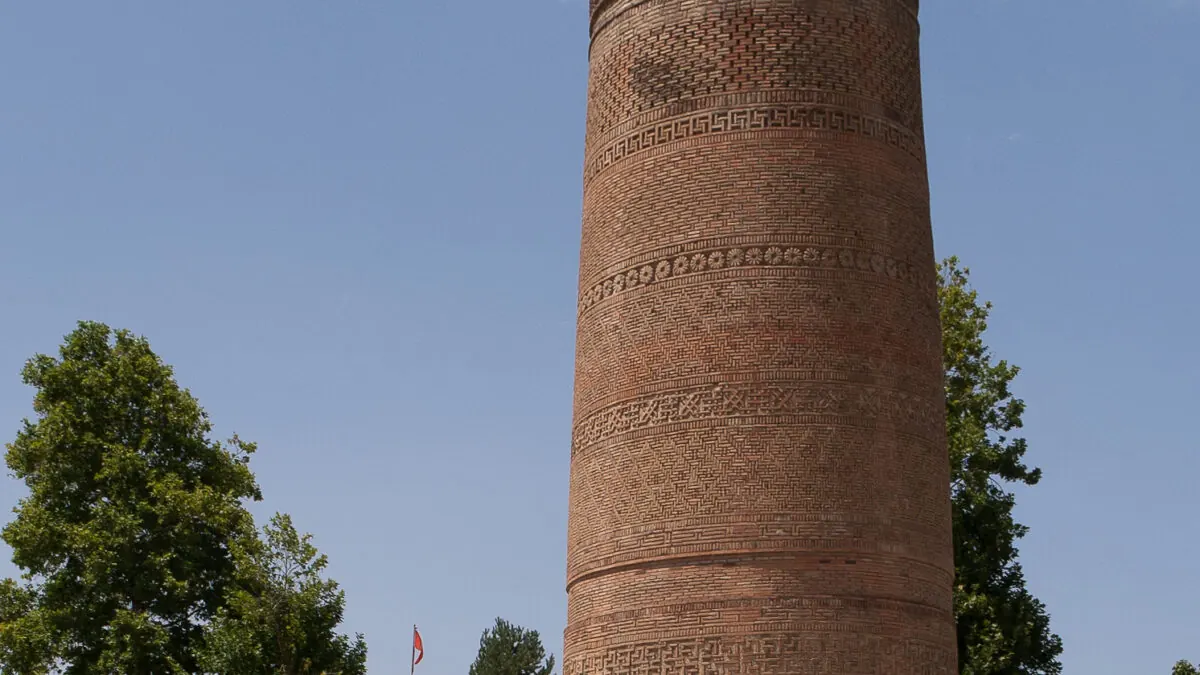
The minaret is the town’s landmark: a tapering brick tower, originally over 40 meters and rebuilt at the top after its upper section fell centuries ago, ringed with bands of patterned brick. In summers when it's open, a tight internal spiral staircase climbs to a small viewing gallery over the river and the town — worth the low ticket if the caretaker is around to unlock it.
Beside it stand the three mausoleums, joined into a single row and built across roughly a century (11th to 12th). Their portals carry the complex’s best carving, deep terracotta friezes framing the doorways, some panels sharp, others softened by weather. The middle tomb is generally held to be the oldest and is linked to the Karakhanid ruling line. You can see the whole site properly in an hour; photographers wanting good light on the west-facing portals should come in the afternoon.
Bazaar and Uzgen Rice
Downhill from the monuments, Uzgen’s bazaar is a genuine Fergana-fringe market, busiest in the morning, thick with produce, spices, and the everyday commerce of an ethnically Uzbek-majority town. It's not a tourist bazaar, which is its charm; go to watch, buy fruit, and eat cheaply.
The town’s edible claim to fame is Uzgen rice (“ozgon kuruch”), a heirloom red-brown rice grown in the surrounding fields and prized across the region for plov. Locals insist it makes the best plov in Kyrgyzstan, and it's sold by the sackful in the bazaar. If you can only eat one thing here, find a chaikhana serving Uzgen-rice plov. For the wider picture of what to order across the south, our Kyrgyz food guide covers plov, laghman, and the Uzbek-influenced southern kitchen in detail.
Getting There From Osh
Uzgen sits about 55 km northeast of Osh, roughly an hour by road on a decent highway. It's the classic half-day trip out of the southern capital, and you do not need to stay overnight.
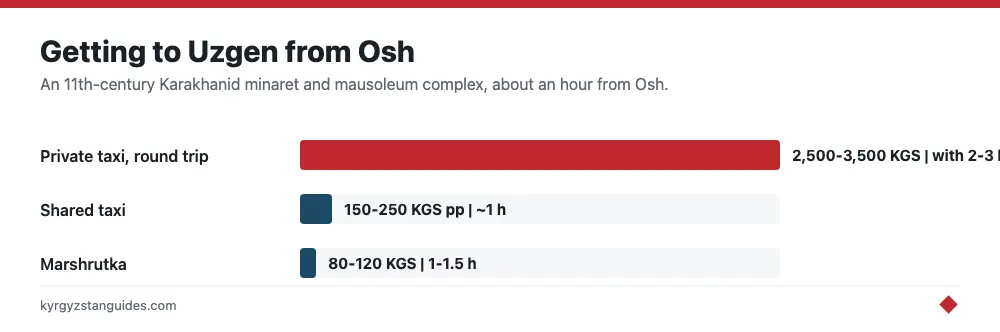
| Option | How | Rough cost / time |
|---|---|---|
| Shared taxi | From Osh’s eastern (Uzgen) stand, leaves when full | 150-250 KGS pp; ~1 h |
| Marshrutka | Regular minibuses from Osh to Uzgen | 80-120 KGS; 1-1.5 h |
| Private taxi round trip | Osh and back with a 2-3 h wait | 2,500-3,500 KGS total |
Shared taxis are the sweet spot — cheap, quick, and frequent. On arrival, a short local taxi hop or a 15-minute walk links the bazaar and the monument complex. For how the shared-taxi and marshrutka system works in practice, see our guide to getting around Kyrgyzstan. Base yourself in Osh, where the accommodation and food actually are; our Osh travel guide covers where to stay and how to fit Uzgen into a southern loop.
Two more places in the south are worth knowing about while you plan that loop. Up the valley from Uzgen there are cold carbonated springs saltier than seawater and a kymyz cure: see Kara-Shoro national park. And Kyzyl-Kiya, the third city of southern Kyrgyzstan, is where the first Soviet in the country was created in March 1917.
If your route runs back through Bishkek, the Soviet years left a stranger legacy there: on Toktogul Street, a 1,500-person bureau built instruments that reached Venus, Mars and Halley’s Comet. See Kyrgyzstan and the Soviet space programme.
The minaret is shorter than you have been told
Nearly every write-up calls this a 44-metre minaret. It is not, and has not been for a very long time. The tower standing in Uzgen today is 27.4 metres. The 44 or 45-metre figure is an estimate of its original height, and the difference between the two numbers is the part an earthquake took off.
There is a second complication. The top you are looking at is not medieval either: a domed lantern with arched windows was built onto the stump in 1923-24, adding roughly five metres. UNESCO's own assessment of the site singles this out as the one intervention that compromised the complex's authenticity, noting the structures are otherwise substantially original "except for bulkhead, built on top of the minaret in 1924". So the silhouette in your photograph is a 1920s idea of what a Karakhanid minaret looked like, sitting on an 11th-century shaft.
Below that, the real thing: a stylobate, an octahedral base, and a conical shaft in figured brickwork, dated by UNESCO to the middle of the 11th century.
What the inscriptions actually say, and the date nobody agrees on
The three mausoleums carry three surviving dated inscriptions: 1152, 1186 and 1187. They name Karakhanid rulers of the Uzgen branch and their military commanders, buried in the northern and southern chambers. That is unusually specific for Central Asian monuments of this period, and it is a large part of why art historians rate the complex so highly.
The middle mausoleum, the earliest of the three, is where the dating breaks down. UNESCO's tentative-list text puts it at the turn of the 11th to 12th centuries. The Kyrgyz heritage portal says early 11th century. A number of specialist sources date it precisely to 1012-13 and attribute it to Nasr ibn Ali, who ruled 996 to 1013. The spread is about a century. Nobody on site will tell you that, so you may as well know it going in.
The decoration is the reason to come. Fired brick with carved architectural terracotta and carved plaster, and inscription bands in three scripts at once: Kufic, Naskh and Thuluth, threaded with vegetal ornament. UNESCO's text calls it an "encyclopedia of ornament" of the Karakhanid epoch, which for a tentative-list document is unusually enthusiastic language.
Excavations in 1988-89 between the minaret and the tombs turned up a monumental fired-brick building, probably the madrasa that Jamal al-Qarshi mentions at the end of the 13th century. Four hundred metres north, a potter's workshop with four rectangular kilns, late 12th century. The complex is administered as part of the Sulaiman-Too museum, and in September 2015 a US Ambassadors Fund for Cultural Preservation grant of $152,910 funded a second phase of conservation work on it.
What makes Uzgen rice different
The town's red rice, devzira, is not just local pride. Uzgen rice is registered as a Kyrgyz appellation of origin through Kyrgyzpatent, the state intellectual property service, which puts it in the same category of protection as a named regional cheese or wine. The registry page itself is currently offline, so treat the registration as documented rather than as something you can go and look up today.
The technical description is precise in a way that helps you spot the real thing: elongated ribbed grains with a red tint, reddish rice flour clinging to them, roughly 2,800 to 3,000 grains per 100 grams, swelling two to two and a half times when cooked. You will see market claims that it swells eightfold. That contradicts the official figure by a wide margin and should make you suspicious of the seller rather than impressed.
Uzgen itself is a town of 61,773 at the 2022 census, which makes the scale of the monument complex relative to its setting part of the point.
Frequently Asked Questions
Is Uzgen worth a trip from Osh?
Yes, if you have any interest in history or architecture. The Karakhanid minaret and mausoleums are among the oldest and best-preserved buildings in the country, and the half-day trip is cheap and easy. If Silk Road monuments leave you cold, it is skippable.
How long do you need in Uzgen?
About two to three hours on the ground covers the monument complex, a wander through the bazaar, and a plov lunch. Combined with the drive, plan on a 4-5 hour round trip from Osh.
Do you need to speak Russian to visit?
It helps for arranging shared taxis and talking to the site caretaker, but it is not essential for a simple day trip. Have your destination written down, carry small cash, and a translation app covers the rest.
How tall is the Uzgen minaret?
27.4 metres today. The 44 or 45-metre figure repeated almost everywhere is an estimate of its original height before an earthquake took the top off. The domed lantern you see on it now was added in 1923-24.
How old are the Uzgen mausoleums?
The three carry dated inscriptions of 1152, 1186 and 1187. The middle and earliest one is disputed: UNESCO says the turn of the 11th to 12th centuries, while specialist sources date it to 1012-13 and attribute it to Nasr ibn Ali.
Is Uzgen a UNESCO World Heritage Site?
No. "Uzgen and Shorobashat sites" has been on Kyrgyzstan's Tentative List since February 2010, with the Uzgen site given as 72.5 hectares. Tentative listing is the formal step before nomination, not inscription.