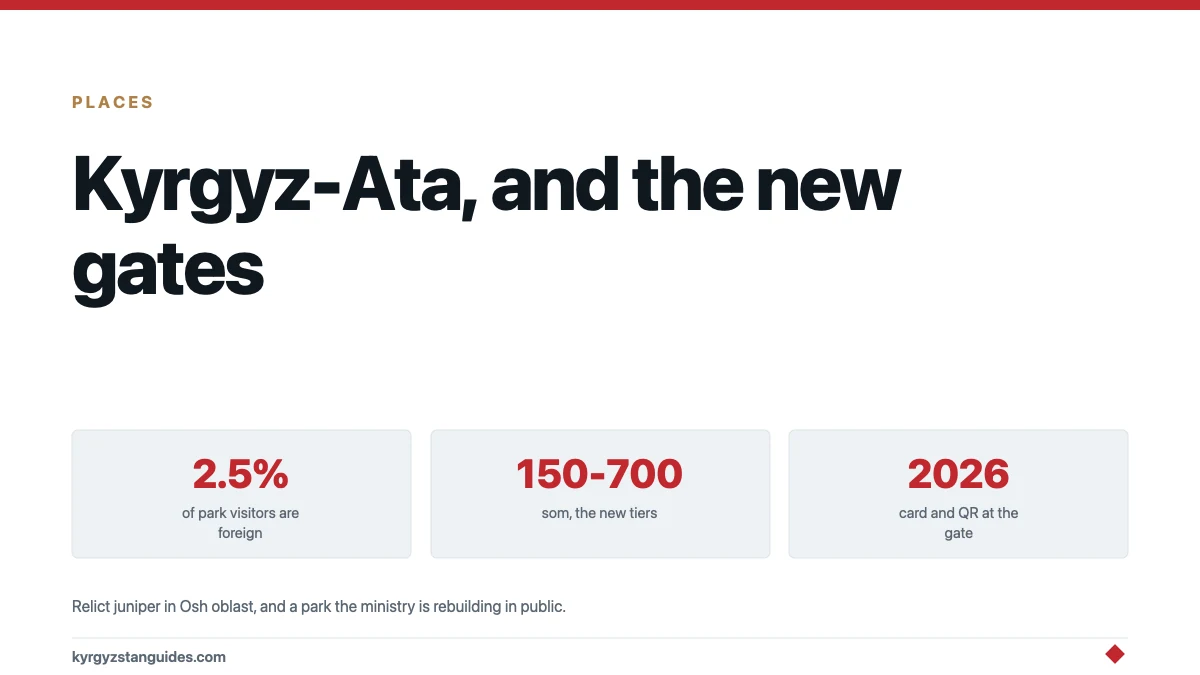
Of the 271,000 people who visited Kyrgyzstan's nature parks in 2025, 6,800 came from outside the CIS. That is 2.5 per cent.
Kyrgyz-Ata is one of the three parks the deputy minister named as most in demand, alongside Sary-Chelek and Besh-Tash. Which means it is genuinely popular — and almost entirely with Kyrgyz families, not with foreigners.
What it is
A national nature park in Kyrgyz law, one of seven the environment ministry names, as distinct from the ten strict reserves that are closed to visitors. Established in 1992, in Nookat district, Osh oblast, on the northern slopes of the Alay range.
Area is given as 11,172 hectares, with a strictly protected core of 1,225 hectares covering the relict juniper stands, and the founding statute dividing the park into three zones: protected core, recreation, and forest management with limited recreation. We could not read the founding decree itself — the government legal database has been refusing access — so treat the hectarage as the best available figure rather than a confirmed one.
Altitude is usually given as 2,000 to 2,400 metres, which appears to describe the forested valley belt rather than the park's full span. The surrounding peaks go higher.
What it protects
Relict juniper forest — archa — is the stated primary object, described officially as of special ecological, aesthetic, geobotanical and faunistic value. Mountain tulips and wild saffron grow in the Kyrgyz-Ata river basin.
Kyrgyzstan's Academy of Sciences has published on the park's juniper-forest biodiversity and on tree-species introduction there, which is more scientific attention than most Kyrgyz parks receive.
For what juniper means in this country, see archa and the juniper forests.
What it costs, and the honest answer about that
There is no published tariff card for Kyrgyz-Ata specifically.
What exists is a national range. In June 2026 the deputy minister of natural resources told a parliamentary committee that park entry is split into three tiers — Kyrgyz residents, CIS citizens, and everyone else — with prices from 150 to 700 som depending on category.
So: 150 som at the floor, 700 at the ceiling, as of mid-2026. A figure of "about 100 som" circulates on travel sites and we could not source it to anything official.
A ministerial order specifically on visitor counting and fee collection in protected areas was signed in February 2026. The reporting on it is paywalled, so we have the headline and not the contents.
The gates are new, and that changes the visit
This is the live story and it is recent.
On 28 July 2026 the ministry announced it had installed automated checkpoints at three protected areas: Kyrgyz-Ata and Besh-Tash national nature parks, and the Padysha-Ata strict reserve. They accept bank card, QR code and e-wallet.
The stated aims are stronger protection, exact recording of vehicles entering and leaving, financial transparency, and reducing the human factor — which is a polite way of saying that cash collected at a barrier by a person did not always reach the ministry.
Construction of modern entrance arches has begun at Kyrgyz-Ata and at Sary-Chelek. In August 2026 reporting added that Kyrgyz-Ata is getting a new entrance group and checkpoint to regulate vehicle entry, and that sewage treatment works are under construction in the park. Drone monitoring of the territory has begun.
Two practical unknowns follow from all this, and we would rather flag them than guess: whether the automated gate charges per person or per vehicle, and whether cash is still accepted. If you are arriving without a card, that is worth establishing in Osh first.
The village inside the park
One thread worth knowing. There is an inhabited village inside the park's boundaries, and the president has instructed that residents be issued land and property documents.
That is the same tension running through Padysha-Ata and Kara-Shoro: protected status drawn around ground people were already living on and using, and a state trying to regularise it decades later.
The south's protected areas, in context
Kyrgyz-Ata is one of a cluster in the south, and they are easy to confuse because three of them are being upgraded at once.
Kyrgyz-Ata — national nature park, Osh oblast, juniper, 1992, automated gate 2026.
Padysha-Ata — a strict reserve, Jalal-Abad oblast, juniper and Semenov's fir, 2003, UNESCO World Heritage, automated gate 2026.
Kara-Shoro — national nature park, Osh oblast, mineral springs and three forest belts, 1996, and not on the ministry's list at all.
Sary-Chelek — biosphere reserve, Jalal-Abad, the famous one, entrance arch under construction.
The pattern across all four is the same: Soviet-era or early-independence designations drawn around forests and water, minimal published information, and a sudden wave of gates, arches, drones and card readers in 2026 as the state tries to capture the revenue and control the access it has never properly had.
If you are travelling the south, treat that as the operating condition. The parks are real and worth visiting; the published detail about them is thinner than anywhere else you are likely to have travelled.
Getting there
About 40 kilometres from Osh, in Nookat district. Drive time is commonly given as an hour and a half to two hours in a private car.
Public transport runs Osh to Nookat past the turnoff at the village of Chapaev. From that turnoff it is roughly 28 kilometres further to the park gate with no scheduled service, so you hitch or hire.
That last 28 kilometres is the whole logistical problem. If you do not have a vehicle, arrange one in Osh rather than assuming you will find something at the junction. See our Osh guide.
What the ministry does and does not publish
Worth setting out, because it explains why this article has the gaps it has.
The environment ministry maintains a page listing the country's protected areas. It is a bare list of names — no areas, no altitudes, no fees, no founding dates, no maps. There are no park factsheets. The register that would carry that detail is a JavaScript application that returns nothing to an ordinary request.
The founding decrees live on the government's legal database, which has been refusing access outright.
So the position is this: a national park system with roughly 23 protected areas, of which 20 sit under the ministry and half are open to visitors, and almost none of the basic reference data about any individual one is published in a form anybody can read. What a traveller gets instead is news coverage of ministerial announcements, which is how the 2026 checkpoint and fee information in this article was assembled.
That is not a complaint about the parks. It is a warning about the numbers. Every hectare figure, altitude band and fee you will read about Kyrgyz protected areas — here or anywhere — is second-hand until the ministry publishes otherwise.
When to go
Late spring through autumn. The tulips and wild saffron are a spring event; the juniper is there year-round; the picnic season runs through summer.
Avoid weekends in high summer if you want the place quiet. This is Osh's day-trip park, and 250,000-odd domestic visitors a year across the system mostly arrive on Saturdays and Sundays with a car boot full of food.
Winter access we could not establish. Given the altitude and the road, assume it is possible and uncomfortable rather than routine.
What to expect
Juniper forest on mountain slopes, a river valley, picnic ground, and Kyrgyz families having a day out. This is a domestic recreation park with real conservation value attached, not a wilderness destination, and the 97.5 per cent domestic visitor share tells you what the atmosphere is.
Go for the juniper, which is genuinely relict and genuinely rare, and for the fact that almost nobody reading this in English will have been.
FAQ
Where is Kyrgyz-Ata National Park?
In Nookat district, Osh oblast, on the northern slopes of the Alay range, about 40 kilometres from Osh. Public transport toward Nookat passes the turnoff at Chapaev village, but the final 28 kilometres to the gate has no scheduled service.
How much does it cost to enter Kyrgyz-Ata?
No park-specific tariff is published. Nationally, park entry runs from 150 to 700 som depending on whether you are a Kyrgyz resident, a CIS citizen or from further afield, as stated by the deputy minister of natural resources in June 2026.
Can I pay by card at Kyrgyz-Ata?
Yes. Automated checkpoints accepting bank card, QR code and e-wallet were installed in July 2026 at Kyrgyz-Ata, Besh-Tash and Padysha-Ata. Whether cash is still accepted, and whether the charge is per person or per vehicle, is not published — check in Osh before setting out.
When was Kyrgyz-Ata National Park created?
In 1992. It is a national nature park under Kyrgyz law, one of seven, as distinct from the country's ten strict reserves which are closed to visitors.
What does Kyrgyz-Ata protect?
Relict juniper forests, the stated primary object of protection, with a strictly protected core of around 1,225 hectares within a park of about 11,172. Mountain tulips and wild saffron also grow in the river basin.
Is Kyrgyz-Ata popular with tourists?
It is one of the three most visited Kyrgyz nature parks, but the visitors are overwhelmingly domestic. Of 271,000 park visitors nationally in 2025, 250,580 were Kyrgyz residents and only 6,800 came from outside the CIS.