Padysha-Ata has been on the UNESCO World Heritage List since 17 July 2016, as one of three Kyrgyz components of the transnational Western Tien-Shan property.
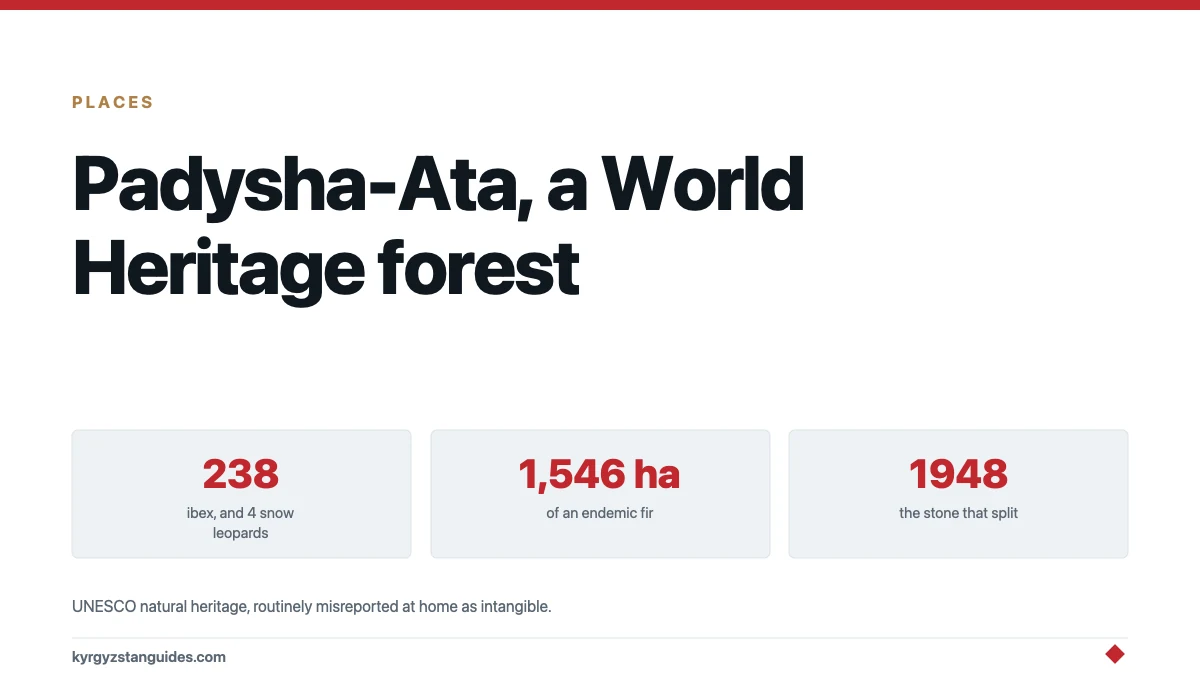
Kyrgyz media regularly report this as an intangible heritage listing. It is not. It is a natural World Heritage inscription, which is a different list and a much rarer thing for a forest in this region to hold.
What it is
Падыша-Ата is a state zapovednik — the strictest protection category in Kyrgyz law, equivalent to IUCN category Ia — established in 2003.
Total area 30,560 hectares, split into a strictly protected core of 15,846 hectares and a buffer zone of 14,714.
It lies in Jalal-Abad oblast, Aksy district, in the Chatkal range of the Western Tien-Shan, in the Padysha-Ata river basin. The district centre is Kerben; the gateway village is Kashka-Suu, and it is 22 kilometres from the district centre up to the mausoleum.
The gorge has no floodplain and no river terraces. The cliffs drop straight into the riverbed, and the Kapchygai canyon sits inside it.
What it protects
The ministry's own wording is that it was created to conserve unique juniper forests.
Kyrgyz sources emphasise a second target that is arguably the more significant one: Semenov's fir, Abies semenovii, a Kyrgyz endemic, which covers 1,546 hectares inside the reserve and is the most widespread tree there. It is on the Red Data Books of the former USSR and of Kyrgyzstan and on the IUCN conifer red list — though the IUCN still treats it taxonomically as a subspecies of Siberian fir, which muddies its formal global status.
You will also see Padysha-Ata described as walnut-fruit forest. It does sit at the western edge of that belt, and the description is not wrong, but the stated statutory purpose is juniper and fir, not walnut. See walnut-fruit forests and archa juniper for the two forest types either side of it.
What lives there
Reserve totals: about 800 plant taxa, 78 shrub species, 31 mammal species and 51 bird species. Red Data Book listed: seven plants, three mammals, four birds.
The headline count, reported in February 2019: 238 Siberian ibex and four snow leopards.
The surrounding Key Biodiversity Area, "Aflatun-Padyshata", covers 60,000 hectares, and its trigger species list is a roll-call of Central Asian endemism: Abies semenovii, several Allium, Androsace aflatunensis, Bunium sary-cheleki, Ferula czatkalensis, Primula eugeniae, and both of the wild apples — Malus niedzwetzkyana, the pink-blossomed Endangered one with only a few hundred wild individuals known in Kyrgyzstan, and Malus sieversii, the wild ancestor of the domestic apple. Conservation funding here specifically targets rare wild apple and pear.
The property it belongs to
Padysha-Ata is not listed by UNESCO on its own. It is one component of Western Tien-Shan, a serial transnational property shared by Kazakhstan, Uzbekistan and Kyrgyzstan.
The whole property covers 528,177.6 hectares with a buffer of 102,915.8, and spans 700 to 4,503 metres across the three countries. Kyrgyzstan contributes three components: Sary-Chelek, Besh-Aral and Padysha-Ata, which is the smallest of the three.
That serial structure is why the listing gets garbled locally. A component of a transnational natural property is a harder thing to explain in a headline than "UNESCO recognised our shrine", which is roughly how it tends to come out.
One honest gap: no source we could reach gives an altitude range for Padysha-Ata itself. The 700-to-4,503-metre figure belongs to the whole three-country property and tells you nothing useful about this particular gorge. We would rather leave that blank than invent a number.
We also could not read the founding decree. The Kyrgyz legal database that holds it refused access on every attempt, so the year 2003 is well corroborated but the decree number is not something we can give you.
Why the fir matters more than it sounds
Semenov's fir is worth a paragraph of its own, because "endemic conifer" undersells it.
Its total range is a handful of small areas in western Kyrgyzstan — one estimate puts it at around a hundred square kilometres in total, across the Chatkal, At-Oinok, Uzun-Akhmat, Talas and Suusamyr ranges and a few gorges. The 1,546 hectares inside this reserve is therefore not a local detail; it is a meaningful fraction of a species.
The threats named for it are logging, forest fires, and a fungal canker disease. Cultivated seedlings at the Bishkek botanical garden have suffered badly from atmospheric and soil drought, which is not encouraging for the wild stands either.
If you want a single reason this reserve exists, that tree is a better answer than the shrine.
The shrine
The mazar of Padysha-Ata sits inside the reserve, and it is why most people come.
It honours Said Kamoluddin Salmani al-Farsi, remembered as a companion who saw the Prophet Muhammad and who held the title padysha, ruler, as an Arab ruler's deputy. Sources place him in the 6th to 7th century or the 8th; he is said to have died of battle wounds.
The object pilgrims come to touch is a stone. In the 1948 earthquake a rock of roughly 1.5 tonnes fell onto the grave and split in two without damaging the tomb. The mausoleum, restored in 1998, now encloses both the grave and the split stone.
Sheep are sacrificed at the site. The approach is a maintained shaded alley. The wider pilgrimage circuit takes in the Shah-Fazil architectural complex and the shrines at Safed-Bulan village nearby.
Visiting a zapovednik
This is the practical tension. A zapovednik legally restricts general entry — and yet the mazar inside it is an active, heavily visited pilgrimage destination with a yurt camp for tourists nearby.
In practice, pilgrimage access to the shrine is the norm and wandering the reserve is not. Go with someone local, stay on the route to the mausoleum, and ask before going further.
Automated checkpoints were reported in place at Padysha-Ata, along with Kyrgyz-Ata and Besh-Tash, at the ministry's half-year board meeting reported in July 2026. We could not obtain a fee figure; the reporting is behind a paywall.
Route: Jalal-Abad to Kerben, then Kashka-Suu, then 22 kilometres up. No border permit is required — Aksy is not in the restricted frontier zone, though the Uzbek border lies to the south-west.
The land case
In 1997 a businessman leased over four hectares inside the Padysha-Ata area for 99 years; the contract was renewed in 2002 for 45 years, and a recreation centre was built.
In 2010 a Kashka-Suu village assembly resolved that the village should reclaim about two hectares, its chairman arguing that "3,000 young people are waiting for land allocations." Litigation ran from 2010 and the courts sided with the leaseholder, holding that the land is state property under the reserve rather than municipal.
On 12 August 2016, at a courthouse in Jalal-Abad, village officials were hospitalised with concussion. The leaseholder described it as a minor scuffle started by the chairman.
We have found no reporting on the outcome after 2016. We include it because it is the honest shape of protected-area politics here: a strictly protected reserve, a 99-year lease predating it, a village with no land, and a court that can only rule on who the state is.
Poaching is the other live concern — the minister toured Jalal-Abad protected areas including this one in May 2026 to discuss anti-poaching and digital monitoring. Regionally the documented pressures on this forest belt are illegal logging, over-collection of forest products, and overgrazing suppressing regeneration.
FAQ
Is Padysha-Ata a UNESCO site?
Yes, but not the kind usually reported. It was inscribed on the World Heritage List on 17 July 2016 as one of three Kyrgyz components of the transnational Western Tien-Shan natural property, alongside Sary-Chelek and Besh-Aral. Kyrgyz media frequently and wrongly describe it as an intangible heritage listing.
What does Padysha-Ata reserve protect?
Officially, unique juniper forests. In practice the standout is Semenov's fir, a Kyrgyz endemic covering 1,546 hectares inside the reserve and listed on the national Red Data Book. The reserve also holds about 800 plant taxa, 31 mammal species and 51 bird species.
Are there snow leopards in Padysha-Ata?
Yes. A count reported in February 2019 gave 238 Siberian ibex and four snow leopards in the reserve. Ibex are the snow leopard's main prey, so the two figures belong together.
Can tourists visit Padysha-Ata?
It is a zapovednik, the strictest category, so general access is legally restricted — but the mazar inside it is an active pilgrimage site visited heavily, with a yurt camp nearby. Go with a local guide, keep to the route to the mausoleum, and ask before going further. Automated checkpoints were reported installed in 2026.
What is the Padysha-Ata mazar?
A shrine honouring Said Kamoluddin Salmani al-Farsi, held to have been a companion who saw the Prophet Muhammad. Its focus is a rock of around 1.5 tonnes that fell onto the grave in the 1948 earthquake and split in two without damaging the tomb. The mausoleum was restored in 1998 and encloses both.
How do I get to Padysha-Ata?
From Jalal-Abad to Kerben, the Aksy district centre, then to Kashka-Suu village, then 22 kilometres up into the mountains to the mausoleum. No border permit is needed, though the Uzbek frontier lies to the south-west.
South of Osh, Kyrgyz-Ata national park protects relict juniper and installed card-payment gates in 2026.