Every apple you have eaten descends from wild trees that still grow, untended, on the slopes of the Tien Shan. The walnut-fruit forests of southern Kyrgyzstan are the largest surviving remnant of that ancestral woodland.
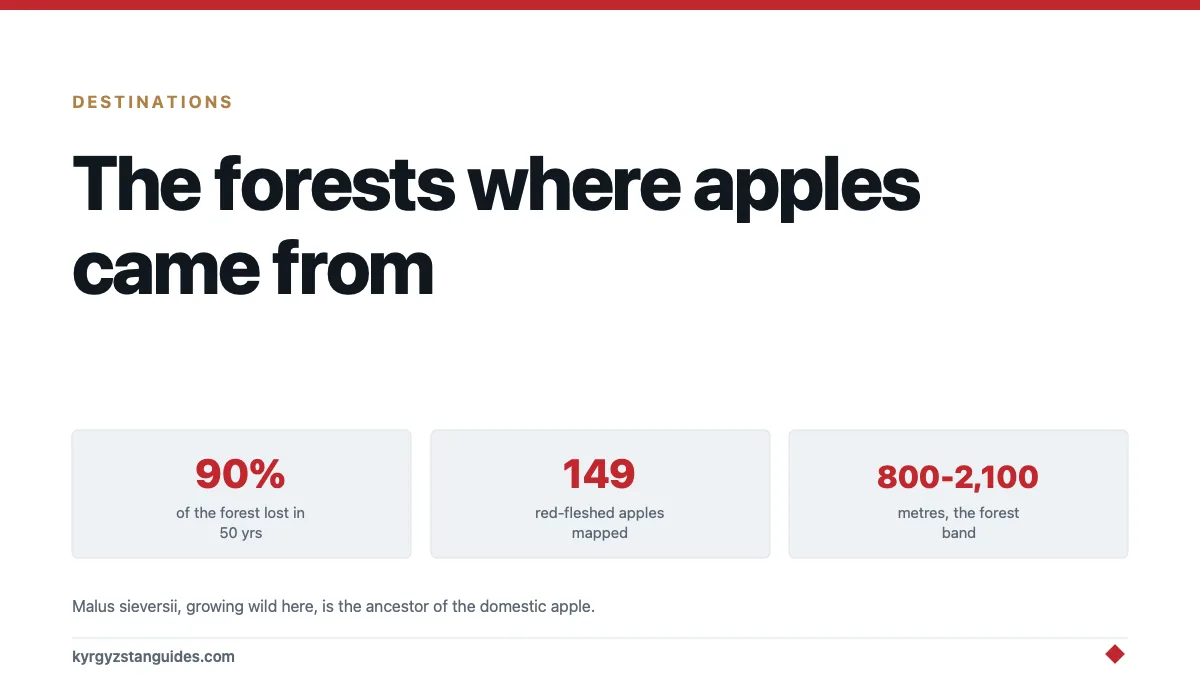
They have lost roughly 90% of their area in the past fifty years.
Most travellers encounter these forests as scenery. The green slopes above Arslanbob, a nice walk, a place where walnuts come from. What they're is something rarer: a living genetic library for a large part of the world's orchard fruit, and one that's being grazed and cut away faster than most people realise.
What grows there
The term "walnut-fruit forest" is doing real work. These aren't walnut plantations. They are mixed wild woodlands in which walnut grows alongside wild apples, pears, plums, cherries, almonds and hawthorn, at altitudes between 800 and 2,100 metres.
Around 88 plant species have been recorded in them. The fruit and nut trees include:
| Species | What it is |
|---|---|
| Juglans regia | The common walnut, wild here, cultivated everywhere else |
| Malus sieversii | The principal wild ancestor of the domestic apple |
| Malus niedzwetzkyana | A rare red-fleshed relative, Endangered |
| Prunus sogdiana | Wild plum |
| Prunus divaricata | Cherry plum |
| Pyrus korshinskyi | Wild pear, also threatened |
| Crataegus spp. | Hawthorns |
A survey of threatened tree species in these forests catalogued how many of them carry conservation status. Across Kyrgyzstan and its neighbours, more than 300 wild fruit and nut tree species have been documented. Including something like eight to ten cherry species, up to ten almond species, and four wild apples.
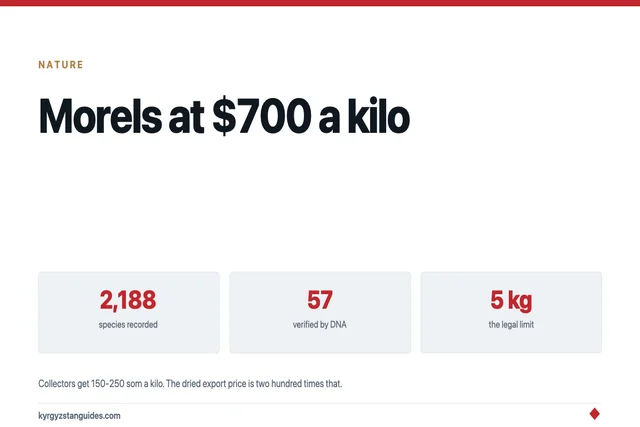
The same forests are said to produce the country's morels, though that link is less well documented than the walnuts. Compare that to a supermarket, which sells perhaps six apple varieties, all of them from a genetic base narrow enough to worry plant breeders.
Why the wild apples matter
Malus sieversii is the tree that became the apple.
Domestic apples (Malus domestica) carry its genes. The varieties grown commercially worldwide are selections and crosses descending from stock that originated in these mountains, carried west along trade routes over millennia. The Kyrgyz variant, Malus sieversii var. kirgizorum, is native specifically to these walnut-fruit forests.
The practical consequence is this: when a commercial apple crop meets a new disease or a changed climate, the resistance traits that might save it are most likely to be found in the wild population. A narrow cultivated gene pool has nowhere to go. A wild one does.
Which makes the state of the wild population a global problem that happens to be located in Jalal-Abad region.
How bad the decline is
The numbers come from research published in Oryx, the Cambridge conservation journal, on the future of Kyrgyzstan's walnut-fruit forests.
Only 5–10% of the original forest area remains. A 90% loss over fifty years.
For Malus niedzwetzkyana specifically, the red-fleshed apple, the one that looks like something invented for a fairy tale, the study mapped 149 individuals across four surveyed forest areas, and called that the largest known dataset for the species. The conclusion was that the known population is not sustainable without intervention.
One hundred and forty-nine trees is not a population. It's a remnant.
What's actually causing it
Two pressures, and the ranking is not what most people assume.
Livestock grazing is the bigger threat. Not because a goat does more damage than an axe, but because grazing is extensive, continuous and largely uncontrolled, while cutting is localised. Grazing animals eat seedlings. A forest that can't regenerate is a forest with a fixed end date, even if every mature tree is left standing.
Firewood collection is second. Kyrgyz households collect somewhere between 4 and 43 cubic metres of firewood per year — a range that tells you how differently rural and less rural households live. In villages without gas, wood is heat, and there is no realistic ask to make of a family in that position.
That is the honest shape of the problem. The damage is not being done by villains. It is being done by people keeping livestock and staying warm, which is what people in these valleys have always done, at a population density the forest was never grazed at before.
The Vavilov connection
There is a reason botanists knew about these forests long before conservationists worried about them.
Nikolai Vavilov, the Soviet botanist who built the theory of centres of origin for cultivated plants, identified Central Asia as one of the world's primary centres of crop domestication. His argument was that the place with the greatest wild diversity of a crop's relatives is the place the crop came from — and for apples, pears, plums and walnuts, that pointed here.
Vavilov assembled what was then the largest seed bank on earth on this logic. He died in a Soviet prison in 1943, convicted on charges arising from his opposition to Lysenko's genetics. The collections survived; so did the framework. Every modern effort to conserve wild crop relatives runs on the idea he formalised, and the Global Crop Diversity Trust exists to do at scale what he started.
That is the strange status of an ordinary-looking hillside above Arslanbob. It's both a village's firewood supply and a documented centre of origin for a substantial share of the world's temperate fruit.
Seeing them properly
If you go, go with the context.
Arslanbob is the main gateway, and the walnut harvest in autumn is the season most people aim for. Families hold traditional harvesting rights on specific plots, and the whole village moves into the forest for several weeks.
Sary-Chelek is the biosphere reserve, and is where protection is most real. The lake gets the photographs; the forest around it's the actual point.
Kara-Alma and Kyzyl-Unkur, north-east of Jalal-Abad, are quieter walnut forest areas that see a fraction of Arslanbob's visitors.
Two things worth doing while you're there:
Ask what's growing. Guides in these villages often know the wild fruit species by local name and where individual old trees are. It's a much better walk when you know you're looking at a wild plum rather than a tree.
Buy walnuts from the harvest. It's the economic argument for the forest standing. A forest that pays is a forest that survives, and the walnut trade is the strongest thing that argument has.
FAQ
Where did apples originally come from?
The wild apple Malus sieversii, native to the mountain forests of Central Asia including southern Kyrgyzstan and southeastern Kazakhstan, is the principal ancestor of the domesticated apple.
What are walnut-fruit forests?
Mixed wild woodlands in the Tien Shan where walnut grows together with wild apple, pear, plum, cherry, almond and hawthorn, at altitudes of roughly 800–2,100 m. Kyrgyzstan holds the largest remaining expanse.
How much of Kyrgyzstan's walnut forest is left?
Research in Oryx estimates only 5–10% of the original area remains, a decline of about 90% over the past fifty years.
What is Malus niedzwetzkyana?
A rare red-fleshed wild apple native to these forests, classified as Endangered. One study mapped just 149 individuals across four surveyed areas and concluded the population is not viable without intervention.
What threatens the walnut-fruit forests?
Livestock grazing above all, because it prevents regeneration by destroying seedlings, followed by firewood collection, pests, disease and climate change.
Where can I visit the walnut forests?
Arslanbob is the main base, especially during the autumn harvest. Sary-Chelek biosphere reserve and the Kara-Alma and Kyzyl-Unkur areas near Jalal-Abad are quieter alternatives.
Tulips are the famous ones, but they are a small part of it: see Kyrgyz wildflowers beyond the tulips for the foxtail lilies, the endemic irises and what the Red Book actually protects.
The third Kyrgyz component of the same UNESCO property, with a pilgrimage shrine inside it, is Padysha-Ata.
Out of harvest season the village is at its emptiest: see Arslanbob in winter, where the skiing is done on horseback and there is no ski base at all.