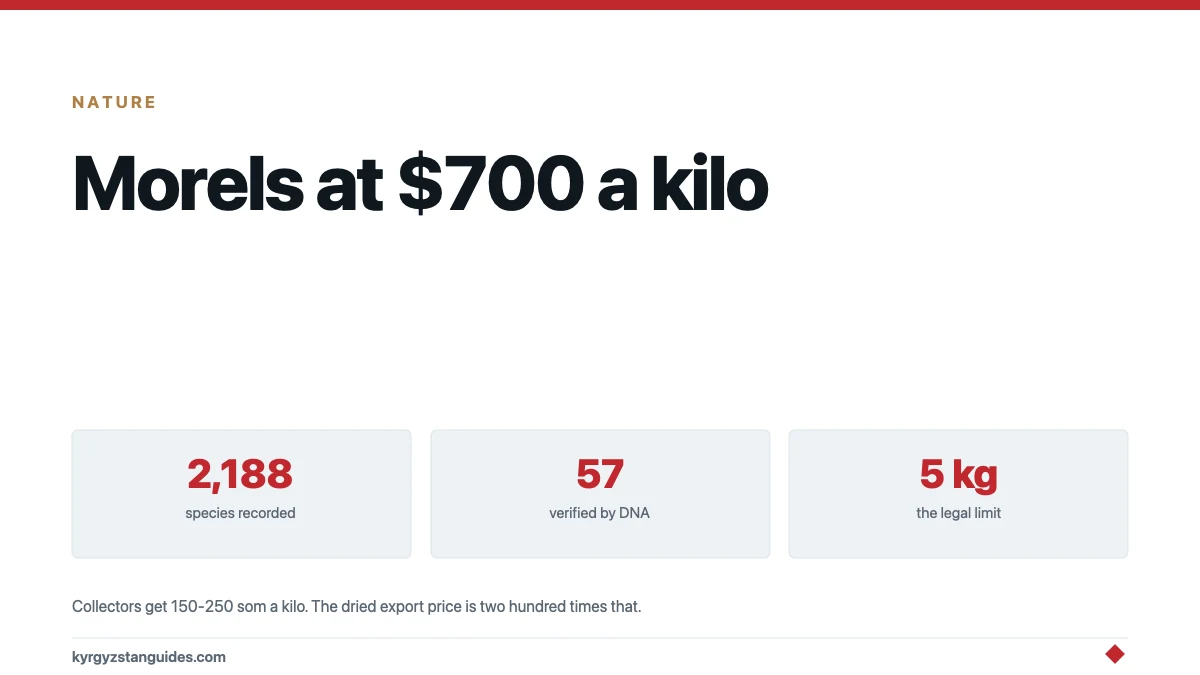
Dried morels from Kyrgyzstan sell for up to $700 a kilogram on export. Fresh wild mushrooms sell at Kyrgyz markets for 150 to 250 som a kilo — under $3. That gap, roughly two hundred to one, is the entire economics of wild mushrooms in this country, and it is why the people who pick them and the people who profit from them are not the same people.
Morels are the reason. They are the one Kyrgyz fungus with a serious international market, mostly in China and Europe, and they grow wild here in spring while the collectors picking them earn market rates rather than export rates.
This is what is actually known about mushrooms in Kyrgyzstan — which is less than you would hope, and I will be specific about where the gaps are.
How many species
Kyrgyzstan's official biodiversity inventory records 2,188 fungal species across 8 classes and 105 families, citing the Inventory of Genetic Fund of Kyrgyzstan compiled by the Biology and Soil Institute of the National Academy of Sciences. That figure appears in the country's national report to the Convention on Biological Diversity. A rounder "about 2,100 species" also circulates and traces back to the same inventory.
Now the caveat that matters. A field survey of the Tian Shan conducted in 2016–2018, with specimens deposited at the Korea National Arboretum and identified by ITS sequencing, formally documented only 57 macrofungal species across 47 genera — and described itself as the first well-documented checklist and phylogenetic analysis of macrofungi for that area.
Fifty-seven modern, molecularly-verified species against an inventory figure of 2,188. Both numbers are real; they are counting very different things. Most of what is "recorded" here has not been revisited with modern taxonomy. Notably, that survey turned up no morel specimens at all.
What people actually pick
A Kyrgyz feature interviewing foragers in Chui oblast puts it at roughly a hundred edible species present, about ten commonly collected. The named ones are oyster mushrooms, champignons (Agaricus), "blue-footed" varieties, white mushrooms — boletes, the belyi grib — and morels.
On species names, one correction to a claim I expected to include: I could not find Kyrgyzstan-specific confirmation for Pleurotus eryngii, the steppe mushroom, which is often assumed to be here. Pleurotus ostreatus, the ordinary oyster mushroom growing on walnut and other deciduous trees, is consistently referenced and is safe to state.
Collecting concentrates in the northern spruce forests of Chui oblast — Tien Shan spruce, Picea schrenkiana — described as especially productive in the second half of summer and autumn, and in the Suusamyr valley, where the white mushrooms are timed to cherry ripening.
Morels are repeatedly said to grow "in the southern regions", which would put them in walnut forest country around Jalal-Abad. But I could not find a source explicitly documenting morel collection inside the Arslanbob walnut forest itself — the Arslanbob material is all about the walnut harvest. The geography makes it plausible. The documentation is not there, so I am flagging it rather than asserting it.
The morel trade
| Price point | Figure |
|---|---|
| Kyrgyz dried morels, export | up to $700/kg |
| Dried morels, China market | $72–127/kg (June 2026); ~$113/kg (March 2026) |
| Dried morels, European wholesale | €35/kg France (April 2025); €22/kg Italy (May 2023) |
| Fresh wild mushrooms, Kyrgyz markets | 150–250 som/kg |
| Oyster mushrooms, Chui region | 180–300 som/kg |
| Cultivated mushrooms, Kyrgyz markets | 300–450 som/kg |
The $700 figure comes from a Kyrgyz mushroom-industry expert interviewed by Sputnik Kyrgyzstan, who also confirmed China as an active buyer of Kyrgyz wild mushrooms. It sits well above the benchmark prices in the table below it, which is worth noting — a top-grade price rather than an average one.
For global context: China holds about 49 per cent of world morel export share, Pakistan 18 per cent and Canada 13 per cent. Kyrgyzstan and Central Asia are not broken out separately in that data, which tells you something about the scale.
A figure I am not going to use: "€1.7 million in annual mushroom exports" circulates, attributed to the same interview, but I could not confirm it against the raw article text and it may be a summarisation artefact.
The rules
There is a 5 kg per person limit on collection, with fines and confiscation at checkpoints for exceeding it, and the standard instruction to cut rather than pull so the mycelium survives.
Beyond that the framework is general. The national CBD report lists mushrooms among biodiversity components threatened by ecosystem degradation and excessive collection, and treats mushroom and berry gathering as a recognised indirect use of protected ecosystems under natural resources management. I found no evidence of a licensing or permit system specifically for commercial morel export, which in a trade with a $700 ceiling is itself notable. I could not find park-specific foraging bylaws either — no Ala-Archa rule, for instance, distinct from the national picture.
Kyrgyzstan's Red Book, second edition 2007, includes 6 species of fungi among protected taxa, alongside 53 birds, 26 mammals and 89 higher plants. The count is sourced. The six names are not — I could not retrieve the fungal list itself.
Poisoning: nothing documented
I searched specifically for mushroom poisoning incidents in Kyrgyzstan and found none. Every mass poisoning I located in recent Kyrgyz reporting was bacterial or food-borne and explicitly not fungal — the Bishkek madrasa case in June 2026 with 58 affected and 23 hospitalised, and an Uzgen wedding with 49 people, were both salad-related.
That is an absence of found reports, not proof that none occur.
One genuine safety point does come out of the domestic reporting, and it applies to the country's most valuable mushroom: fresh morels are toxic raw. The toxic properties are destroyed by boiling and drying. This is standard and well-established for Morchella generally. If you are offered morels anywhere, they should be cooked, and this is not a cultural preference but a chemical requirement.
Growing them
Oyster mushroom cultivation is a real cottage industry. One grower interviewed reported roughly 60 kg a day from 100 square metres of growing space, with startup costs around $1,500 for that area. Button mushrooms sold in Kyrgyzstan are mostly imported, from Poland, Kazakhstan and China.
No named large commercial farm and no national production tonnage turned up in any search. The picture is many small growers, not an industry.
The question I could not answer
Here is the thing I most wanted to establish and could not: whether mushrooms feature in traditional Kyrgyz pastoral cuisine at all.
My working assumption going in was that they largely do not — that a nomadic herding culture built on meat, dough and dairy would not have developed a foraging tradition, and that mushroom collecting here is more associated with Russian settler, Dungan and Uzbek populations. The evidence is suggestive: general Kyrgyz-cuisine sources describe the national food as a blend of Kyrgyz, Uzbek, Uyghur and Dungan elements and do not mention mushrooms as an ingredient at all.
But absence from a list is not a statement of exclusion, and the one claim I found attributing foraging to Russian communities came from an AI-generated search summary rather than a document I could read. So: plausible, consistent with everything, undocumented. If you eat mushrooms in Kyrgyzstan you are most likely eating them in a Russian or Dungan context, and I cannot prove that sentence.
FAQ
Are there mushrooms in Kyrgyzstan?
Yes. The national biodiversity inventory records 2,188 fungal species, though a 2016–2018 molecular survey of the Tian Shan formally documented only 57 macrofungal species, which shows how little of the inventory has been checked with modern taxonomy. Foragers report about a hundred edible species present with roughly ten commonly collected.
What are Kyrgyz morels worth?
Dried morels from Kyrgyzstan are reported selling for up to $700 a kilogram on export, against 150–250 som a kilogram for fresh wild mushrooms at domestic markets. China is an active buyer. Benchmark dried-morel prices elsewhere run $72–127/kg in China and €22–35/kg wholesale in Europe.
Can I forage for mushrooms in Kyrgyzstan?
Within limits. There is a 5 kg per person collection cap, with fines and confiscation at checkpoints for exceeding it, and collectors are told to cut rather than pull mushrooms to preserve the mycelium. No park-specific foraging bylaws turned up, only the national framework.
Are Kyrgyz mushrooms dangerous?
I found no documented mushroom poisoning incident in Kyrgyzstan, though that is absence of found reports rather than proof. One concrete safety point does apply: fresh morels are toxic raw, and the toxicity is destroyed by boiling and drying. Morels must be cooked.
Are mushrooms part of traditional Kyrgyz food?
Probably not, but I could not confirm it. Sources describing Kyrgyz national cuisine do not mention mushrooms as an ingredient at all, which is suggestive, and foraging appears more associated with Russian, Dungan and Uzbek communities. No source states this positively, so treat it as a likely pattern rather than an established fact.
Does Kyrgyzstan farm mushrooms?
On a small scale. Oyster mushroom growing is a cottage industry, with one grower reporting about 60 kg a day from 100 square metres at a startup cost near $1,500. Button mushrooms sold domestically are mostly imported from Poland, Kazakhstan and China, and no large commercial farm or national production figure could be found.
Are any fungi protected in Kyrgyzstan?
Yes, six species of fungi appear in the second edition of the Kyrgyz Red Book from 2007, alongside 53 bird, 26 mammal and 89 higher plant species. The count is documented but the list of which six fungi they are could not be retrieved.