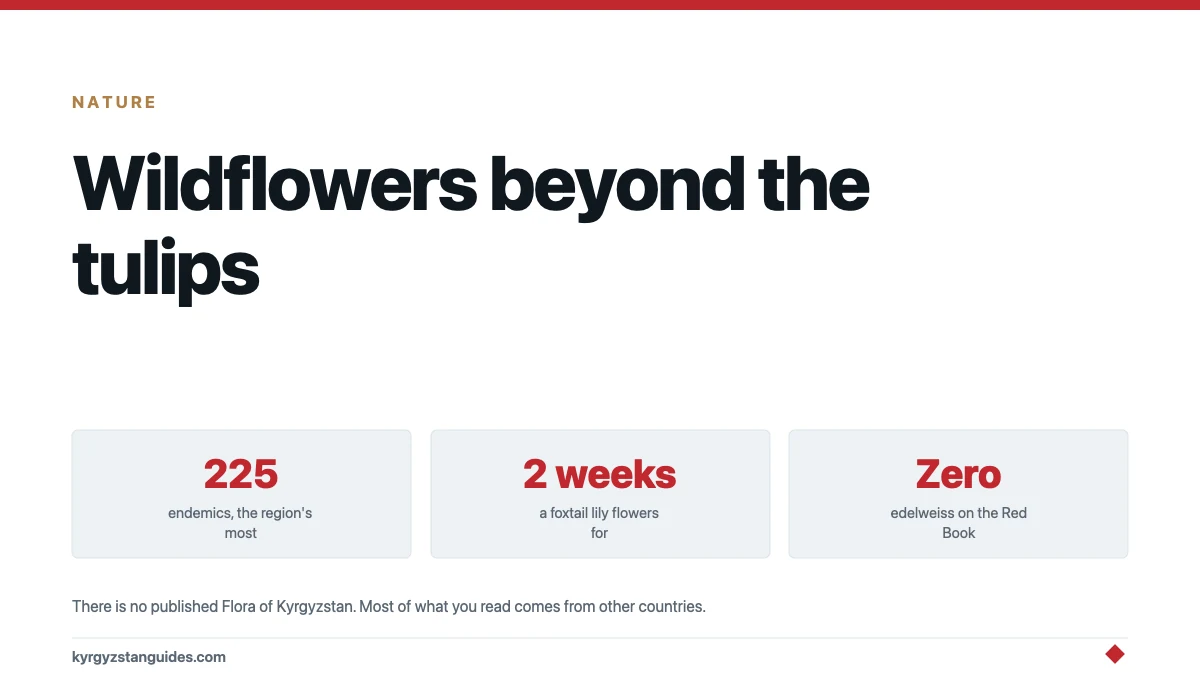
Start with the thing that will save you from repeating a common error. There is no edelweiss on Kyrgyzstan's Red Book. No gentian either, no columbine, no peony, no wild rhubarb. The list of protected plants is public, it runs to 89 higher plants under a 2005 government decree, and those genera are not on it.
Plenty of pages call Kyrgyz edelweiss a protected species. We read the decree. It isn't.
The scale of the flora
Kyrgyzstan's native flora is assessed at close to 3,800 vascular plant species, and it is described by the specialists themselves as still seriously underexplored.
The Tien Shan as a whole holds 871 endemic species and subspecies, and Kyrgyzstan holds the largest share of them by a clear margin:
| Country | National endemics | Total endemic taxa present |
|---|---|---|
| Kyrgyzstan | 225 | 507 |
| Kazakhstan | 205 | 485 |
| Uzbekistan | 69 | 320 |
| Tajikistan | 16 | 82 |
The wider Mountains of Central Asia biodiversity hotspot carries 5,000 to 6,000 vascular plant species, of which roughly a quarter are endemic — a mix of Siberian, Mediterranean, Indo-Himalayan and Iranian elements meeting in one range system.
The families that dominate that endemism are Asteraceae, Fabaceae, Apiaceae, Lamiaceae and Amaryllidaceae. The genera are Astragalus, Allium, Cousinia, Oxytropis and Gagea — which is to say milkvetches, onions and thistles, not the showy things.
Foxtail lilies are the signature plant
If one flower should replace the tulip in your mental image of Kyrgyzstan, it is Eremurus, the foxtail lily: a dense vertical spike, sometimes chest-high, rising out of a dry slope.
Eremurus zoae is endemic to Kyrgyzstan, found on the Kyrgyz Range, 25 to 40 centimetres tall with yellow flowers on a short conical spike. It is nationally assessed as Vulnerable. It flowers in April and May and — this is the detail that matters if you are planning around it — flowering lasts about two weeks. Grazing, root-digging and flower-picking are the named threats.
The rest of the genus staggers itself across the season and the altitude bands:
| Species | Flowering | Altitude |
|---|---|---|
| E. alberti | April | foothills, loess and gypsum |
| E. lactiflorus | April–May | 1,100–1,200 m |
| E. regelii | April–June | 1,000–3,000 m |
| E. soogdianus | May–June | 950–2,600 m |
| E. robustus | May–June | mountain meadows |
| E. aitchisonii | May–June | 1,600–3,000 m |
| E. fuscus | June–July | 2,000–3,000 m |
| E. kaufmannii | June–July | 1,600–2,800 m |
| E. stenophyllus | June–July | 1,600–2,500 m |
Those months and altitudes come from an Uzbek synopsis of the genus, which is the nearest thing available. More on that limitation below.
Worth knowing: of the entire genus, only four species have ever had a global IUCN assessment, and one of them, E. chloranthus, is listed as Extinct.
Wild onions, which are more interesting than they sound
Allium in Kyrgyzstan went from 67 recorded species in 1951 to 85 in 2011 — a quarter more in sixty years, which tells you how much is still being described. They span 600 to 4,200 metres, with most between 800 and 2,500.
Several are single-valley endemics. Allium formosum, described in 2013, is known from one locality in the Babash-Ata Range east of the Fergana Valley, at about 1,650 metres, flowering in July. The describing authors counted roughly ten clusters of flowering plants and recommended it be classed as Endangered on the criterion of fewer than 250 mature individuals. Its nearest relative, A. spathulatum, is a narrow endemic of the Chatkal Range near Arkyt village in Sary-Chelek — about 60 kilometres away.
Allium pskemense, the Pskem onion of the Chatkal Range, is on the Red Book as Endangered nationally and Data Deficient globally. It flowers in May and June. The threat is straightforward: people dig the bulbs to eat.
Irises, and one that is Kyrgyzstan's alone
***Iris graeberiana* is endemic to Kyrgyzstan and is on the Red Book under its older name. Tall, robust, large blue flowers, flowering in April** in the middle mountain zone. It was long thought restricted to the Fergana Range; work published in 2014 showed it spread through the Kyrgyz Western Tien Shan — the Talas Range, Sary-Chelek, the At-Oinok and Babash-Ata mountains, and the mountains along the Naryn.
Iris rodionenkoi, described in 2014, is also a Kyrgyz endemic, from the Babash-Ata mountains along the Naryn, flowering March to April.
Iris kolpakowskiana is the other Red Book iris, flowering March to May on grassy and stony slopes up to 3,000 metres. In the Bishkek botanical garden it blooms in mid-March.
Iris narbutii is genuinely rare here — as of 2014 there were two confirmed Kyrgyz localities, one in the Turkestan Range and one on the Alai.
Not one of Kyrgyzstan's irises has a global IUCN assessment. That absence is real rather than an artefact: the Red List does hold 78 Iris assessments, just none from here.
The tulip picture changed in 2022
Since our wild tulips guide was written, the conservation picture has been formally established for the first time. In December 2022, 53 Central Asian tulip species were assessed — the first assessment of the region's tulips ever, covering 84 per cent of its species. About half came out as threatened, with six Critically Endangered.
Two Kyrgyz species came out Endangered: Tulipa toktogulica and Tulipa talassica.
T. toktogulica was only described in 2022. It is endemic to Kyrgyzstan, known from four populations in three locations northeast of the Toktogul Reservoir, between roughly 1,080 and 1,670 metres. It flowers in early to mid-April; lower populations are already dispersing seed while higher ones are still in bloom. Fewer than a thousand individuals are known, in no protected area. Unusually for a tulip, it is scented.
One conflict worth flagging: Tulipa ferganica is globally Least Concern but is treated as threatened in Kyrgyzstan's own Red Book. Global and national assessments answer different questions.
The odd ones
Crocus. Kyrgyzstan has only two crocus species in its natural flora. Crocus alatavicus is the one you will meet — fragrant, white with a yellow centre, grey or blue striping on the outside, flowering February to April in the foothills. Sources disagree sharply on its season: a Chinese flora gives May to June for the Xinjiang range edge, while field records from Kazakhstan and Kyrgyzstan cluster in February to April.
Colchicum luteum is yellow, not the usual autumn mauve, and flowers February to May "soon after the snow melts", fairly common between 1,500 and 3,000 metres. Its seeds and corm contain colchicine, so it is not something to handle casually.
Colchicum talassicum is brand new: a Kyrgyz endemic described in the Kew Bulletin, restricted to the Talas Ala-Too and the Talas valley. A spring-flowering ephemeroid. Its conservation assessment is behind a paywall and we could not read it.
Corydalis gortschakovii breaks the pattern of its genus by flowering in high summer, July to September, in yellow to orange, at 2,100 to 3,800 metres in spruce forest margins and shaded moist scree. Kyrgyzstan holds the largest national record set for it anywhere. Most other Corydalis here are March-to-May plants of the foothills.
Corydalis sochivkoi is endemic to Kyrgyzstan, known from conglomerate cliff walls above the Kindyk River in Batken region at 2,600 metres. Nobody has recorded its flowering months.
The walnut-fruit forest understorey
The broadleaved fruit-and-nut forests sit between roughly 800 and 2,000 metres, and only 5 to 10 per cent of their original area remains — the largest surviving block being in Kyrgyzstan. Our walnut-fruit forests and Arslanbob harvest guides cover them.
The trees themselves carry the serious threat categories. Pyrus korshinskyi is Critically Endangered. Malus niedzwetzkyana, the pink-blossomed apple, is Endangered; a 2019 study mapped 149 individuals across four southern Kyrgyz sites and found Sary-Chelek had the largest pristine expanse and the most stable population, with limited regeneration overall. Malus sieversii, one of the main ancestors of the domestic apple, is Vulnerable and turned up at every surveyed site. Crataegus knorringiana is Critically Endangered and known from a single ravine in the Alai.
A regional assessment of 96 Central Asian tree taxa found 44 of them threatened with extinction.
One honest note on the walnut itself: palaeontological evidence from the Fergana Valley suggests walnut may be anthropogenic in origin here rather than native — introduced, in other words. The assessors took a precautionary approach anyway.
The limitation you should know about
This is the part most flower articles about Kyrgyzstan do not tell you.
There is no Flora of Kyrgyzstan available online. With the exception of about a dozen species whose phenology the national botanical garden publishes from its own cultivated collection in Bishkek, every flowering month and altitude band above comes from a Flora of China, a Flora of Pakistan, or an Uzbek or Kazakh regional revision. Those are neighbouring countries with different altitudes and climates.
Kyrgyz flowering will generally run later at altitude than a Chinese lowland figure suggests, but that is an inference and we are labelling it as one. For about twenty of the species checked, no published flowering months exist in any source at all.
The same goes for conservation status. The two editions of the Red Data Book of the Kyrgyz Republic are cited variously as 2006 and 2007, with 83 or 89 plant species depending on which government source you read, and no third edition could be found.
Practical planning
If you are coming for flowers rather than for mountains, the shape of the season is:
Late February to April, foothills. Crocus, yellow colchicum, the early irises, and the first tulips at low elevation.
April to May, low and middle slopes. The bulk of it: tulips, Iris graeberiana, the early foxtail lilies, Eremurus zoae for its fortnight.
June to July, middle and upper slopes. The tall foxtail lilies, columbines, the meadow flora.
July to September, high. Summer-flowering Corydalis, high-altitude composites, and the alpine cushion plants.
Flowering runs later the higher you go, and a late snow year shifts everything by weeks. If a specific species is the point of the trip, build in slack.
And do not dig anything up. The threats named in the assessments for the rarest plants here are grazing, root-digging and flower-picking, in that order.
FAQ
Is edelweiss protected in Kyrgyzstan?
No. Kyrgyzstan's Red Book list of protected plants, established by a government decree of 28 April 2005, contains no Leontopodium at all. It also contains no gentian, columbine, peony or wild rhubarb. Many pages state otherwise; the decree is public and does not support it.
When is the best time to see wildflowers in Kyrgyzstan?
April and May in the foothills and middle slopes for the bulk of the bulb flora, June and July higher up for foxtail lilies and meadow flowers, and July to September in the alpine zone. The season runs later the higher you go, and a late snow year shifts it by weeks.
What is the flower on the tall spikes in Kyrgyzstan?
Almost certainly a foxtail lily, Eremurus. Several species occur, flowering from April at low altitude through to July higher up. One, Eremurus zoae, is endemic to Kyrgyzstan and flowers for only about two weeks in April and May.
How many endemic plants does Kyrgyzstan have?
The Tien Shan holds 871 endemic species and subspecies, of which Kyrgyzstan has 225 found nowhere else and 507 in total — more than Kazakhstan, Uzbekistan or Tajikistan. The country's whole native flora is assessed at close to 3,800 vascular plant species and is described by specialists as still underexplored.
Are Kyrgyz tulips endangered?
Some are. A 2022 assessment covered 53 Central Asian tulip species, the first ever done, and found about half threatened, with six Critically Endangered. Two Kyrgyz species are Endangered: Tulipa toktogulica, described only in 2022 and known from fewer than a thousand individuals in no protected area, and Tulipa talassica.
Can I trust flowering dates for Kyrgyz plants online?
Treat them with care. There is no Flora of Kyrgyzstan published online, so almost every flowering month in circulation is taken from a Chinese, Pakistani, Uzbek or Kazakh source for a neighbouring country. For roughly twenty species checked here, no published flowering months exist anywhere.