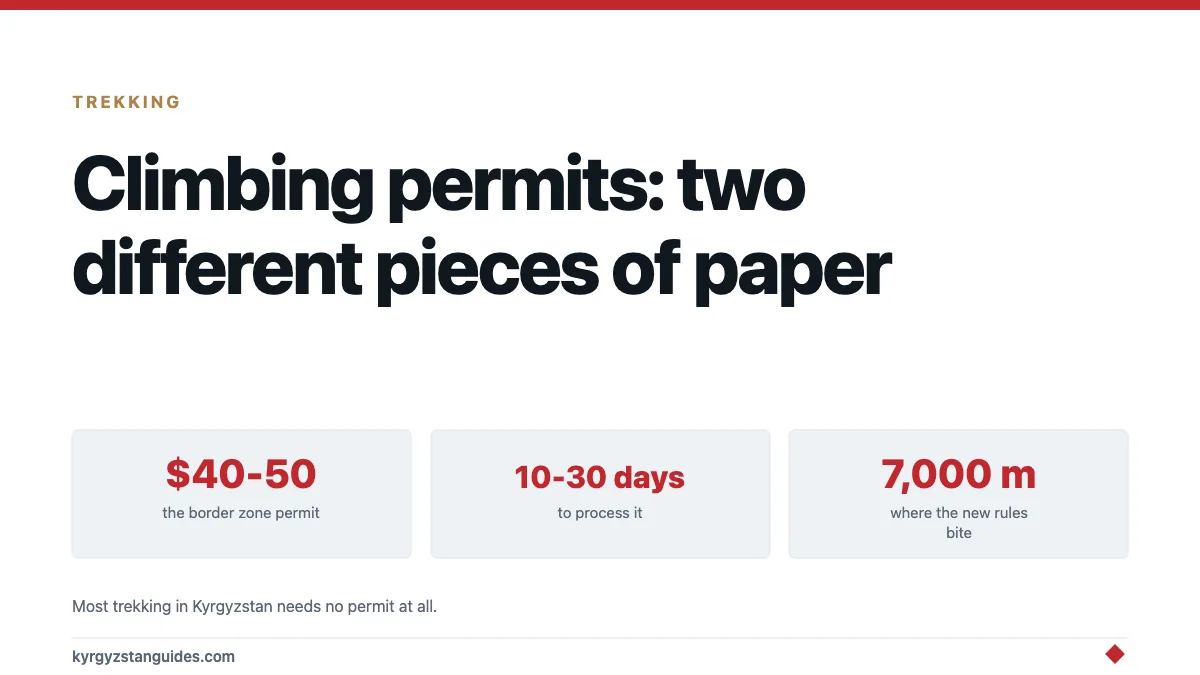
Anyone heading for the Central Tien Shan (Khan Tengri, Pobeda, the Inylchek glacier) needs a border zone permit, arranged in advance. Operators quote roughly $40–50 and ten to thirty days; the underlying state duty is 250 som on a statutory four working days, so most of that price and delay is the operator's process rather than the state's.
What is newer is a second requirement. Kyrgyzstan has been introducing a permit system for the seven-thousand-metre peaks themselves, assessed on a climber's qualifications rather than on geography, with the explicit aim of keeping under-prepared people off mountains that kill them.
Two different documents, two different reasons, and it's worth being clear about which one applies to you.
The border zone permit
The old requirement, and the one that catches out trekkers as much as climbers.
Large parts of eastern and southern Kyrgyzstan sit inside controlled zones along the Chinese and Tajik frontiers. Access needs a propusk — a border zone permit tied to your passport, arranged before you travel rather than on arrival.
Where it applies to climbers and high trekkers: the Central Tien Shan including the Inylchek glacier, Khan Tengri and Pobeda; the Alay valley approach to Lenin Peak; and the Kel-Suu and Chatyr-Kul country in the east. Our entry fees and permits guide covers the non-climbing side of the same rules.
What it costs and takes: operators quote around $40–50, with ten to thirty days of processing. That lead time is the thing to plan around. Deciding on a Khan Tengri trip three weeks out is cutting it fine.
How to get it: through a licensed operator. This is not a form you fill in yourself at a counter.
Carry it. Physically, with your passport, and expect to show both. Checkpoints exist and they check.
The new peak permit
This is the change, and it is aimed at a specific problem.
Kyrgyzstan has been introducing permits for climbers attempting its seven-thousanders — Pobeda, Khan Tengri and Lenin Peak. The stated purpose is safety: restricting the highest and most technical mountains to people with demonstrable experience, training and equipment.
For Pobeda in particular, applicants are expected to hold at least a second-level sports qualification, preferably first level, plus prior experience on difficult peaks such as Khan Tengri. Those are Soviet-legacy climbing grades, still used across the former USSR, and they are not something a Western climber will automatically hold.
The reasoning is not hard to follow. Pobeda at 7,439 metres is widely regarded as the most dangerous of the seven-thousanders in the former Soviet Union, cold, remote, high, and with a long committing summit ridge. Lenin Peak has the opposite problem: a reputation for being the easiest of them, which draws people whose experience doesn't match what the mountain can do.
Rules in this area are changing. Confirm the current position with a licensed Kyrgyz operator before you plan anything around it, and treat any page on the internet, this one included, as a starting point rather than an authority.
Which mountain wants what
A rough map, and every line in it needs confirming for the current season.
| Objective | Border permit | Peak permit / qualification |
|---|---|---|
| Lenin Peak (7,134 m) | Yes, Alay border zone | Increasingly, yes |
| Khan Tengri (7,010 m) | Yes, Central Tien Shan | Increasingly, yes |
| Pobeda (7,439 m) | Yes — Central Tien Shan | Yes, with experience requirements |
| Inylchek glacier trek | Yes | No |
| Tulpar-Kul, Traveller's Pass | No | No |
| Ala-Kul, Ala-Archa, most trekking | No | No |
That last row matters. The overwhelming majority of walking in Kyrgyzstan needs no permit at all, and our trekking guide covers where you can simply go.
Why the rules tightened
Because the accident record justified it.
These are serious mountains with a history of fatal seasons, and the accessibility that makes Lenin Peak attractive. A valley approach, a base camp you can drive near, no technical climbing on the normal route — also makes it easy to underestimate. Our Pik Lenin guide and the Tulpar-Kul piece both describe base camp in season, where the range of experience on display is wide.
A qualification-based permit is a blunt instrument. It is also the instrument available to a state that would rather not run another rescue at 6,000 metres.
What this means for ordinary trekkers
Very little, and that's worth saying because permit talk makes people anxious.
If you're walking Ala-Kul, Ala-Archa, Jyrgalan, Song-Kul, the Alay valley floor or almost anything else in this country, none of the above applies. No permit, no qualification, no paperwork — as our entry fees guide sets out, the great majority of Kyrgyz mountain country is simply open.
The permits exist for two narrow categories: ground near a sensitive international frontier, and mountains above seven thousand metres. Everything else is between you and the weather.
The Soviet grading system, briefly
Worth understanding if you're going to be assessed against it, because it does not map onto anything most Western climbers hold.
The former Soviet system grades climbers, not just routes. A climber works through sporting ranks by completing a specified number of ascents at specified difficulties, logged and certified — a progression rather than a qualification you sit an exam for. Routes carry their own grades, from 1B up through 6B, and the ranks are earned by accumulating ascents across those grades.
Which means "second-level sports qualification" is a statement about a documented climbing history, not about a certificate. A climber from outside that system may have equivalent or greater experience and no paperwork that says so.
In practice this is handled through operators, who assemble a climbing CV and make the case. If you're planning something at this level, the conversation to have early is with a licensed Kyrgyz operator about what evidence they will need from you, not with a website.
Practical sequence
If you're going for a big peak:
Six months out: pick the objective, choose a licensed operator, and ask them directly what the current requirements are.
Two to three months out — start the border permit. Ten to thirty days of processing is the quoted range; leave far more.
Assemble your documentation — climbing CV, any qualifications, prior summits. Under the new system this matters.
Insurance. With high-altitude cover and helicopter evacuation, explicitly stated. Our travel insurance guide covers the general gaps, and standard policies don't go anywhere near 7,000 metres.
Carry everything physically. Passport, permit, insurance documents.
FAQ
Do I need a permit to climb in Kyrgyzstan?
For the Central Tien Shan, Khan Tengri, Pobeda, the Inylchek glacier, and for the Lenin Peak approach, yes: a border zone permit, arranged in advance through an operator. Most ordinary trekking elsewhere in the country needs nothing.
How much does a Kyrgyzstan border permit cost?
Operators typically quote around $40–50, with processing taking ten to thirty days. It has to be arranged before you travel, not on arrival, and it's tied to your passport.
What is the new peak permit system?
Kyrgyzstan has been introducing permits for its seven-thousanders, Pobeda, Khan Tengri and Lenin Peak, assessed on a climber's qualifications and experience rather than geography, with the aim of keeping under-prepared climbers off them.
What qualifications do I need for Pobeda?
Applicants are expected to hold at least a second-level sports qualification, preferably first, along with experience on difficult peaks such as Khan Tengri. These are Soviet-legacy grades still used across the region.
Do I need a permit for Ala-Kul or Ala-Archa?
No. Neither needs a permit of any kind. Ala-Archa charges a park entry fee at the gate, and Ala-Kul is simply open. The permit requirements apply to border zones and the very high peaks.
How far in advance should I arrange permits?
Start months rather than weeks ahead. The quoted ten to thirty days for a border permit is the processing time alone, and documentation for a peak permit takes longer to assemble. Confirm current rules with a licensed operator.