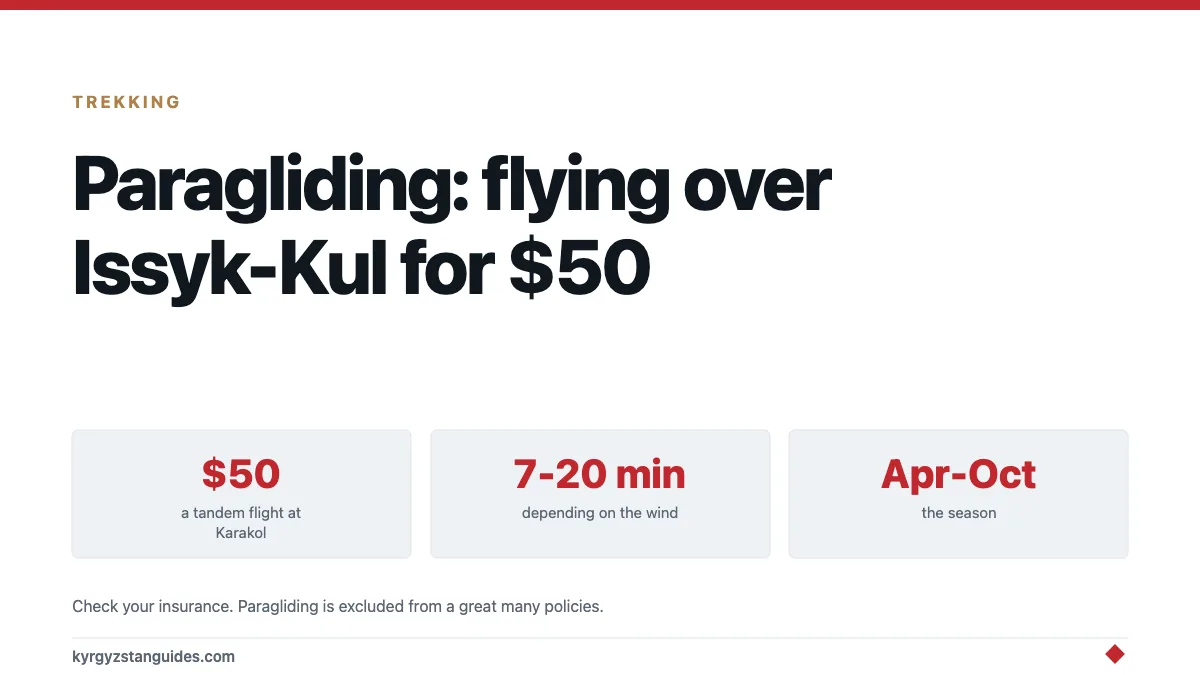
A tandem paraglide above Karakol costs around $50 and lasts somewhere between seven and twenty minutes depending on what the wind is doing, with Issyk-Kul filling the horizon below you. Around Bishkek the same thing runs $100–150 including transfers. Neither figure is what a comparable flight costs in the Alps, and that price gap is most of the reason to do it here.
Season runs roughly April to October, and the flying window on any given day is the middle of it — broadly 11am to 5pm, when the thermals are working.
The two places that matter
Karakol. Bald Mountain, about 15km from town, is the site everyone means. You launch with Issyk-Kul spread out to the west and the Terskey Ala-Too behind you, which is as good a combination of lake and mountain as paragliding offers anywhere. This is also the cheapest flying in the country, and our Karakol guide covers the town it runs from.
Bishkek. Sites in the foothills of the Kyrgyz Ala-Too, half an hour to an hour from the city. Convenient if you're only in the capital, and the flying is good, but you're looking at the Chuy valley rather than at a lake. Costs more because the packages usually bundle transfers from the city.
Destination Karakol's activities listing is the useful starting point for the eastern end, since it's run by the local tourism association rather than by a single operator.
What a tandem flight is actually like
Short, and that surprises people who've paid for it.
Seven to twenty minutes is the honest range. A long flight means the pilot found lift and stayed up; a short one means still air and a straight glide down. You aren't in control of which you get, and no operator can promise you the long version.
The launch is the part people worry about and it's the least alarming: you run a few steps downhill with the pilot behind you, the wing lifts, and your feet stop touching ground without any particular moment of drama. Landing is a similar few steps in reverse.
Bring a jacket. It's colder up there than on the hill, especially over the lake, and people routinely launch in a t-shirt and regret it within ninety seconds.
Timing it properly
Season: April to October. Outside that the sites are snowed in and the conditions are wrong.
Time of day: late morning to late afternoon. Thermal activity builds through the morning and drops off in the evening, so 11am–5pm is the working window. Early-morning air is usually too still to fly.
Weather is the real variable. Paragliding is weather-dependent in a way that trekking isn't: a day that looks fine from the ground can be unflyable because the wind is coming from the wrong direction or gusting. Operators cancel, and they should.
Which means: don't plan this for your last day. Give it two or three possible days in your itinerary and treat a flight as a bonus rather than a fixture. People who build a trip around one weather-dependent activity on a fixed date are usually disappointed.
Our guide to autumn in Kyrgyzstan covers the end of the season, which is often the most stable flying of the year.
Why the flying is good here, technically
Worth a short explanation, because it isn't only about the view.
Thermals need heat and relief — ground that warms unevenly, and mountains for the rising air to work against. Kyrgyzstan has an unusual amount of both: dry sunny slopes, very large vertical relief, and the dark rock and bare ground that heat fastest.
Issyk-Kul adds a second mechanism. A large body of water next to warm land generates its own circulation, which is why the Karakol side of the lake is reliable in a way that a site in the middle of a flat basin isn't.
The catch is the same terrain seen from the other side. Big relief produces strong conditions as readily as pleasant ones, valley winds funnel, and an afternoon that has been benign for three hours can turn. That's a consideration for pilots rather than for tandem passengers, whose operator makes the call for them — the site listings for Kyrgyzstan give a sense of how thinly documented most of the country still is.
The safety conversation
Worth having plainly, because the price makes people suspicious and the industry here is small.
Tandem paragliding is a regulated activity in most countries with licensed pilots and certified equipment. Kyrgyzstan's oversight is lighter than western Europe's, and the practical consequence is that the operator you choose matters more than it would elsewhere.
Reasonable things to ask: how long the pilot has been flying tandem, how old the wing is, whether they carry a reserve parachute, and whether they have insurance. A good operator answers all four without becoming defensive.
Check your own travel insurance too. Paragliding is on the excluded list of a great many standard policies, and the ones that cover it usually require you to have declared it. Our travel insurance guide covers what policies need to include for Kyrgyzstan generally, and adventure activities are the usual gap.
This is general information, not a safety assessment of any particular operator.
If you already fly
Kyrgyzstan is more interesting for experienced pilots than the tandem market suggests, and correspondingly less organised.
There is no dense network of established sites with published rules, no club infrastructure comparable to Europe's, and limited rescue provision if something goes wrong in a remote valley. What there's: enormous terrain, reliable summer thermals, very little air traffic, and almost nobody else in the sky.
Bringing your own wing is normal enough. Flying unsupported in the mountains here is a serious undertaking, and the border zones in the east and south add a legal dimension: our permits guide explains where those restrictions apply.
What else is on the adventure list
Paragliding sits alongside a short list of things Kyrgyzstan does well and cheaply.
Rafting on the Kokomeren and Chuy in late summer — see our rafting guide.
Skiing and heliskiing in winter, with the resorts near Karakol and Bishkek and heli operations in the Tien Shan. Our ski season guide covers it.
Horse trekking, which is the one thing here that is genuinely world-class rather than merely good value — our horse trekking guide explains why.
For most visitors a tandem flight is a half-day add-on rather than a reason to come. At $50 above Issyk-Kul, it doesn't need to be more than that.
FAQ
How much does paragliding cost in Kyrgyzstan?
Around $50 per flight in the Karakol area, and $100–150 near Bishkek where packages usually include transfers. Both are well below comparable prices in western Europe.
Where can you paraglide in Kyrgyzstan?
Bald Mountain near Karakol, about 15km from town, with views over Issyk-Kul, and sites in the Kyrgyz Ala-Too foothills near Bishkek. Karakol is the more scenic and the cheaper of the two.
What is the paragliding season in Kyrgyzstan?
April to October, with the best conditions in summer. The daily flying window is roughly 11am to 5pm, when thermals are working. Early mornings are usually too still.
How long does a tandem paragliding flight last?
Between seven and twenty minutes, depending on conditions. If the pilot finds lift you stay up longer; in still air it's a straight glide down. No operator can guarantee the longer flight.
Is paragliding in Kyrgyzstan safe?
Oversight is lighter than in western Europe, so the operator matters. Ask about the pilot's tandem experience, the age of the wing, whether they carry a reserve, and whether they're insured. Check your own policy too — paragliding is excluded from many.
Do I need to book paragliding in advance?
Not usually, but build flexibility into your dates. Flights are weather-dependent and get cancelled, so allow two or three possible days rather than scheduling it for your last afternoon.