Around $40 buys you a half-day of genuine whitewater within an hour of Bishkek. That single fact surprises most travelers, who associate Kyrgyzstan with horses and yurts rather than paddles — yet the country drains some of the highest mountains in Central Asia, and the rivers that come off them are the real thing.
The quick picture: day trips run on the Chuy River near Bishkek from roughly May through September, costing about $30-60 per person depending on group size and season. The difficulty swings with the snowmelt — gentle class II in early May, punchy class III-IV in June and July when the melt peaks, then easing again toward autumn. Beyond the day trips, Kyrgyzstan offers serious multi-day expeditions on the Chatkal and Naryn rivers for experienced paddlers. Here is what to expect from each, and the honest state of safety standards.
The Chuy River: Bishkek’s Backyard Run
The Chuy is where nearly every commercial rafting trip in Kyrgyzstan happens. The standard put-in is in the Boom Gorge, the canyon the Bishkek-Issyk-Kul highway threads through, about 90 minutes to two hours from the capital. Trips typically cover 12-20 kilometers over one to two hours on the water, with the whole outing taking half a day door to door. Several Bishkek operators bundle it with transport, wetsuits, and a picnic, which makes it an easy add-on to a city stay — it pairs well with a day or two of Bishkek sightseeing before you head for the mountains.
What you get depends heavily on when you go:
- May: moderate water, class II-III. Cold — the river is snowmelt, and a proper wetsuit is non-negotiable, not a comfort item.
- June-July: peak melt. The same rapids push into class III-IV, waves get big, and swims are consequential. This is the most exciting window and the one where operator quality matters most.
- August-September: levels drop, difficulty settles back toward class II-III, water and air are warmer. The best window for first-timers and families with teenagers.
The timing logic mirrors the country’s broader seasons — our best time to visit Kyrgyzstan guide covers the fuller picture — but the key point is that “the Chuy” is not one experience. Ask the operator what the river is running at, not just whether trips are available.
The Big Rivers: Chatkal and Naryn
The Chatkal, in Kyrgyzstan’s remote far west, is the country’s expedition classic: multi-day self-supported descents through a committing gorge, sustained class III-IV, normally run in August-September when levels are manageable. Trips run 5-8 days with riverside camping, cost several hundred to over a thousand dollars depending on the operator and group, and need to be booked months ahead. This is genuine wilderness — helicopter-evacuation-only territory — and belongs strictly to fit paddlers with prior multi-day river experience.
The Naryn, Kyrgyzstan’s longest river, offers big-volume rafting through central Kyrgyzstan’s canyons. Sections range from friendly floats to heavy class IV, and a handful of operators run trips of one to several days out of Naryn town or as part of longer tours. Dams and ongoing hydropower construction have altered some stretches, so itineraries shift year to year — another reason to book through an operator who actually runs the river annually rather than one reselling a program.
What a Day Trip Actually Costs
| Trip | Typical price | Season | Difficulty |
|---|---|---|---|
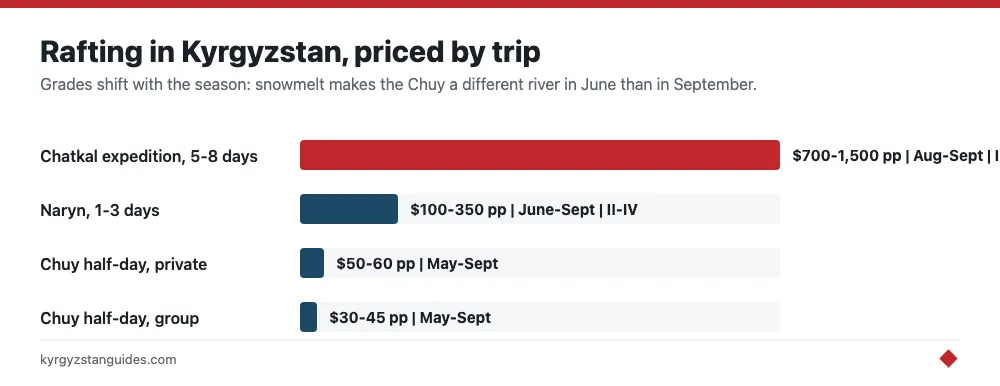
| Chuy half-day (group) | $30-45 pp | May-Sept | II-IV by month |
| Chuy half-day (private/small group) | $50-60 pp | May-Sept | II-IV by month |
| Naryn 1-3 days | $100-350 pp | June-Sept | II-IV |
| Chatkal expedition 5-8 days | $700-1,500 pp | Aug-Sept | III-IV, remote |
Prices in som work out similar (1 USD is around 87-89 KGS), and paying cash is standard. By regional standards this is cheap — comparable trips in Nepal or Turkey often cost more — and it fits comfortably inside a typical Kyrgyzstan travel budget even for backpackers.
Safety: The Honest Part
Kyrgyzstan has no national rafting regulator, no mandatory guide certification, and no equivalent of the licensing regimes you may know from New Zealand or the US. Standards therefore vary from genuinely professional — ex-competition kayakers running well-maintained gear — to informal outfits with aging rafts and one guide for too many boats. The good operators are easy to spot if you ask the right questions before paying — local outdoor communities such as the Trekking Union of Kyrgyzstan can also point you toward reputable outfits:
- Is there a safety kayaker or a second raft on class III+ water?
- What is the guide-to-guest ratio, and do guides have swiftwater rescue training?
- Are helmets and properly fitted PFDs (not car-ferry life vests) provided for everyone?
- How old are the rafts and wetsuits? Ask to see photos if booking remotely.
- What happens if the river is too high on your date — refund, reschedule, or run it anyway? “We always run” is the wrong answer in June.
None of this should scare you off — thousands of people raft the Chuy every summer without incident, and the country’s overall risk picture is calmer than its reputation suggests, as we argue in our Kyrgyzstan safety guide. But the difference between a great day and a bad one here is the operator, and the price difference between the best and the worst is often less than $15. Pay it.
What to Expect on the Day
A typical Chuy trip: morning pickup in Bishkek, gear-up at the riverside (wetsuit, splash jacket, helmet, PFD), a safety briefing that may be in Russian with translated summaries — ask for the full version in English if you need it — then one to two hours on the water with a mix of rapids and calm stretches, photos from the bank, and a picnic or café stop before the drive back. Bring swimwear to wear under the wetsuit, secure sandals or old sneakers, sunscreen, and a change of clothes. Leave phones in the van unless you have a leashed waterproof case; the Chuy keeps a steady collection of them on its riverbed.
Rafting in Kyrgyzstan FAQ
Do I need experience to raft the Chuy River?
No experience is needed for Chuy day trips in May or August-September, when the water runs class II-III. For the June-July peak melt, you should be a confident swimmer and comfortable with the idea of an accidental swim in fast, cold water. First-timers are better off waiting for late summer.
How much does rafting in Kyrgyzstan cost?
Chuy River half-day trips from Bishkek typically cost $30-60 per person including transport and gear. Multi-day Naryn trips run roughly $100-350, and full Chatkal expeditions cost $700-1,500 depending on length and operator.
When is the rafting season in Kyrgyzstan?
The commercial season runs from around May to late September. June and July bring the biggest, coldest water from snowmelt; August and September offer warmer, friendlier conditions. Chatkal expeditions run almost exclusively in August and September.
For where all this water actually goes — and why not one Kyrgyz river reaches an ocean — see Kyrgyzstan’s rivers.
Where can you go rafting near Bishkek?
The Chuy River, within an hour of the city. Day trips run from roughly May through September and cost about $30 to $60 per person depending on group size and season.
How difficult is the rafting in Kyrgyzstan?
It moves with the snowmelt. Gentle class II in early May, punchy class III to IV in June and July when the melt peaks, then easing again toward autumn. The same stretch of river is a different trip in May and in July.
Is there multi-day rafting in Kyrgyzstan?
Yes, on the Chatkal and Naryn rivers, but those are serious expeditions for experienced paddlers rather than extensions of the Chuy day trip. The country drains some of the highest mountains in Central Asia and the rivers reflect it.