There is no via ferrata in Kyrgyzstan. I went looking in English and Russian, checked the obvious candidate locations including Ala-Archa, and found nothing — no cable route, no operator selling one, no mention in Russian-language climbing media, which covers via ferrata installations in Crimea and the Caucasus perfectly well.
I am starting there because the question gets asked and the internet is bad at answering "no". If you want fixed-cable climbing with a harness and no technical skill, Kyrgyzstan is not the destination. There is a cable car going in at Ala-Archa, which is a gondola for sightseeing and skiing, not the same thing at all.
What Kyrgyzstan does have is serious alpinism with a deep Soviet lineage, a handful of developing sport crags, and a mountain rescue situation you need to understand before you tie in.
Ala-Archa is alpine, not sport
The gorge is 40 km and about half an hour from Bishkek, and it carries more than 150 to 160 established routes on rock, ice and mixed ground. The Kyrgyz Alpine Club puts it at more than 160 routes climbed from the Ak-Sai glacier area specifically.
But read the composition, because this trips people up: those are overwhelmingly alpine, trad and ice routes. Reviewers note only one or two bolted sport routes in the whole park. If you arrive with a rack of quickdraws and a sport-climbing plan, Ala-Archa is not what you were imagining.
What it is, is one of the former Soviet Union's great mountaineering arenas. The Soviet-era camp "Ala-Too" operated here through the 1970s and 80s. The stone Ratsek hut in the Ak-Sai gorge — named for Vladimir Ratsek, a Soviet Master of Sport whose first ascents included work on 7,439 m Peak Pobeda — originates in 1930s military mountaineering training he organised, and it is still the standard high camp. Modern Ak-Sai facilities run to three huts sleeping up to 40.
The classic peaks above it:
| Peak | Height | Note |
|---|---|---|
| Korona | ~4,860 m | The multi-towered classic |
| Free Korea (Svobodnaya Koreya) | 4,740 m | North face of 900–1,100 m depending on source; first climbed on that face from 1974; one of the celebrated big walls of the USSR |
| Uchitel ("Teacher") | ~4,540 m | The standard beginner peak, first ascended 1938 by a group under V. Ozerovsky via the West Ridge, grade 1B |
The Free Korea wall height genuinely disagrees between sources — 900 m in one account, 1,100 m in the Kyrgyz Alpine Club's guidebook — so take the range rather than either number.
The sport crags, such as they are
Chon-Kurchak (Chunkurchak) gorge, about 45 minutes from Bishkek, is described as the country's most accessible crag: slopey granite with more than 45 routes. Its topo on theCrag is explicitly "still under construction", which is the honest state of documentation here.
Sokuluk canyon, on the northern slopes of the Kyrgyz range, is reached via Sokuluk village, then 18 km of road, then a six to eight hour hike to the upper gorge. It appears in mountain literature; I found no bolted-route count for it.
Two places often listed as climbing areas that I could not substantiate: Kok-Moinok in the Boom gorge appears in travel content as canyon scenery with no route or grade data, and Barskoon turned up in no climbing source at all — it is a waterfall and valley destination, and our Barskoon post treats it that way for good reason.
Across every Kyrgyz crag I searched, I could not find named route developers, published grade ranges, or a printed guidebook. If you are planning a sport-climbing trip, that absence is the planning problem.
Gyms, clubs and the federation
The governing body is the Mountaineering and Sport Climbing Federation of the Kyrgyz Republic, a non-commercial public association whose stated aims include building climbing walls at universities in Bishkek, Osh, Karakol and elsewhere; its office is at Business Centre "Aurora", Igemberdieva 1a, Bishkek. A climbing wall for the national team was reported planned for Bishkek as of March 2023.
Clubs: SKIF-Polytech operates under the School of the Olympic Reserve, with mountaineering schools also at the Academy of Tourism and at the Kyrgyz-Russian Slavic University.
Bishkek gyms found in Russian-language listings: K2 at Bakayeva 121, with a 12 m wall and varied overhangs; Луч (Luch), a bouldering gym; and a trampoline-and-climbing venue. I confirmed these exist but not their current hours, pricing or operating status, so check before travelling across town.
A sourcing caveat worth stating: the federation's own site and the Kyrgyz Alpine Club guidebook both returned HTTP errors to direct fetching, so those details rest on page summaries rather than my own read.
Rescue, which is the part to take seriously
This section matters more than the route counts.
The primary responder is the Ministry of Emergency Situations quick-reaction groups, and rescue does function — Ala-Archa sees it regularly, with documented evacuations from near the Ratsek hut and the Korona shelter, and a teenager brought out at two in the morning. The squad covering the valley is reported as Edelweiss.
But the private rescue coordination service operating in the country states its terms plainly: pre-registration two or more weeks in advance, insurance documentation, route maps and a communication plan, and rescue will not commence without a payment guarantee.
The numbers:
Kyrgyzstan's mountain rescue service requires medical evacuation insurance of at least €30,000. Independent advisories for the region recommend $50,000 and up to $250,000, the higher figure reflecting cross-border evacuation to Almaty. Helicopter rescue costs start around $1,600 an hour and total bills commonly reach $50,000 or more.
And the structural fact behind all of it: Kyrgyzstan has no reliable public helicopter rescue network for tourists comparable to an Alpine country's. The national destination organisation's own wording is that serious injuries usually mean stabilisation and a long ground transfer before advanced care, and that standard travel insurance often excludes high-altitude activity.
Read your policy's altitude clause before you come. Our mountain rescue post goes into the mechanics; the short version is that the mountain does not care and neither does the insurer.
Permits
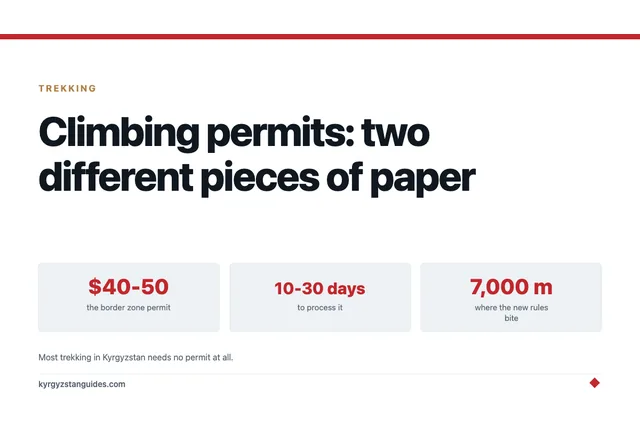
Ala-Archa needs only the park entry fee — it sits outside restricted territory. But a border zone permit is required for anything within roughly 50 km of the Chinese or Tajik frontier, which catches Kel-Suu, parts of the Engilchek glacier approach, Alay valley segments and parts of Batken. Khan Tengri and Lenin Peak typically require one given where they sit. Permits go through licensed operators, and our permits guide covers lead times.
Who to go with
Ak-Sai Travel, operating since 1998 from Ibraimova 113/2 in Bishkek, is described as the country's largest adventure operator and runs base camps for Lenin Peak, Khan Tengri and Pobeda. ITMC Travel offers gear storage and rental — tents, boots, sleeping bags, climbing hardware — plus guides and satellite communication, and is directed by Vladimir Komissarov, an IFMGA-standard guide with over 45 years in the Tien Shan and Pamir. Asia Mountains rents tents, sleeping bags, burners, pots and ice axes. Silk Road Guiding runs guided alpine climbing in Ala-Archa and Tuyuk-Su.
So should you come to climb
If you are an alpinist: yes, emphatically, and Ala-Archa is a half-hour from a capital city with cheap flights, which is close to unique.
If you are a sport climber: bring low expectations and a sense of exploration. Forty-five routes at Chon-Kurchak with an unfinished topo is a weekend, not a trip.
If you wanted a via ferrata: go somewhere else, and be glad you found out here rather than after booking.
FAQ
Is there a via ferrata in Kyrgyzstan?
No. Searches in both English and Russian found no via ferrata route anywhere in the country, and no operator offering one. A cable car has been built at Ala-Archa, but that is a sightseeing and ski gondola, not a via ferrata.
How many climbing routes are there in Ala-Archa?
More than 150 to 160, with the Kyrgyz Alpine Club citing over 160 climbed from the Ak-Sai glacier area. Almost all are alpine, trad or ice routes — reviewers note only one or two bolted sport routes in the park.
Where can you sport climb near Bishkek?
Chon-Kurchak gorge, about 45 minutes from the city, with more than 45 routes on slopey granite and a topo still under construction. Sokuluk canyon exists in the literature but has no published route count. Kok-Moinok and Barskoon appear in travel content rather than any climbing source.
What insurance do I need to climb in Kyrgyzstan?
Kyrgyzstan's mountain rescue service requires at least €30,000 of medical evacuation cover, while independent advisories recommend $50,000 to $250,000 given the possibility of evacuation to Almaty. Helicopter rescue starts around $1,600 an hour and total bills commonly exceed $50,000. Check your policy's high-altitude exclusions specifically.
Who runs mountain rescue in Kyrgyzstan?
The Ministry of Emergency Situations quick-reaction groups are the primary responders, with the Edelweiss squad covering Ala-Archa. A private coordination service also operates, requiring registration two or more weeks ahead with insurance documents and a route plan, and it states that rescue will not begin without a payment guarantee.
Do I need a permit to climb in Kyrgyzstan?
Not for Ala-Archa beyond the park entry fee. A border zone permit is required within roughly 50 km of the Chinese or Tajik frontiers, which covers Kel-Suu, parts of the Engilchek approach, Alay valley segments and parts of Batken — and typically Khan Tengri and Lenin Peak. Permits are arranged through licensed operators.
What is the Ratsek hut?
The stone high camp in the Ak-Sai gorge above Ala-Archa, named after Vladimir Ratsek, a Soviet Master of Sport, and originating in 1930s military mountaineering training. It remains the standard bivouac for the classic peaks, and modern Ak-Sai facilities include three huts sleeping up to 40 people.